Comparisons
Royal jelly vs peptides: what the evidence actually says
Royal jelly contains proteins, short peptides, lipids, and sugars. A few small human trials report signals for muscle strength, exercise performance, or skin measures, but the evidence is product-specific and far thinner than the marketing suggests. It is not a substitute for a clinically tested peptide drug.
Published by PeptideSchool Editorial Desk
The viral pitch versus the data
Royal jelly gets marketed as the natural peptide that beats testosterone therapy, growth hormone, and recovery injections all at once, and does it cheaper with no prescription needed. The molecules people point to when they make that pitch are real. The human research backing it up is thin, short-term, and covers a lot less ground than the marketing implies.
Every so often a post makes the rounds claiming royal jelly is the single most convenient supplement a person can take, and that it outperforms testosterone, sermorelin, BPC-157, and DSIP while being both cheaper and safer. There's something real underneath that pitch. 10-HDA is a genuinely interesting compound, and royalactin is a legitimate bioactive protein. But the claim stretches the actual human evidence far past what it can support.
What this piece does differently is grade each claim by how strong the human trials behind it are, then put royal jelly side by side with the peptides it keeps getting compared to. On some goals, those peptides don't outperform royal jelly either, and that's worth knowing too. For the same kind of evidence-tier breakdown applied more broadly, the peptide craze explained walks through what separates real signal from marketing noise across the category.
What royal jelly contains
Royal jelly is the secretion worker bees produce to feed larvae, and it's fed exclusively to the future queen. It's a mixture of proteins and lipids, not a peptide. Most of what gets credited to it traces back to 10-HDA, a fatty acid. The queen phenotype that royal jelly produces is an epigenetic effect happening in a bee, not a forecast of what it does in a person.
A queen bee lives on royal jelly for her entire life and ends up about 50% larger than a worker bee, despite carrying the identical genome. That switch is real, and it's the source of most of the hype. It's also genome-wide epigenetic reprogramming happening in an insect, which says very little about what a spoonful does inside an adult human body.
The mixture breaks down into a handful of components. 10-hydroxy-2-decenoic acid, known as 10-HDA or "queen bee acid," is the dominant fatty acid and is unique to royal jelly. In-vitro work and studies in model organisms show it influences TOR signaling, dietary-restriction pathways, autophagy, and inflammation. Royalactin, also called MRJP1, is a glycoprotein tied to the queen-development effect in bees, working through EGFR signaling in model organisms. The major royal jelly proteins, MRJPs 1 through 9, make up most of the dry weight of the substance and also happen to be the main allergen family. Defensin-1 is a small antimicrobial peptide, one of the few true peptides found in the mixture. Beyond that there are minor amounts of B vitamins, free amino acids, and trace minerals.
Calling royal jelly a peptide is technically incomplete. That distinction matters, because a lot of the viral pitches slide casually between protein, peptide, and fatty acid as if the three behaved the same way in the body. For the underlying chemistry, the natural vs synthetic peptides guide covers how naturally sourced compounds and manufactured peptides differ in stability, bioavailability, and regulatory standing.
What the human trials show
Only three findings hold up, and all come from small trials: a six-month randomized trial found higher testosterone and better glucose control, a two-week crossover in trained runners boosted time to exhaustion, and a pilot trial in swimmers lowered markers of oxidative stress and muscle damage. These are directional signals, not proof of anything settled.
A randomized, placebo-controlled, double-blind trial gave 61 healthy adults aged 42 to 83 either royal jelly or a placebo for six months source 1. The royal jelly group saw bigger gains in red blood cell count and hematocrit, improved fasting glucose and insulinogenic index, higher SF-36 mental health scores, and a real rise in serum testosterone paired with a drop in DHEA-S. The researchers read this as faster conversion of DHEA-S into testosterone rather than the body making new hormone from scratch. That reads as a normalizing effect in an older, mixed group, not a performance boost.
On the endurance side, 18 trained male athletes went through two-week royal jelly and placebo phases in a crossover design source 3. Time to exhaustion rose about 4.6 minutes over placebo, and PGC-1-alpha expression climbed, but oxidative stress markers and Nrf2 expression barely moved, weakening the common antioxidant explanation.
The recovery data comes from 20 swimmers given royal jelly plus coenzyme Q10 or placebo for ten days source 4. Performance improved and damage markers dropped, but since two compounds were combined, royal jelly's individual contribution stays unclear.
Where the claims outrun the data
The growth-hormone story is the weakest link in the whole royal jelly pitch. The largest and longest human royal jelly trial on record measured muscle strength, not IGF-1, and its primary endpoint missed significance. Lifespan claims come from worms and skin claims come mostly from cell culture, and the one real wrinkle trial on humans was run by a bee-products company testing its own product.
The idea of a "natural growth-hormone stack" has no human trial standing behind it at all. The biggest and longest study in this whole body of research followed 163 elderly nursing-home residents for a full year on protease-treated royal jelly versus placebo. The primary outcome was handgrip strength, and while it improved relative to placebo, it missed statistical significance, landing at P = 0.06, though there was a significant dose trend at P = 0.02. None of the physical-performance tests improved. The researchers' own conclusion was careful and modest: royal jelly might slow the decline in muscle strength rather than reverse or improve it. No human trial has established an IGF-1 or growth-hormone effect in either direction. The fair answer here is that the claim is unsupported, not that it has been disproven.
Lifespan extension is animal-only territory. 10-HDA has been shown to extend lifespan in Caenorhabditis elegans, and researchers have traced the mechanism to dietary-restriction pathways and TOR signaling rather than insulin-like signaling. That is genuinely interesting work, but it was done in a worm. There is no human longevity data on royal jelly at all, not even preliminary.
Skin claims land somewhere in the middle. 10-HDA has been shown to inhibit melanin synthesis in cell culture, and a 12-week placebo-controlled split-face study in 70 Japanese women did report reduced crow's-feet wrinkle depth and increased dermal thickness using a protease-treated royal jelly cream. That is a real trial in real humans, which puts it a step above the worm and cell-culture work. It is also worth knowing that most of the study's authors were employees of the bee-products company that manufactures the ingredient being tested, which is the kind of detail a reader deserves before taking the result at face value.
Side-by-side: royal jelly vs the peptides it gets paired with
| Question | Royal jelly | Peptide drugs or research peptides |
|---|---|---|
| What is it? | A variable bee secretion containing proteins, peptides, lipids, and sugars | A defined molecular sequence or drug product |
| Evidence quality | Mostly small supplement trials and preclinical studies | Ranges from approved drugs with phase 3 trials to research compounds with animal-only data |
| Product consistency | Depends on source, processing, and standardization | Approved products have defined identity and manufacturing controls; research products vary |
| Main limitation | Results from one preparation may not transfer to another | Evidence must be judged compound by compound |

Pick a goal and you can see royal jelly placed next to the peptide or peptides usually recommended for that same outcome, with each one tagged by its evidence tier. The comparison is built to be unflattering in places where the peptide has no solid human data either, because tiering claims honestly is the whole point of doing this.
Most comparison content picks a winner before it even starts writing. This is not that. On several goals, the honest answer is that neither royal jelly nor the peptide it is being compared to has controlled human evidence behind it, and readers are better served by knowing that plainly than by being handed a comparison that pretends otherwise. Pick a goal, then read the tier badge before trusting the summary underneath it.
Where peptides have cleaner human data
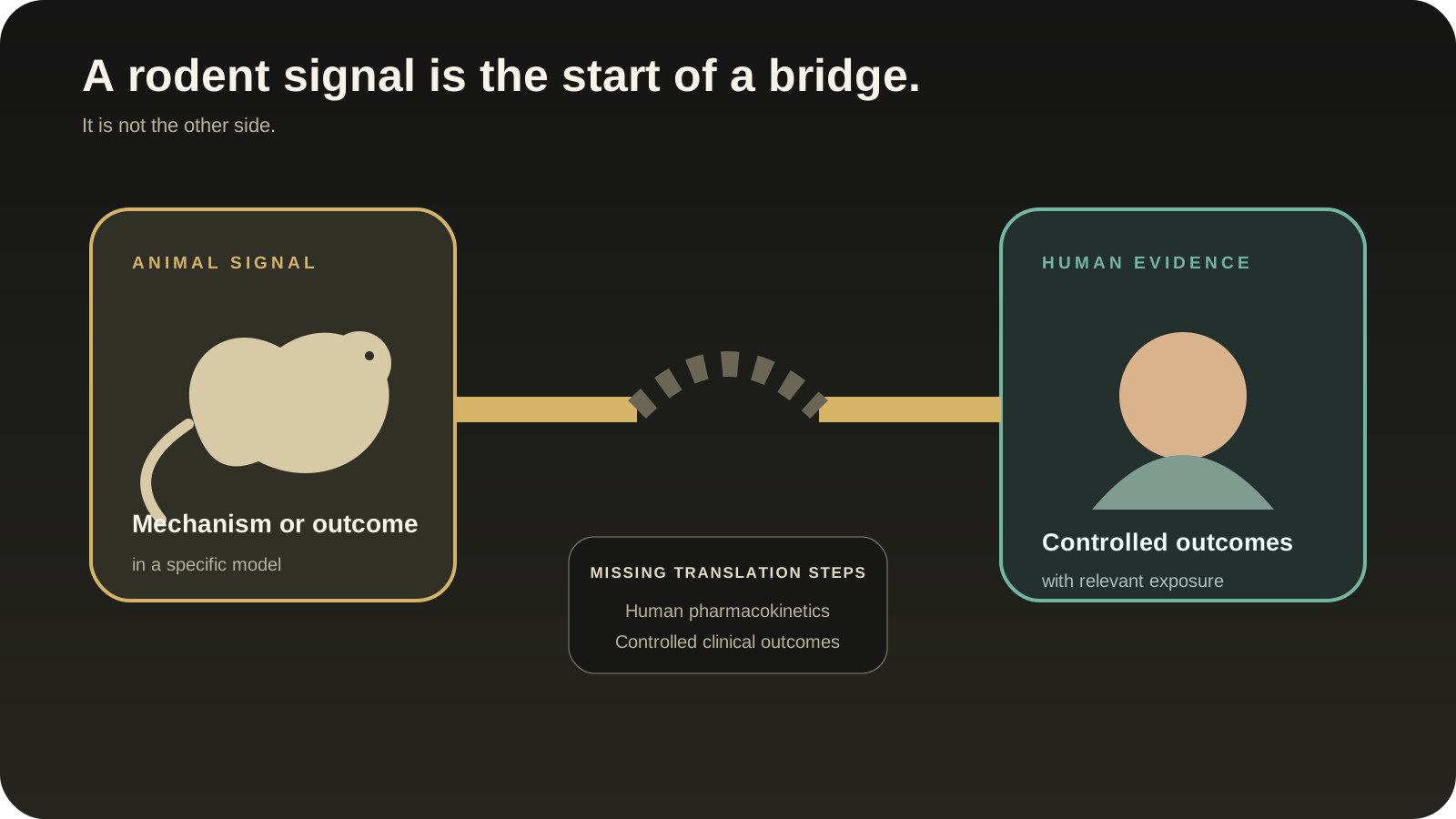
On two specific endpoints, the peptide literature genuinely reads better than the royal jelly literature: dermal collagen response with GHK-Cu, and slow-wave sleep with GHRH analogs in men. Both come with a caveat worth knowing, one commercial and one tied to sex differences in the data. A third comparison, tendon and gut repair with BPC-157, is still overwhelmingly rodent work and should be read that way.
Dermal collagen and wrinkle depth: GHK-Cu
Topical copper tripeptide has a longer and broader dermal research history than royal jelly does, covering fibroblast activation, wound healing, and gene-expression studies. The honest caveat is that much of the synthesis and review writing on GHK-Cu comes from the researcher who discovered the molecule and who holds commercial interests tied to it, so those reviews should not be treated as fully independent. For readers wanting to see how this fits into practice rather than just theory, the GHK-Cu skincare routine builder shows how the peptide is typically worked into an existing regimen.
Slow-wave sleep: GHRH analogs and DSIP
The earlier version of this piece was too generous here. Intravenous GHRH does boost slow-wave sleep in young men, but that same protocol works against sleep in women, cutting into REM and stage 4 sleep depending on dose. The effect runs along sex lines, not a uniform benefit. DSIP's human data is older and thinner yet, resting mostly on work from the 1980s describing changes in sleep continuity and stress physiology, with nothing modern to back it up. Royal jelly, by comparison, has essentially no human sleep-architecture data to point to at all.
Tendon and gut repair: BPC-157, rodent-weighted
BPC-157's human trial record is thin, but the rodent literature behind it is large and genuinely mechanistic, spanning tendon-to-bone reattachment, gut ulcer healing, and neurovascular repair. Royal jelly's recovery effect, where a person can find one, tends to trace back to antioxidant capacity rather than any direct role in rebuilding tissue. Neither has a gold-standard human trial for something like a tendon injury, but BPC-157 carries the stronger mechanistic case by a wide margin.
The allergy footnote that gets skipped
Royal jelly has killed someone. A fatal asthma case is documented, and a community survey found 7% of respondents skin-test positive, with atopic people carrying sharply higher risk. This is the most commonly reported adverse event tied to royal jelly in the literature, and it is left out of nearly every viral post pushing the stuff.
The fatal case, published in 1994, was not a one-off oddity. A cross-sectional survey of 1,472 hospital employees in Hong Kong, where royal jelly use is common, found that about 7% of those skin-tested reacted to pure royal jelly, and that all but one of the 36 positive subjects were already atopic to other common allergens. The link between atopy and royal jelly sensitization was strong. Reported reactions ranged from urticaria and eczema to rhinitis and acute asthma.
The practical takeaway is plain. Anyone with a history of bee-product allergy, atopy, or asthma should treat royal jelly as anything but a casual supplement, and skipping it is the sensible move rather than testing your luck. That warning belongs at the top of any writeup on royal jelly, not buried in a footnote, and its steady absence from the viral pitches is reason enough to question the rest of what those posts claim.
Sources
- Morita H, Ikeda T, Kajita K, Fujioka K, Mori I, Okada H, Uno Y, Ishizuka T. "Effect of royal jelly ingestion for six months on healthy volunteers." Nutr J. 2012.
- Meng G, Wang H, Pei Y, Li Y, Wu H, Song Y, Guo Q, Guo H, et al. "Effects of protease-treated royal jelly on muscle strength in elderly nursing home residents: a randomized, double-blind, placebo-controlled, dose-response study." Sci Rep. 2017.
- Pasdar Y, Tadibi V, Sadeghi E, Najafi F, Abbaspour M, Saber A, Ghorbani Z, Sharifi S, Miryan M. "Royal jelly supplementation improves endurance and mitochondrial biogenesis in athletes: a crossover trial." Food Sci Nutr. 2025.
- Ovchinnikov AN, Paoli A, Seleznev VV, Deryugina AV. "Royal jelly plus coenzyme Q10 supplementation improves high-intensity interval exercise performance via changes in plasmatic and salivary biomarkers of oxidative stress and muscle damage in swimmers: a randomized, double-blind, placebo-controlled pilot trial." J Int Soc Sports Nutr. 2022.
- Honda Y, Araki Y, Hata T, Ichihara K, Ito M, Tanaka M, Honda S. "10-Hydroxy-2-decenoic acid, the major lipid component of royal jelly, extends the lifespan of Caenorhabditis elegans through dietary restriction and target of rapamycin signaling." J Aging Res. 2015.
- Peng CC, Sun HT, Lin IP, Kuo PC, Li JC. "The functional property of royal jelly 10-hydroxy-2-decenoic acid as a melanogenesis inhibitor." BMC Complement Altern Med. 2017.
- Ikegami S, Ito T, Okamoto H, Fujikura C, Itatani H, Yagi M, Ohkuma A, Okumura N, et al. "Effect of protease-treated royal jelly extract on facial wrinkles: a placebo-controlled, double-blind, parallel-group study." J Cosmet Dermatol. 2025.
- Bullock RJ, Rohan A, Straatmans JA. "Fatal royal jelly-induced asthma." Med J Aust. 1994.
- Leung R, Ho A, Chan J, Choy D, Lai CK. "Royal jelly consumption and hypersensitivity in the community." Clin Exp Allergy. 1997. PMID 9088660
- Pickart L, Vasquez-Soltero JM, Margolina A. "GHK peptide as a natural modulator of multiple cellular pathways in skin regeneration." Biomed Res Int. 2015. PMID 26236730 DOI
- Mathias S, Held K, Ising M, Weikel JC, Yassouridis A, Steiger A. "Systemic growth hormone-releasing hormone (GHRH) impairs sleep in healthy young women." Psychoneuroendocrinology. 2007. PMID 17850984 DOI
- Schneider-Helmert D, Schoenenberger GA. "Effects of DSIP in man. Multifunctional psychophysiological properties besides induction of natural sleep." Neuropsychobiology. 1983. PMID 6689058 DOI
- Seiwerth S, Milavic M, Vukojevic J, Gojkovic S, Krezic I, Vuletic LB, Pavlov KH, Petrovic A, et al. "Stable gastric pentadecapeptide BPC 157 and wound healing." Front Pharmacol. 2021. PMID 34267654 DOI
Educational content only. Not medical advice.