Comparisons
Exercise-Mimic Peptides Ranked: MOTS-c, Apelin, Irisin and the Rest
An evidence-graded look at the exercise-mimic peptide field going into 2026: which compounds engage AMPK, PGC-1alpha, and myokine pathways, which have human trial data, which have been flagged for safety or banned by WADA, and why none of them replace a workout.
Published by PeptideSchool Editorial Desk
Where the field stands in 2026
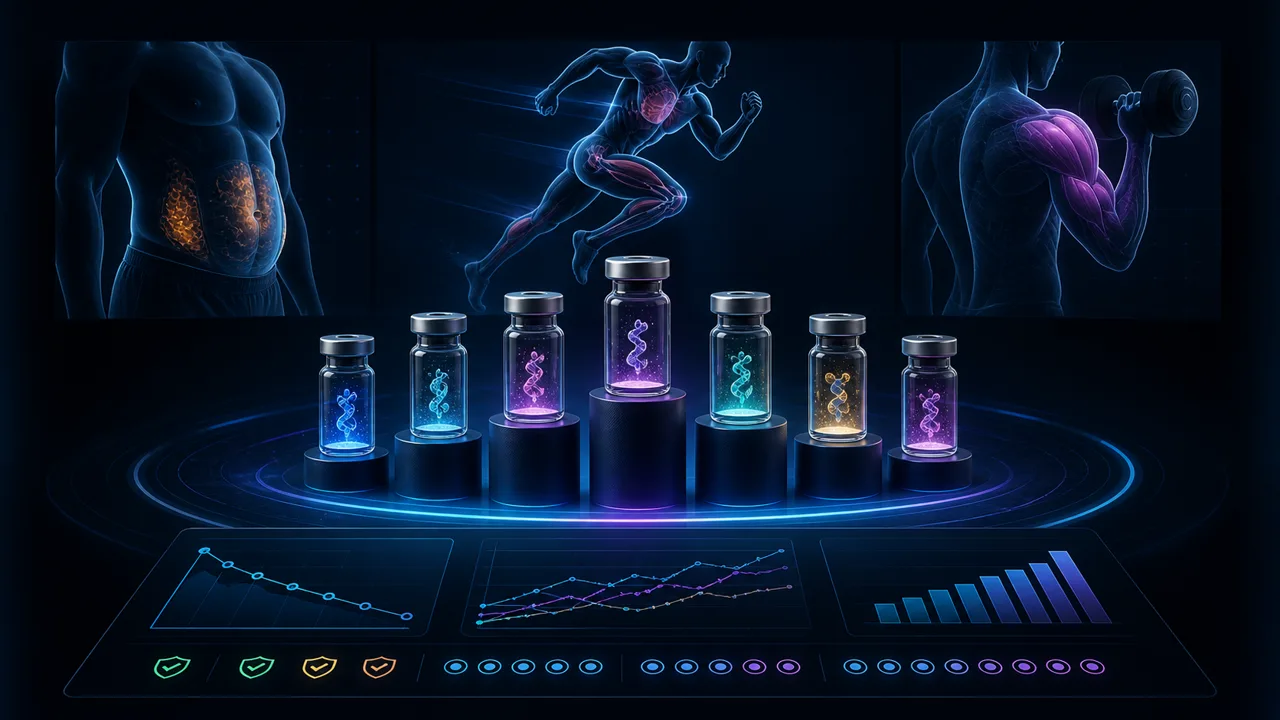
The pitch of exercise in a bottle has quietly moved out of science fiction and into real preclinical labs. A handful of peptides and peptide-adjacent molecules switch on the same molecular circuits that a hard workout switches on: AMPK, PGC-1alpha, mitochondrial biogenesis, and the myokine signals muscle releases when it is under load. That much is not hype. The question is whether any of that translates into results a person would notice.
Here is the honest state of play. MOTS-c doubled running capacity in aged mice and a modified version of it cleared an early safety trial. Apelin improved insulin sensitivity in a real human study and reversed muscle wasting outright in mice. Irisin, after years of scientists doubting it was even real, was confirmed as a genuine hormone your muscles release when you exercise. None of that is nothing. But not one of these compounds has been shown, in a rigorous human trial, to reproduce what actual training does. If your interest is stacking any of this with real resistance work rather than replacing it, that is a different and better-supported conversation, and the muscle-building peptide comparison covers the compounds with the strongest track record there.
What exercise is doing at the molecular level
To judge whether a peptide is a legitimate exercise mimetic, you need to know what it is trying to mimic. Exercise triggers five overlapping molecular programs, and a compound worth taking seriously has to plug into at least one of them directly, not just adjacently.

AMPK is the master energy sensor. When your AMP-to-ATP ratio climbs during exertion, AMPK fires up glucose uptake through GLUT4 transporters, switches the body toward burning fat, and kicks off mitochondrial biogenesis. MOTS-c gets there by causing the body's own AICAR to build up. Apelin gets there through its APJ receptor.
PGC-1alpha is the master regulator of building new mitochondria. Exercise pushes PGC-1alpha up in muscle tissue, and that also switches on FNDC5, the raw material that eventually becomes irisin.
Myokine signaling is the flood of hundreds of signaling molecules that working muscle dumps into the bloodstream. Apelin and irisin are both myokines released specifically by exercise, and both have effects that reach well beyond the muscle itself.
Mitochondrial quality control covers the fusion, fission, and cleanup (mitophagy) that exercise forces mitochondria through. MOTS-c promotes fusion, and a related peptide called humanin rises in the blood and muscle after high-intensity intervals, offering some protection against cell stress during that process.
The NRF2 antioxidant pathway responds to the burst of reactive oxygen species that exercise generates, switching on a set of protective genes. MOTS-c does this directly, binding NRF2 in the cell nucleus during metabolic stress.
Why exercise in a vial is still an overclaim
Exercise is not one signal. It trains your muscles, heart, bones, blood vessels, immune system, and brain all at once, on different timelines that overlap and reinforce each other. A peptide can plausibly reproduce a slice of that, one metabolic pathway at a time. None of them reproduce the whole package.
What gets left out includes neuromuscular load and motor learning, the cardiovascular adaptations in stroke volume and heart rate, the mechanical loading that keeps bone and tendon strong, the shear-stress adaptations in blood vessel walls, the remodeling of the immune and myokine network, and the psychological and autonomic effects that come from moving your body. Given all of that, the fair label for these compounds right now is pathway-mimetic or candidate adjunct. Exercise replacement is not an accurate description of anything currently on the market or in trials.
The Evidence Ranking
This ranking measures evidence for an exercise-related human signal, not how dramatic the marketing sounds. First is apelin, because a controlled human infusion study measured insulin sensitivity, even though the muscle-preservation story is still mainly animal work. Second is irisin, because its existence and exercise response are confirmed in humans, but giving irisin as an intervention has not been shown to reproduce training. Third is MOTS-c, with unusually detailed mechanisms and strong mouse performance data, plus early safety work on a modified analog, but no human efficacy trial of exogenous MOTS-c.
Fourth is AOD-9604. It ranks below the three candidates because the important human program was negative, not because it was never studied. Fifth is 5-amino-1MQ, which has mouse data but no published human clinical trial and is not a peptide. A negative human result is more informative than a promising mouse result, so the order is about decision value, not a simple good-to-bad ladder.
| Rank | Candidate | Best evidence | What remains missing |
|---|---|---|---|
| 1 | Apelin pathway | Controlled human metabolic signal | Human training, strength, and function outcomes |
| 2 | Irisin | Endogenous hormone confirmed in humans | Trials of administered irisin |
| 3 | MOTS-c | Strong mechanistic and animal performance work | Human efficacy for exogenous MOTS-c |
| 4 | AOD-9604 | Large human development program | Positive efficacy result |
| 5 | 5-amino-1MQ | Mouse metabolic data | Human safety and efficacy, plus it is not a peptide |
MOTS-c: from mitochondrial DNA to a doping ban
MOTS-c has the most interesting origin story of the bunch. In 2015, Changhan Lee's group at USC found a 16-amino-acid peptide hiding in mitochondrial DNA itself, encoded in the 12S rRNA gene. That was a real surprise, since it meant the mitochondrial genome does more than just make oxidative phosphorylation proteins. It also produces signaling peptides.
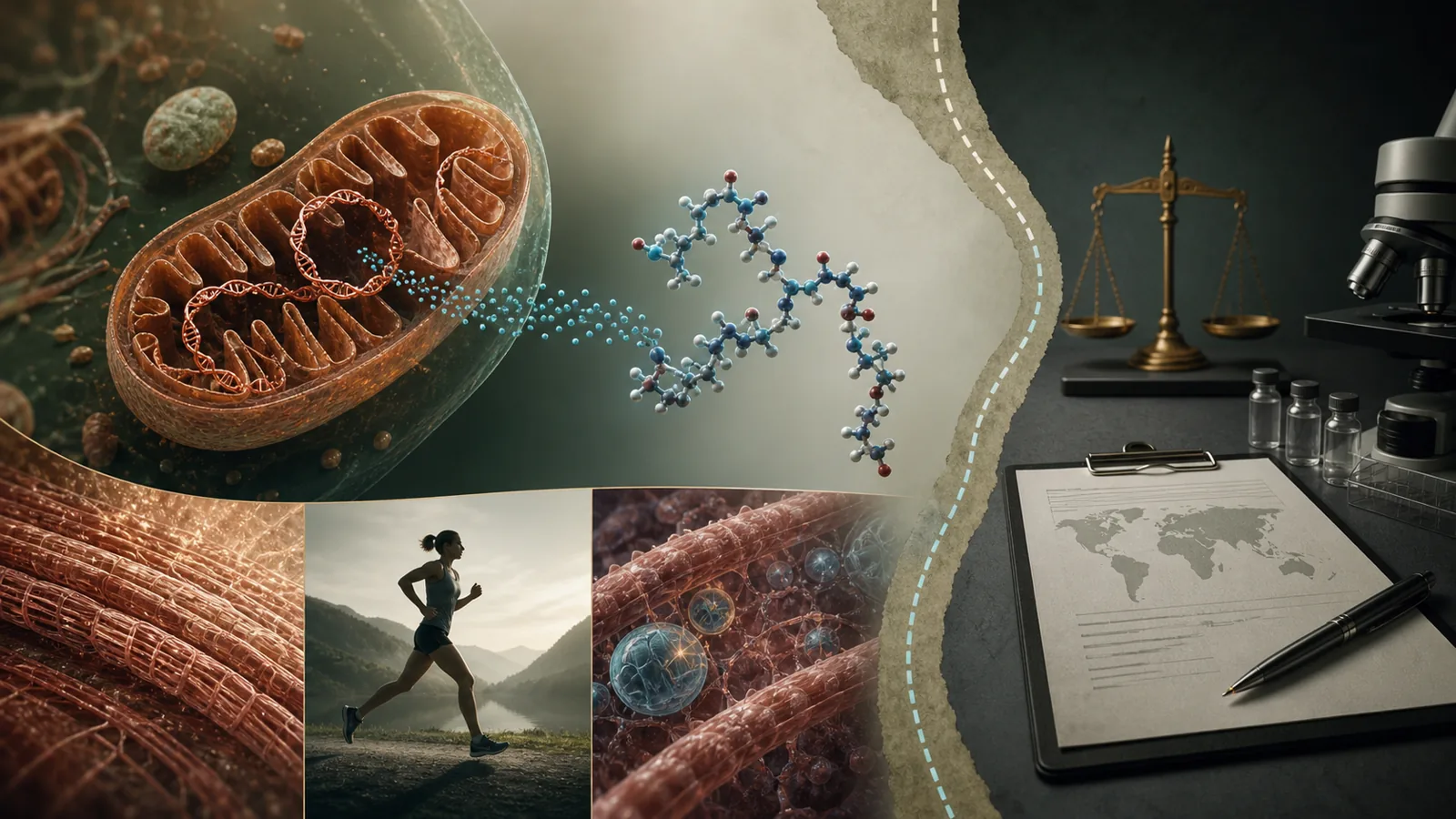
The mechanism is unusually well mapped out. MOTS-c disrupts one-carbon and purine metabolism, which causes the body's own AICAR to build up, and that activates AMPK the same way exercise does. Under metabolic stress, the peptide moves into the cell nucleus within 30 minutes, peaks around the 3-hour mark, and binds directly to NRF2 at antioxidant response elements. In aged mice given the peptide just three times a week, running distance doubled and grip strength improved.
MOTS-c is named in the WADA Prohibited List under AMPK activators and is prohibited at all times. It was not newly added for 2026; the 2026 list continued that status. FDA’s April 2026 document says MOTS-c left Category 2 because the nomination was withdrawn, not because FDA cleared a safety concern. PCAC reviewed MOTS-c in July and issued an advisory recommendation, which did not itself add the substance to the final 503A Bulks List.
On the human safety side, a modified analog called CB4211 finished a phase 1b trial in adults with fatty liver disease with no serious adverse events reported. That result came from a company announcement rather than a peer-reviewed paper, and the developer has not moved it into phase 2. So the mechanism is genuinely compelling, but there is still no human efficacy trial showing exogenous MOTS-c does what the mouse data suggests it might.
Apelin: the strongest human signal, with a safety asterisk
Of everything in this category, apelin has the best human evidence. In a randomized, double-blind, crossover phase 1 study, an intravenous apelin infusion improved insulin sensitivity in overweight men during a clamp study, a well-validated way of measuring how the body handles insulin. Separately, researchers found that apelin levels naturally drop with age in both humans and rodents, and that restoring apelin signaling reversed age-related muscle loss in mice by kicking mitochondrial production, autophagy, and muscle stem cells back into gear. That reversal is mouse data, not human data, and the distinction matters.
The drug-development story is a useful warning about translating a pathway into a product. BioAge stopped the STRIDES phase 2 study after liver enzyme elevations were observed in 11 of 204 enrolled participants. Tirzepatide-only participants did not show the same signal in the company report. A later human-liver-spheroid study reproduced toxicity with azelaprag and tirzepatide coexposure, but an in vitro model cannot by itself identify the clinical mechanism or establish that every APJ agonist carries the same risk.
Irisin: the hormone that was declared fake, then confirmed real
When Bruce Spiegelman's lab at Harvard first described irisin in 2012, an exercise-released hormone that converts white fat into calorie-burning beige fat, it was a genuinely exciting finding. Then multiple labs tried and failed to detect it in human blood using commercial antibody tests, and the whole thing turned into a fight over whether irisin even existed.
The resolution came in 2015. Targeted mass spectrometry, a much more precise method than antibody-based tests, confirmed real circulating irisin in human blood at roughly 3.6 nanograms per milliliter, and levels rose after aerobic exercise. The earlier failures turned out to be a problem with the antibodies used in commercial test kits, not a problem with the biology. Later work in mouse Alzheimer's models found that blocking irisin canceled out the cognitive benefits normally seen with exercise, though again, that is animal-model evidence, not something demonstrated in people yet. One practical wrinkle worth knowing: native irisin has a half-life of under an hour in the body, and most lab experiments testing its effects use doses far higher than what a real workout produces.
AOD-9604 and 5-amino-1MQ: sold as mimics, but failing the test
Two widely sold compounds get marketed under this umbrella but do not hold up on the evidence. AOD-9604 is a synthetic fragment of growth hormone designed to isolate its fat-burning effect. It went through six clinical trials with over 900 participants total, but its pivotal phase IIb trial, 24 weeks long with 536 subjects, showed no statistically significant weight loss compared to placebo, and the whole development program was shut down in 2007. It does not activate AMPK, PGC-1alpha, or any of the exercise pathways described earlier. Despite that dead end, it is still sold by peptide clinics with weight-loss claims attached, and in December 2024 an FDA advisory committee recommended against putting it on the 503A compounding list.
5-amino-1MQ is a different case entirely. It is a small molecule that inhibits an enzyme called NNMT, and it gets sold right alongside peptides even though it is not one, which is a category error worth knowing about. The mouse data is real: it boosted NAD+ and reduced body weight and fat mass in diet-induced obese mice. But there are zero published human clinical trials on it. If you are evaluating any vendor selling compounds like these, the guide to vetting research peptides by COA and HPLC walks through how to check what you are buying.
The Bottom Line on Exercise Mimics
No compound in this guide replaces exercise. Apelin has the strongest direct human signal, irisin is the best-confirmed natural exercise messenger, and MOTS-c has the most compelling preclinical peptide story. Those are three different achievements, and none demonstrates a full exercise replacement in people.
The useful way to follow this field is to watch for human outcomes that matter: cardiorespiratory fitness, strength, mobility, metabolic health, and safety over time. Until those trials exist, pathway mimic is the accurate phrase. Exercise in a vial is not.
Sources
- Exercise Mimetics in Aging: Suggestions from a Systematic Review
- High-intensity interval exercise increases humanin, a mitochondrial encoded peptide, in the plasma and muscle of men
- The mitochondrial-derived peptide MOTS-c promotes metabolic homeostasis and reduces obesity and insulin resistance
- The Mitochondrial-Encoded Peptide MOTS-c Translocates to the Nucleus to Regulate Nuclear Gene Expression in Response to Metabolic Stress
- MOTS-c is an exercise-induced mitochondrial-encoded regulator of age-dependent physical decline and muscle homeostasis
- Apelin administration improves insulin sensitivity in overweight men during hyperinsulinaemic-euglycaemic clamp
- The exerkine apelin reverses age-associated sarcopenia
- Detection and Quantitation of Circulating Human Irisin by Tandem Mass Spectrometry
Educational content only. Not medical advice.