Comparisons
Modafinil vs Peptide Wakefulness Agents: What the Evidence Shows
Modafinil, research peptides, and everyday caffeine stacks don't solve the same problem. This guide compares how each one works, where human trial evidence exists, and where mechanistic interest gets mistaken for proven alertness. The goal is to help readers separate treatment for clinical sleepiness from nootropic use and long-term metabolic research.
Published by PeptideSchool Editorial Desk
How Wakefulness Works in the Brain
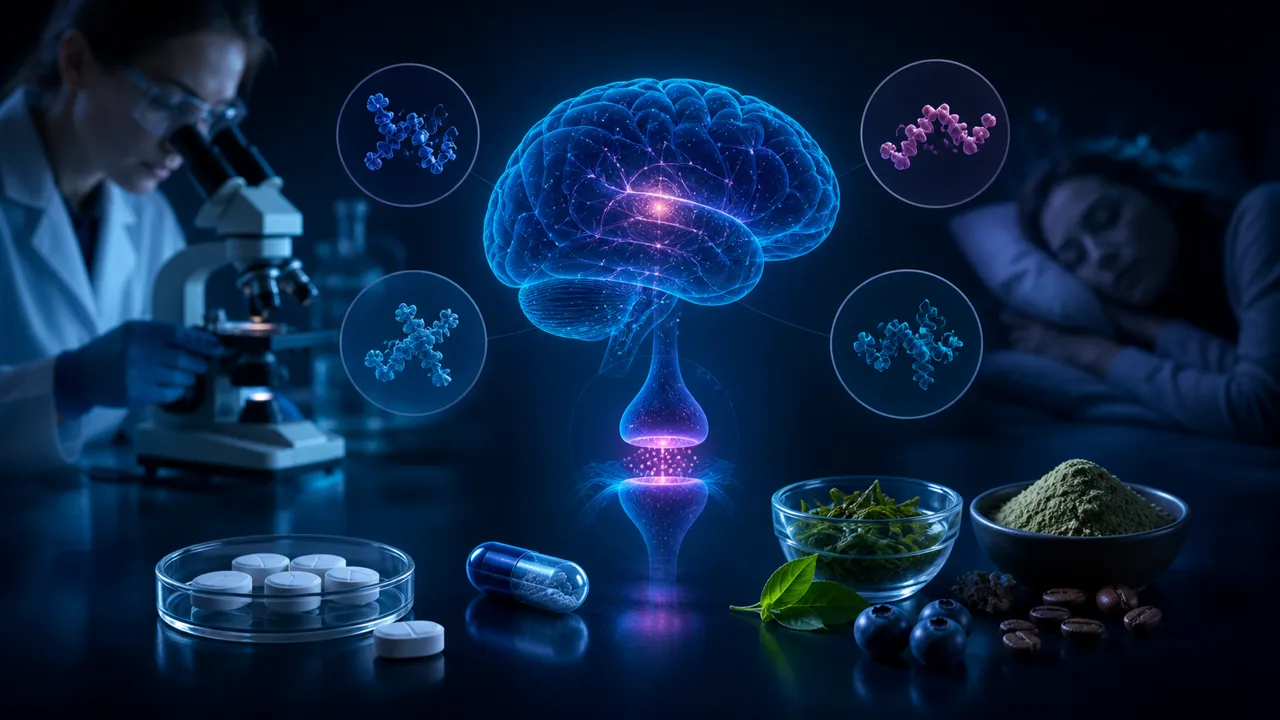
Every wakefulness tool, whether it is a prescription drug, a research peptide, or a cup of coffee, is working with the same energy the brain already has. Nothing creates energy from nothing. What changes is how the brain allocates it and how it perceives fatigue.

There are two systems in constant negotiation. One pushes toward sleep, driven mostly by adenosine, a byproduct of brain activity that builds up while you're awake and gets cleared during sleep. The other holds you awake, run by a small cluster of neurons in the hypothalamus that produce orexin, also called hypocretin. In narcolepsy, those orexin neurons are destroyed, which is exactly why narcoleptic patients can't stay awake and can collapse into sleep without warning.
Dopamine plays a supporting role here. It isn't a wakefulness chemical the way orexin is, but pushing dopamine levels up in the right circuits produces arousal as a side effect. Amphetamines do this bluntly, forcing dopamine out of neurons in a flood. Modafinil is gentler, blocking the transporter protein that normally clears dopamine after release so it lingers longer. Peptide compounds mostly skip the dopamine system entirely and work upstream, on growth factors, GABA receptor activity, or cellular energy metabolism.
Modafinil: Mechanism and Trial Evidence
Modafinil blocks the dopamine transporter and secondarily nudges the orexin and histamine wakefulness pathways. It has solid randomized trial support for narcolepsy, shift work sleep disorder, and sleepiness tied to obstructive sleep apnea, plus modest evidence for cognitive enhancement in healthy adults.
The strongest data comes from the US Modafinil in Narcolepsy Multicenter Study Group, which randomized 271 patients to modafinil or placebo over nine weeks. Both objective sleepiness tests, the Multiple Sleep Latency Test and the Maintenance of Wakefulness Test, and self-reported sleepiness scores improved significantly on modafinil. That's strong RCT evidence for the drug's primary approved use.
For shift work sleep disorder, the landmark trial is Czeisler and colleagues, published in the New England Journal of Medicine in 2005. Across 278 adults at 31 centers, modafinil cut excessive sleepiness and improved simulated driving performance compared to placebo. This trial is what earned the FDA approval specifically for shift workers, which is notable since few wakefulness drugs have a dedicated trial for that population rather than narcoleptics alone.
For healthy people using it off-label, the best synthesis is Battleday and Brem's 2015 systematic review in European Neuropsychopharmacology, covering 24 studies of modafinil in non-sleep-deprived adults. The benefits were more consistent for complex tasks, meaning ones that require planning or sustained attention, than for simple reaction-time tests. Roughly half the studies showed gains in memory consolidation. The reviewers concluded modafinil qualifies as a genuine cognitive enhancer, though the effect sizes in healthy people are modest next to what it does for clinical sleepiness.
Armodafinil, the R-enantiomer of modafinil, shares the same approved uses and side-effect profile but has a longer half-life, which can mean steadier alertness into the afternoon. Common side effects for both include headache, nausea, dry mouth, and trouble sleeping if taken too late. Both are Schedule IV controlled substances in the US, requiring a prescription, and long-term unsupervised use carries a real if smaller risk of psychological dependence.
The healthy-volunteer literature answers a narrower question than the narcolepsy and shift-work trials. It asks whether performance on selected tasks changes in people who are already awake and functioning, not whether a drug restores safe alertness in someone with a diagnosed sleep disorder. Planning, attention, memory, and reaction time also do not move together. A positive result on one task should not be translated into a general intelligence or productivity effect.
Trial context also explains why modafinil cannot serve as the benchmark for every kind of fatigue. The narcolepsy study measured pathological daytime sleepiness, and the shift-work trial enrolled people with a defined disorder tied to work hours. Neither trial established a treatment for ordinary tiredness caused by short sleep, overtraining, anemia, mood disorders, medication effects, or an irregular schedule. The symptom may sound similar while the cause and evidence are completely different.
Peptide Wakefulness Agents in Context
Selank, semax, and dihexa all sidestep the dopamine transporter entirely, which is the key thing that separates them from modafinil. They work through GABA modulation, BDNF upregulation, or synaptic plasticity instead.
Selank is a heptapeptide built by extending tuftsin, a fragment of an immune protein, with three amino acids for stability. The cited studies here are preclinical: one reported changes in genes tied to GABA signaling in rats, and another examined BDNF-linked memory effects in an animal model. Those findings can support a mechanism hypothesis, but they do not establish reliable wakefulness or cognitive benefits in healthy people.
Semax is derived from ACTH(4-10) and stabilized with an added tripeptide. The cited 2009 study found increased transcription of BDNF, TrkB, and other neurotrophin genes in ischemic rat cortex. That is relevant to experimental neuroprotection, not direct proof of sharper attention or resistance to fatigue in healthy people. This source set does not contain a large randomized trial for those claims.
Selank and semax are often grouped together because both are short peptides discussed in cognitive research, but the cited experiments do not test the same outcome. The selank papers look at GABA-related gene expression and memory protection in animal models. The semax paper looks at neurotrophin transcription after experimental cerebral ischemia. None measures sustained wakefulness, driving performance, or productivity in healthy adults, and none compares either peptide with modafinil.
That endpoint mismatch is the central lesson. A molecule can change BDNF or GABA-related signaling without producing a useful alertness effect, just as a wakefulness drug can improve the ability to stay awake without improving every cognitive task. Mechanism studies tell researchers where to look next. They do not supply the missing clinical result.
MOTS-c and the Mitochondrial Energy Angle
MOTS-c is a different animal entirely. It is a 16-amino-acid peptide encoded not in nuclear DNA but in mitochondrial DNA, discovered by Lee and colleagues in 2015 inside a short reading frame of the 12S ribosomal RNA gene. Mitochondria were thought to only make proteins for their own internal use, so finding one that circulates like a hormone was a genuine surprise.

MOTS-c activates AMPK, the enzyme that senses when a cell is low on energy and switches on programs to conserve and generate it more efficiently. In mouse models, MOTS-c treatment prevented diet-induced obesity and reversed age-related insulin resistance in skeletal muscle without any change in food intake. That pattern looks a lot like what regular exercise does to metabolism, which is why MOTS-c gets called an exercise mimetic rather than a stimulant.
It doesn't touch dopamine, orexin, adenosine, or any neurotransmitter system used by established wakefulness drugs. Whether better mitochondrial efficiency translates into sustained daytime energy in humans isn't yet established in trials. MOTS-c won't replace modafinil for a shift worker who needs to stay alert on demand. It belongs in the metabolic endurance and longevity conversation, not the acute alertness one.
The original MOTS-c study was about metabolic homeostasis. It examined glucose handling, insulin sensitivity, diet-induced obesity, and skeletal-muscle metabolism in experimental models. It did not test sleep latency, vigilance, reaction time, or the ability to remain awake. Calling MOTS-c a wakefulness agent therefore imports an outcome the cited experiment never measured. Its place in this comparison is to show how easily the word energy can blur cellular metabolism and conscious alertness.
The everyday comparison: caffeine and L-theanine
Caffeine and L-theanine have something the research peptides in this comparison do not: controlled human data on short-term attention and mood. Caffeine blocks adenosine receptors, reducing the perception of sleep pressure. L-theanine, an amino acid found in tea, has been studied alongside caffeine for attention and subjective tiredness.
In a randomized crossover trial, the combination improved accuracy on an attention-switching task and reduced self-rated tiredness compared with placebo. That is a short-term cognitive result, not a substitute for sleep and not evidence that the pair treats a sleep disorder.
This comparison also has a hard limit. Caffeine can mask sleep pressure, but it does not resolve sleep debt or treat the cause of excessive sleepiness. Modafinil has condition-specific trial evidence and a prescription framework. The peptide candidates discussed here do not have comparable human wakefulness trials.
The caffeine and L-theanine trial has the opposite strength and limitation. It directly measured short-term human performance and mood, so it sits closer to the reader's question. But it was an acute experiment, not evidence that the combination repairs chronic sleep loss or stays equally effective with repeated use. Tolerance, timing, baseline caffeine habits, and the reason someone feels tired can all change the real-world result.
A Practical Way to Choose the Right Lane
The most useful question to ask isn't which compound is strongest, it is what problem you're trying to solve. A night-shift worker who is falling asleep at the wheel has a completely different problem from a student cramming for exams, who has a different problem again from someone in their mid-40s thinking about metabolic longevity. Each maps to a different tier of what is covered above.
For the shift worker with documented excessive sleepiness, the clear path is a conversation with a clinician who can first rule out other causes, obstructive sleep apnea being extremely common and treatable with CPAP rather than a stimulant. If modafinil or armodafinil is appropriate, it should be prescribed and monitored. Sourcing a controlled substance on your own for this purpose is both legally risky and clinically the wrong move.
For a student or knowledge worker without a clinical diagnosis, the evidence hierarchy is still useful: sleep and schedule come first; caffeine plus L-theanine has direct short-term human data; selank and semax rely mainly on preclinical mechanism studies in this source set. That is a large evidence gap, not a simple progression from mild to strong.
For the reader focused on longevity and metabolic resilience, MOTS-c and the broader mitochondrial peptide literature represent a genuinely separate conversation. The question shifts from staying alert today to maintaining cellular energy production and metabolic flexibility over years. That's a legitimate goal, but trying to solve it with a wakefulness drug misses the point entirely, since the two aren't addressing the same problem.
Sources
- Randomized trial of modafinil as a treatment for the excessive daytime somnolence of narcolepsy
- Modafinil for excessive sleepiness associated with shift-work sleep disorder
- Modafinil for cognitive neuroenhancement in healthy non-sleep-deprived subjects: a systematic review
- Selank administration affects the expression of some genes involved in GABAergic neurotransmission
- Selank, peptide analogue of tuftsin, protects against ethanol-induced memory impairment by regulating BDNF content
- Semax and Pro-Gly-Pro activate the transcription of neurotrophins and their receptor genes after cerebral ischemia
- The mitochondrial-derived peptide MOTS-c promotes metabolic homeostasis and reduces obesity and insulin resistance
- The effects of L-theanine, caffeine and their combination on cognition and mood
Educational content only. Not medical advice.