Comparisons
Is PDRN a Peptide? How Salmon DNA Compares to GHK-Cu
PDRN is fragmented DNA, not a peptide. GHK-Cu is a true copper-binding tripeptide. They signal through different pathways, use different delivery methods, and sit in different evidence and regulatory categories. This comparison explains what each molecule is, what human research supports, and why topical GHK-Cu and injectable PDRN aren't interchangeable skincare choices.
Published by PeptideSchool Editorial Desk
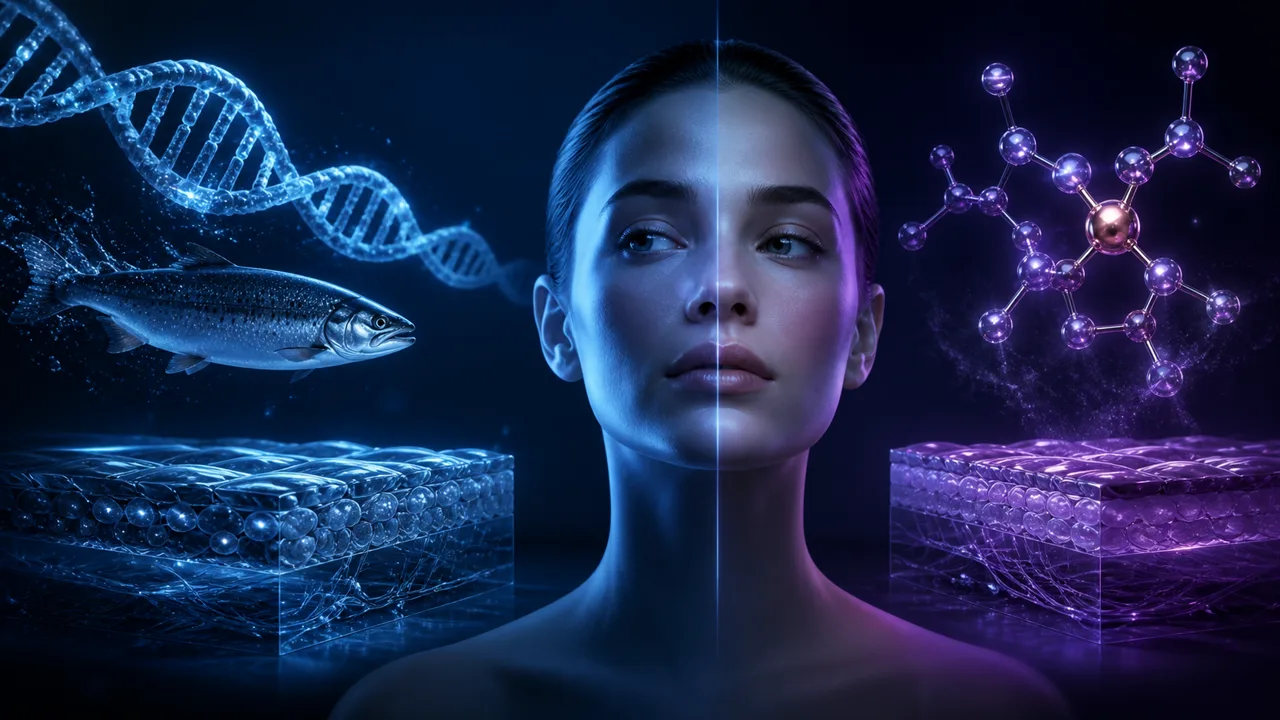
The short answer: PDRN is not a peptide
PDRN stands for polydeoxyribonucleotide. Break that word apart and it tells you exactly what it is: poly means many, and deoxyribonucleotide is the chemical unit that makes up DNA. So PDRN is many DNA units strung together in a chain. A peptide is a completely different kind of chain, built from amino acids, the building blocks of proteins. Both are chains of small repeating pieces, but the pieces themselves come from different chemical alphabets.
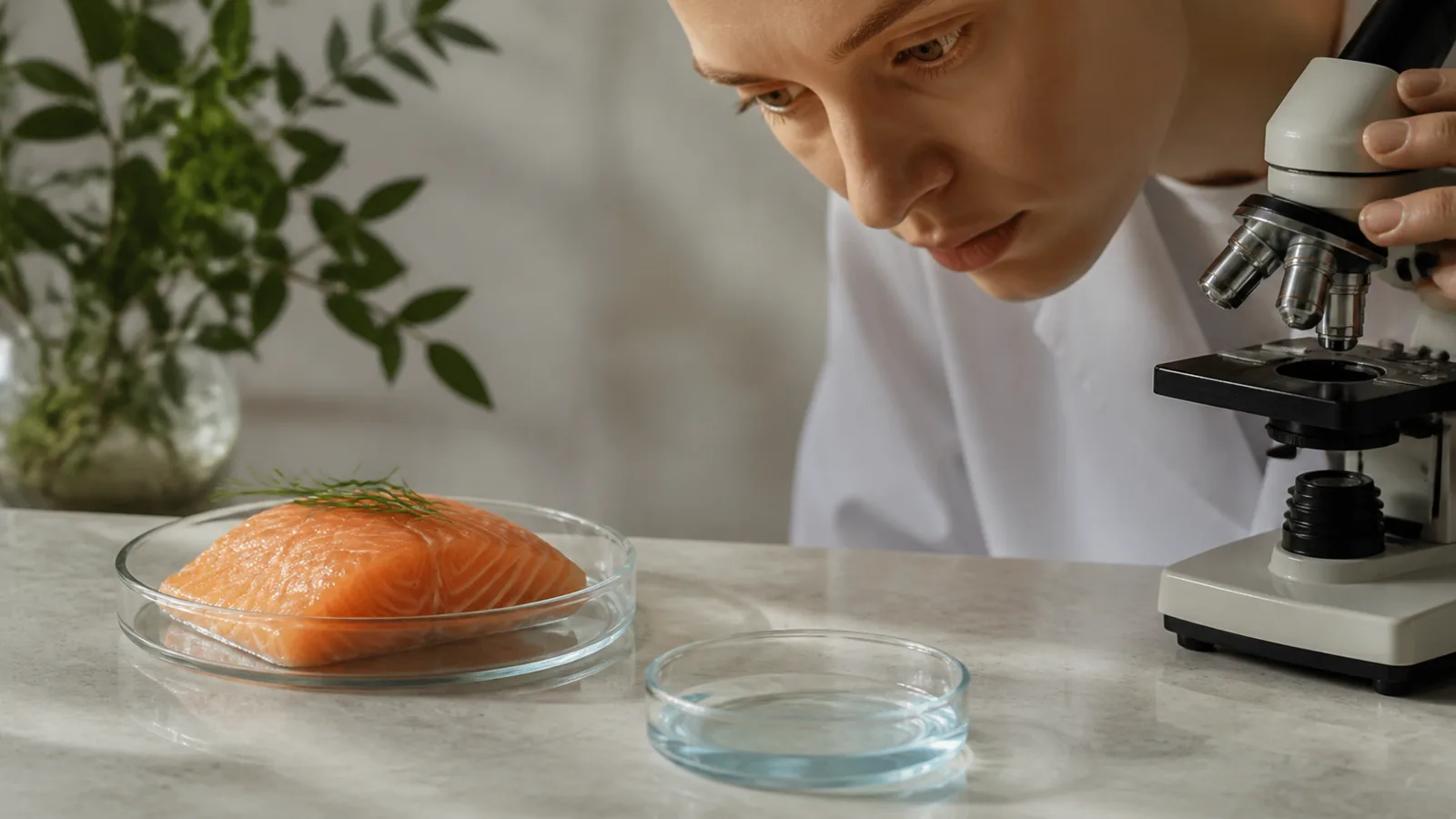
Think of it like two languages. English and Spanish are both languages, but they run on different alphabets and different grammar. Peptides and PDRN are both molecular chains that your skin cells can read, they just speak different chemical languages.
The mixup is understandable because PDRN shows up under brand names like Rejuran, Plinest, and Mastelli, and it gets marketed right next to peptides on skincare sites. But chemically the two are not the same category of molecule. In fact, the purification process used to make PDRN specifically strips out any leftover peptides on purpose, because residual protein fragments could trigger a skin allergy.
What PDRN is made of
PDRN is fragmented DNA, and yes, it really does come mostly from the sperm cells of salmon trout or chum salmon. Manufacturers take raw fish DNA, use enzymes (tiny molecular scissors) to chop it into shorter pieces, then purify the batch until more than 95 percent of the proteins and peptides are removed. What is left is a clean set of DNA fragments, typically sized between 50 and 1500 kilodaltons.
A kilodalton is just a weight unit for very small things, roughly 1000 hydrogen atoms worth of mass. For comparison, GHK-Cu, the copper peptide we cover below, weighs about 0.4 kilodaltons. That size gap is not a trivia point, it directly determines how each molecule has to be delivered into skin.
You will also see the term polynucleotide biorevitalization, or just PN. A 2025 review that mapped this field proposed a working line at 1500 kilodaltons: shorter DNA chains get called PDRN, longer ones get called PN. Whether a clinic menu lists Rejuran, Plinest, or Mastelli, they are all running on the same underlying molecule. Rejuran is to PDRN roughly what Ozempic is to semaglutide, a brand name built on top of an active ingredient.
What PDRN does in your skin
Your skin relies on fibroblasts, the cells that manufacture collagen and elastin, the two proteins responsible for youthful firmness and bounce. As fibroblasts slow down with age, you get wrinkles, thinner skin, and slower wound healing.
PDRN wakes those fibroblasts up by binding to a receptor on their surface called the adenosine A2A receptor. Picture a receptor as a docking slot on the outside of a cell. When the right molecule clicks into that slot, the cell changes behavior. Once PDRN docks into the A2A slot, three things happen: the fibroblast ramps up collagen production, local inflammation calms down, and new small blood vessels start forming, which improves nutrient delivery to the area.
There is a second mechanism worth knowing about too. The DNA fragments in PDRN can be recycled by the cell through what is called the salvage pathway. Cells are thrifty by nature, they would rather reuse available fragments than build new DNA components from scratch. PDRN effectively hands the fibroblast a stack of pre-made parts, freeing it up to spend more energy on collagen output and repair instead.
GHK-Cu: a real peptide with different strengths
GHK-Cu is where real peptides enter this comparison. The name stands for glycyl-L-histidyl-L-lysine bound to a copper ion, which just describes its recipe: three amino acids (glycine, histidine, lysine) linked in a small chain, with one copper atom attached. Three amino acids makes it a tripeptide.
GHK-Cu was first identified in human blood plasma back in 1973 and has been studied in dermatology for decades since. It works at a more fundamental level than PDRN. Rather than telling fibroblasts to simply make more collagen, it enters the cell and changes which genes get switched on or off. One analysis mapped GHK-Cu's effect against more than 4000 genes tied to tissue remodeling, antioxidant defense, and collagen synthesis, and found it nudged activity across all of those networks.
GHK-Cu is small enough to be formulated in topical serums, although skin delivery still depends on the finished formula and the skin barrier. Most of the clinical PDRN and polynucleotide evidence comes from injections placed in or below the skin. Topical products containing PDRN also exist, but they should not be assumed to reproduce injection studies because a much larger molecule faces a different delivery problem.
Head to head: what matters for your decision
Both ingredients are discussed in collagen, inflammation, and skin-repair research, but they have not been tested as interchangeable treatments. The useful comparison is delivery method, strength of human evidence, regulatory status, and practical burden.
On evidence, PDRN has one especially clean win. A phase III randomized double-blind trial published in 2014 pitted a polynucleotide filler against a leading hyaluronic acid filler for crow's feet, the fine lines at the outer corner of the eye. After a full treatment course, the polynucleotide group showed greater elasticity, higher collagen density, and measurably smaller wrinkle depth. GHK-Cu does not have a trial that direct and head to head, but it carries a much larger body of general dermatology research going back to the 1980s, plus formal gene-expression data that PDRN simply does not have.
That single strong trial deserves to be kept in proportion. A 2024 review of polynucleotides across aesthetic medicine found the overall human evidence genuinely mixed, with some studies showing real gains in elasticity and hydration and others reporting limited or no benefit. The reviewers concluded more research is needed before the field can say definitively where these treatments help most. One strong result in one specific indication is not the same thing as a fully settled ingredient.
On regulation, the products sit in different lanes. Rejuran injectables are not FDA approved in the United States. Describing their use as off-label would be inaccurate because off-label use applies to a product that already has an FDA approval. GHK-Cu appears in over-the-counter cosmetic formulas, but that availability is not the same as FDA approval of the ingredient as a treatment.
Cost also differs in practice: a topical serum is usually a retail purchase, while an injected polynucleotide treatment adds a clinic procedure and repeat visits. Prices vary too much by product, provider, and market to turn that difference into one reliable ratio.
How to compare them without turning this into a recommendation
Use four questions: Which outcome are you comparing? Was the evidence topical or injected? How strong was the human study? What regulatory category applies where you live? GHK-Cu is easier to find in topical formulas, while the strongest PDRN result discussed here came from a specific injected treatment for crow's feet. That does not make either option the universal winner. It means the route and the study have to match the claim. A known fish allergy is also relevant to discuss with the treating professional because many PDRN products use salmon-derived material. No published trial in this source set tests PDRN and GHK-Cu together.
The bigger picture: your skin cares about signaling, not labels
Here is the point that matters more than the peptide-versus-DNA technicality. Both PDRN and GHK-Cu work because they send signals to your skin cells. Your skin does not know or care whether that signal arrived as a peptide, a DNA fragment, a growth factor, or a retinoid. What matters is whether the signal reaches the right cells and tells them to do something useful.
That is exactly why 'is this a peptide?' is the wrong question to lead with. 'Does this signal the thing I want, and can it reach the right cells?' is the question that matters. Peptides get outsized marketing because the word sounds scientific. PDRN gets hyped because it sounds exotic and new. In practice, both are part of the same larger toolkit of cellular signaling molecules that also includes long-standing ingredients like retinoids, vitamin C, and niacinamide, all of which work through different signals and still deliver results. Neither PDRN nor GHK-Cu is magic, they are simply well-characterized ways of nudging fibroblasts in a useful direction.
Skin quality also depends on factors that have nothing to do with which ingredient you choose. Chronically elevated cortisol accelerates collagen breakdown and slows wound repair, hitting the same fibroblast pathways that both PDRN and GHK-Cu are trying to upregulate. Separately, advanced glycation end-products from a high-sugar diet create cross-links in collagen that neither ingredient can reverse. If either stress-related skin changes or diet-driven glycation are part of your picture, those upstream causes are worth addressing alongside, not instead of, whichever signaling ingredient you pick.
Sources
- Pharmacological Activity and Clinical Use of PDRN
- From Polydeoxyribonucleotides (PDRNs) to Polynucleotides (PNs): Bridging the Gap Between Scientific Definitions, Molecular Insights, and Clinical Applications of Multifunctional Biomolecules
- Polydeoxyribonucleotides (PDRNs) From Skin to Musculoskeletal Tissue Regeneration via Adenosine A2A Receptor Involvement
- Polydeoxyribonucleotide: A Promising Biological Platform to Accelerate Impaired Skin Wound Healing
- Regenerative and Protective Actions of the GHK-Cu Peptide in the Light of the New Gene Data
- A phase III, randomized, double-blind, matched-pairs, active-controlled clinical trial to compare polynucleotide filler and hyaluronic acid filler in crow's feet
- Polynucleotides in Aesthetic Medicine: A Review of Current Practices and Perceived Effectiveness
Educational content only. Not medical advice.