Comparisons
Creatine and Peptides: What the Evidence Shows
Creatine isn't a peptide, and sharing shelf space doesn't give two products the same evidence base. Monohydrate remains the best studied and least expensive form, with no published trial showing peptide-bound creatine works better. Compared with compounds marketed for strength and recovery, creatine has much stronger human data. Combining it with peptides remains untested.
Published by PeptideSchool Editorial Desk
Is Creatine a Peptide?
No. The mix-up is worth untangling before anything else makes sense. Your body builds creatine from three amino acids, glycine, arginine, and methionine, but it doesn't leave them intact. It takes them apart and reassembles the pieces into one small, self-contained molecule. A peptide is a different kind of structure entirely: two or more amino acids left whole and strung together end to end by what chemists call a peptide bond. Creatine has zero peptide bonds anywhere in it.
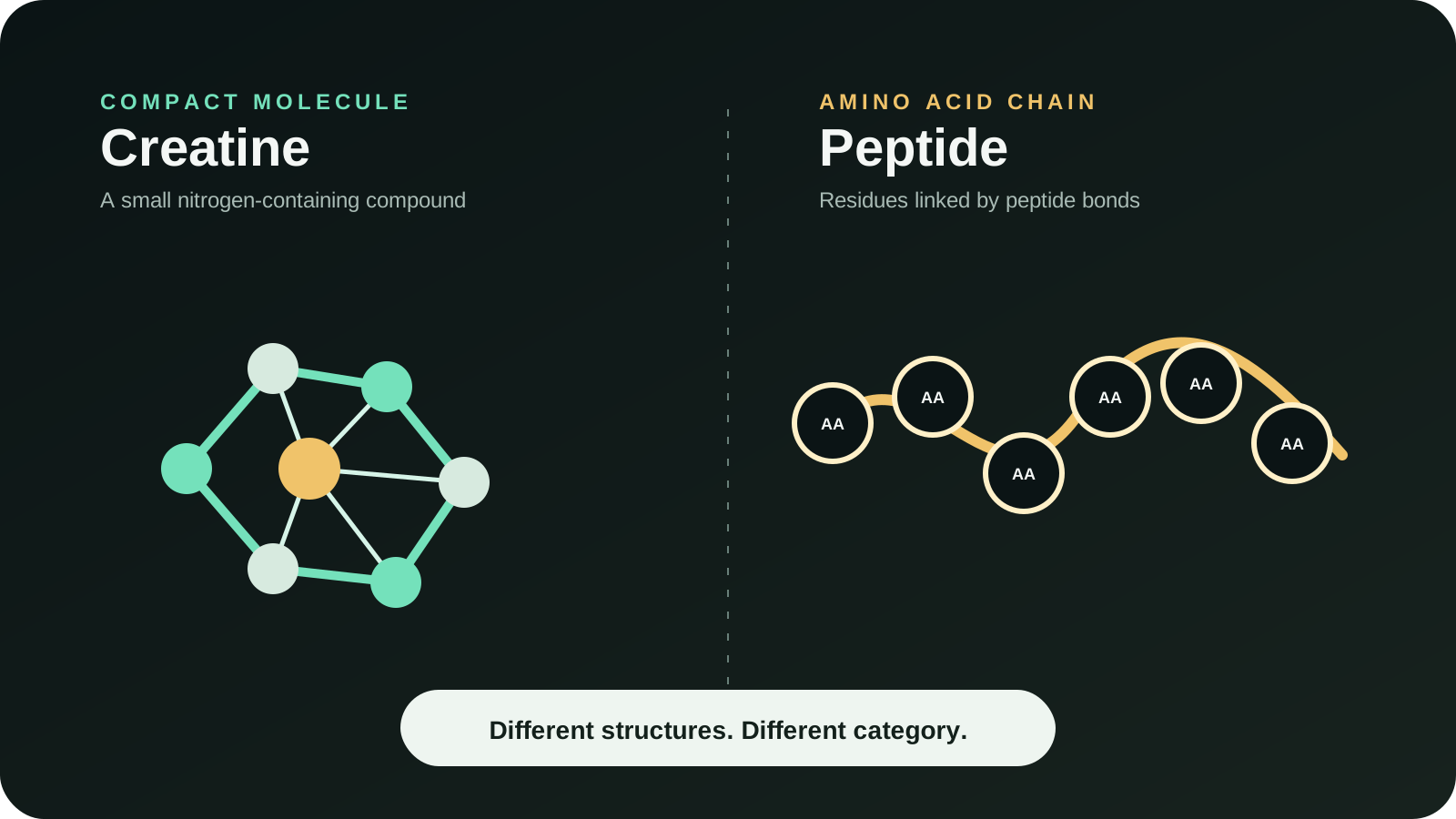
Chemically, creatine belongs to a family called guanidino compounds, named for the nitrogen-rich group sitting at its core. It weighs in around 131 daltons, which is tiny even next to a modest peptide. BPC-157, a peptide frequently mentioned in the same conversations, is a 15-amino-acid chain and weighs more than ten times as much.
So why does the label keep sliding? Some of it is writers compressing 'derived from amino acids' down to 'amino acid based' and then just to 'peptide.' Some of it is that creatine and peptides are now sold by the same retailers to the same audience chasing the same goals. And some of it is that a real product category called 'creatine peptides' exists, which keeps the confusion alive. None of this makes creatine inferior for not being a peptide. If anything, the opposite is true, and that is exactly why the mislabeling is worth correcting: it quietly borrows creatine's decades of research credibility for a product category that hasn't earned it.
What the Creatine Research Shows
Creatine monohydrate is one of the most studied supplements available. It works by topping up phosphocreatine, a fast-recharge energy store inside muscle cells that regenerates the fuel your muscles burn during short, hard bursts of effort. Supplementation raises muscle creatine and phosphocreatine by roughly 15 to 40 percent, which is why the payoff shows up in repeated sprints and heavy sets, not in a single all-out lift or a long steady run.

The clearest number comes from a meta-analysis pooling 22 randomized controlled trials across 721 older adults doing resistance training. Creatine groups packed on an extra 1.37 kilograms of lean tissue compared with placebo, with a confidence interval running from 0.97 to 1.76 kilograms, meaning the real effect is almost certainly in that range and not zero. Chest press and leg press strength both improved too, by smaller but still real margins. The International Society of Sports Nutrition's position stand backs this up across a much wider body of research and reports no medically significant harm in healthy people.
The brain-health claim needs more scrutiny than it usually gets. A 2023 meta-analysis found a small memory benefit, concentrated almost entirely in adults aged 66 to 76 and essentially absent in younger people. That same paper then drew a published letter to the editor arguing its statistics double-counted participants in a way that can manufacture a false positive. The finding isn't made up, but it is contested, small, and narrow to an older age bracket, which is a long way from 'creatine sharpens your mind.'
Two limits deserve to be stated plainly. First, creatine doesn't replace training. Nearly all the lean-mass evidence comes from trials pairing supplementation with resistance exercise, and on its own creatine does very little. Second, your starting point matters. Vegetarians tend to carry lower muscle creatine stores and see the biggest gains from supplementing, while someone already eating a lot of meat has less room for creatine to fill. That is the accurate version of the 'non-responder' idea that circulates online.
Do Creatine Peptides Beat Monohydrate?
No published head-to-head trial shows peptide-bound creatine outperforming monohydrate. 'Creatine peptides' is a genuine product where suppliers bind creatine to short peptides from hydrolyzed protein, usually whey or collagen, and market it on claims of better solubility and delivery. The chemistry behind the product is real. The performance claim is where it collapses, and the reason is easy to overlook.
Nearly every absorption pitch assumes there is a gap to close. With plain monohydrate, there simply isn't one. Around 99 percent of an ingested dose is either taken up by muscle or excreted in urine rather than lost in digestion. When something is already absorbed that thoroughly, a fancier carrier has almost nothing left to improve. That is not a marketing nitpick, it is basic arithmetic: you can't meaningfully raise a number already sitting at its ceiling.
The research on other creatine forms confirms this. A pharmacokinetic study comparing monohydrate against creatine citrate and creatine pyruvate at matched doses found pyruvate hit a peak blood concentration about 17 percent higher, yet the researchers concluded that any bioavailability edge was unlikely to matter, since monohydrate absorption is already close to complete, and that the small kinetic differences were unlikely to change muscle creatine levels at all. A broader review of novel creatine forms is even more direct, finding little to no evidence that any newer form beats plain monohydrate on effectiveness or safety.
Read the efficacy numbers on creatine peptide packaging carefully. They are typically manufacturer-run studies of the branded ingredient against a placebo or against baseline, not against monohydrate. A product can beat doing nothing and still be no better than the cheap tub next to it on the shelf. Until someone runs a real head-to-head against monohydrate and publishes it, the reasonable assumption is that you are paying extra for the same outcome. That mirrors exactly what the regulatory-status review on novel creatine forms flagged: new versions arrive with confident pricing and unconfident evidence.
How the Peptide Evidence Compares
The evidence gap here is large. Creatine rests on hundreds of controlled human trials. The peptides marketed for muscle building and recovery mostly rest on animal studies and uncontrolled self-reports. Lining these up side by side is the most useful thing this piece can do, because they are rarely compared directly.

Start with the compound in this space that has strong human body-composition data, and note that it isn't technically a peptide either. MK-677 is an orally active growth hormone secretagogue, meaning it prompts your own pituitary gland to release more growth hormone. It is a small molecule, not a chain of amino acids, but it gets discussed alongside injectable peptide secretagogues constantly. It earns a spot in this comparison because no peptide in that category has a lean-mass trial of comparable length or rigor. MK-677 was tested in a two-year, double-blind, placebo-controlled trial involving 65 healthy adults aged 60 to 81. After twelve months, fat-free mass rose by 1.1 kilograms in the treated group while it fell by 0.5 kilograms on placebo.
Here is the sentence that reframes the whole comparison: the trial reported that the increased fat-free mass didn't translate into changes in strength or physical function. Participants carried more lean tissue and were not measurably stronger or more capable for it. Compare that to creatine's meta-analysis, where a similar 1.37 kilograms of lean tissue came bundled with measurable strength gains on both chest press and leg press. The comparison is not perfectly clean, since every trial in that creatine meta-analysis paired supplementation with resistance training while the MK-677 participants did not train at all, but that caveat favors creatine rather than undercutting it. The MK-677 trial also recorded higher fasting blood glucose and reduced insulin sensitivity in the treated group, a real downside attached to an outcome that never became functional strength.
The tissue-repair peptides sit even further back on the evidence ladder. BPC-157 shows real promise in animal models of tendon and muscle injury, but a 2026 review of its development status calls it investigational and points to unresolved formulation and translational barriers, which is a technical way of saying the human trials that would settle the question haven't happened yet. Most of what circulates about BPC-157 online is animal data, proposed mechanisms, and personal anecdotes.
That doesn't make peptides worthless as a category. Several are approved drugs with solid trial evidence for specific medical uses. The narrower and more practical point is this: for the everyday goals people buy creatine for, building muscle, getting stronger, improving training output, the peptides and peptide-adjacent compounds marketed for the same goals currently carry thinner human evidence, cost more, and in the one well-run long-term trial available, delivered a lean-mass gain that never showed up as extra strength.
Can You Combine Creatine With Peptides?
No controlled trial has tested creatine alongside the peptide compounds discussed here. The literature also does not establish a specific interaction. Those are two separate facts: the first means synergy is unproven, while the second does not prove the combination is safe.
Creatine uses its own cellular transporter, while different peptides follow different absorption and signaling pathways. That makes a direct interaction less obvious on mechanism alone, but mechanism cannot characterize a combination that has not been studied. Claims of either guaranteed compatibility or special synergy run ahead of the evidence.
The most genuinely interesting angle here is newer than most writing on the topic. GLP-1 receptor agonists, the weight-loss drug class that includes semaglutide and works by mimicking a gut hormone that suppresses appetite, produce dramatic weight loss. The STEP 1 trial recorded an average loss of 14.9 percent of body weight over 68 weeks. A meaningful chunk of that loss isn't fat but lean tissue, and a 2024 commentary in Lancet Diabetes and Endocrinology argued the field hasn't paid enough attention to exactly this problem.
Creatine is the obvious candidate to pair with GLP-1 therapy on paper. It is inexpensive, has a long safety record, and its most reliable effect is preserving and building lean tissue when combined with resistance training. Every strand of reasoning points the same direction. What's still missing is an randomized trial testing creatine alongside GLP-1 therapy, so the honest framing is a well-reasoned hypothesis, not a proven benefit. Anyone presenting it as settled science is running ahead of the data.
Two practical notes to close on. If you're taking something alongside a prescribed medication, it belongs in a conversation with the clinician who prescribed it, not a supplement forum thread. And every figure cited in this piece is a result a specific trial reported, shared here so you can weigh the evidence yourself. None of it amounts to a protocol, and nothing here tells you what to take or how much.
Sources
- International Society of Sports Nutrition position stand: safety and efficacy of creatine supplementation
- Analysis of the efficacy, safety, and regulatory status of novel forms of creatine
- Comparison of new forms of creatine in raising plasma creatine levels
- Common questions and misconceptions about creatine supplementation
- Effect of creatine supplementation during resistance training on lean tissue mass and strength in older adults: a meta-analysis
- Effects of creatine supplementation on memory in healthy individuals: a systematic review and meta-analysis
- Effects of an oral ghrelin mimetic on body composition and clinical outcomes in healthy older adults
- Once-weekly semaglutide in adults with overweight or obesity
Educational content only. Not medical advice.