Peptide Guides
The Peptide Craze Explained: What's Real, What's Hype, and What to Watch
Peptide conversations mix together approved medicines, experimental compounds, and cosmetic ingredients. This guide separates those categories, explains where evidence is strong or thin, and updates the regulatory picture through the July 2026 PCAC meeting.
Published by PeptideSchool Editorial Desk

What peptides are
Peptides are short chains of amino acids, the same building blocks that make up every protein in your body. You already produce thousands of them naturally, and they work as signaling molecules, telling cells to release growth hormone, calm inflammation, repair damaged tissue, or dial appetite up or down.
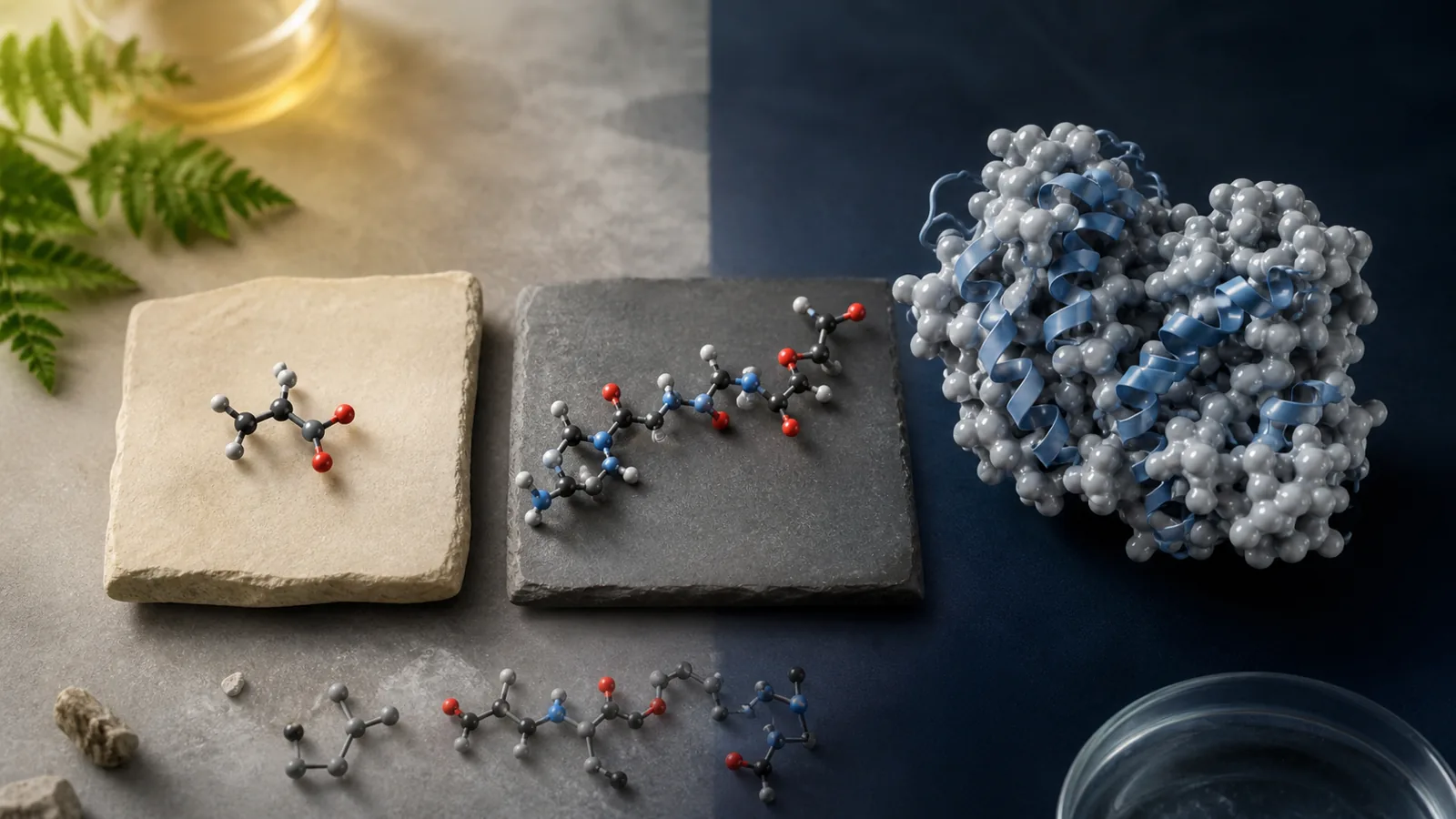
The part most coverage skips over is that the word "peptide" is doing double or triple duty. There are three genuinely different categories being talked about as if they were one thing, and the gap between them explains most of the confusion in this space.
FDA-approved peptide medicines have been evaluated as specific products for specific uses and are manufactured under regulated quality systems. Insulin, semaglutide, oxytocin, and bremelanotide belong in this category. Approval doesn't make every use risk-free, but it provides a defined product, indication, label, and evidence base.
Research peptides are sold under a "research use only" label specifically to sidestep that regulatory process. There are no manufacturing quality standards protecting a human user, and compounds like BPC-157, TB-500, and CJC-1295 live here. Most of what backs these up is animal data, and this is exactly where the social media hype has concentrated.
Cosmetic peptides show up in skincare. Signal peptides are meant to stimulate collagen production, and carrier peptides deliver minerals like copper into the skin (Pickart and Margolina, 2018). These reach the shelf without the rigorous approval a drug needs, and how well they absorb through skin remains an open question.
How peptides went mainstream
Peptides did not suddenly appear in the culture. They moved from niche gym circles into mainstream conversation in stages, and the biggest single push was regulatory rather than viral: the 2021 approval of semaglutide for weight loss put a peptide drug into everyday medical conversation for the first time.
Through the 2010s, peptides mostly circulated in hardcore bodybuilding communities, where lifters experimented with BPC-157 and growth hormone secretagogues sourced from underground suppliers. That changed in 2021 when Wegovy (semaglutide) won FDA approval for weight loss. In 2022 and 2023, tirzepatide followed under the names Mounjaro and Zepbound, compounding pharmacy use of peptides surged, and celebrity endorsements picked up the pace.
Late in 2023, the FDA placed BPC-157, TB-500, CJC-1295, and several other compounds into Category 2 or related compounding-risk buckets, citing safety and evidence concerns. Political pressure to loosen those restrictions became public and explicit through 2024, and gray-market imports kept climbing. By 2025, biohacking content had gone fully mainstream on short-form video, imports of hormone and peptide compounds rose sharply, and high-profile figures started naming specific peptides on camera.
Then in April 2026, the FDA removed 12 peptides, including BPC-157 and TB-500, from the 503A Category 2 list, effective April 22. That is a procedural step toward possible future compounding. It is not an approval, and the difference matters a great deal, which the next section digs into.
What the evidence supports
There is a real gap between what a compound does inside a clinical trial and what gets claimed about it online. The honest way to sort this is into three tiers: strong human evidence, promising animal evidence that has not been tested in people, and hype that has simply outrun what anyone has studied.
GLP-1 agonists sit in the strong evidence tier. In the STEP 1 trial, weekly semaglutide produced an average body weight reduction of about 15 percent over 68 weeks (Wilding et al., 2021). In SURMOUNT-1, tirzepatide reached roughly 21 percent at its highest dose over 72 weeks (Jastreboff et al., 2022). Add insulin analogs, bremelanotide for HSDD, and tesamorelin for HIV-related lipodystrophy, and you have a group of compounds that went through full clinical programs involving thousands of participants.
The middle tier is promising but unproven in humans. BPC-157 for tissue repair is the headline example: a 2025 systematic review of the orthopaedic sports medicine literature covered 36 studies, of which 35 were preclinical and exactly one was clinical, and it found no clinical safety data at all (Vasireddi et al., 2025). GHK-Cu has some topical support for wound healing, though the evidence for injectable use is thin (Pickart and Margolina, 2018). MOTS-c for metabolic health is early-stage, and thymosin alpha-1 for immune modulation sits in a similar spot.
Then there is the tier where hype has genuinely outrun the evidence. So-called Wolverine stacks have zero human data as a combination. Most anti-aging injection regimens, peptide nasal sprays marketed for cognitive enhancement, and vague longevity cocktails belong here too. Strong results in animals do not automatically translate to humans, and 35 rodent studies are not the same thing as 35 human trials, no matter how the marketing reads.
The BPC-157 case deserves a closer look because it is the most repeated claim in this entire space. The single clinical entry in that 2025 review was a small retrospective series of knee-pain patients, not a randomized efficacy trial (Vasireddi et al., 2025). That is a real signal worth following up on. It is not proof, and no honest reading of the literature turns it into proof.
Where regulation stands in 2026
The regulatory picture shifted in 2026, and it has been misreported in both directions since. On April 15, 2026, the FDA updated its 503A Categories list and removed 12 peptides from Category 2, the bucket reserved for bulk drug substances the agency considers to carry significant safety risk in compounding. The change took effect April 22, 2026, covering BPC-157, TB-500, injectable GHK-Cu, Epithalon, MOTS-c, DSIP, Melanotan II, KPV, LL-37, Semax, Dihexa, and PEG-MGF.
Here is what that change does not mean, because this is exactly where most coverage goes wrong. Removal from Category 2 is not FDA approval. Approval requires a specific drug product to complete phase 1 through phase 3 trials and receive marketing authorization for a defined use, and none of these 12 compounds have done that. Removal is also not authorization to compound. To reach the actual 503A Bulks List, the list that lets a licensed pharmacy prepare a substance under prescription, each peptide still needs a recommendation from the Pharmacy Compounding Advisory Committee and a final FDA rule. Until that happens, these compounds sit in a middle status: no longer listed in Category 2 after the nominations were withdrawn, but not authorized for compounding.
The practical effect for anyone buying outside a licensed pharmacy is close to nothing. Federal law still does not allow non-prescription retail sale of these peptides to consumers, and the April update did not change that fact. What it did change is the medium-term outlook, since a legal compounding pathway is now plausible where it previously was not.
It is also worth stating what did not change at all. Over 80 FDA-approved peptide drugs were fully available before April 2026 and remain so today (Muttenthaler et al., 2021). The FDA never banned peptides as a category, and any headline implying otherwise, in either direction, is describing a much narrower compounding rule than it sounds like.
PCAC then reviewed seven substances on July 23 and 24, 2026. The committee recommended six for possible inclusion on the 503A Bulks List and did not recommend emideltide, also called DSIP. Those votes were advisory. They did not approve a drug product, add a substance to the final list, or finish FDA rulemaking.
Why promising compounds can still stall
A compound can remain unapproved for many reasons. Commercial incentives matter, especially when a sequence is difficult to protect or the likely market is small. But weak human evidence, safety concerns, formulation problems, manufacturing complexity, and a poor trial result can stop development just as easily.
Lack of approval doesn't prove a molecule is ineffective, but it also shouldn't be reframed as evidence that an effective treatment was ignored. The honest label is simpler: the required product-level evidence hasn't been established. Until it is, benefits and risks remain less certain than they are for an approved medicine.
The real risks
The safety concerns here are not theoretical, and most of them trace back to sourcing rather than chemistry itself. Product identity, purity, and sterility are essentially unverifiable outside a regulated supply chain, documentation can be faked, and stacking unapproved compounds introduces interaction risks nobody has studied in anyone.
Unverified contents are a repeated problem. Gray-market peptides have been found deviating from their label in identity, quantity, or contamination with residual solvents and endotoxins, and some samples have contained no detectable target peptide at all. There is no regulator checking any of this, which is the core of the problem.
No clinical safety data exists for many of the most-hyped research peptides, and this is literal rather than a figure of speech. The 2025 BPC-157 systematic review found preclinical safety work across several organ systems and no clinical safety data whatsoever (Vasireddi et al., 2025).
Gray-market sourcing compounds the risk. Overseas vendors sell through messaging apps and social platforms at a fraction of clinic pricing, with no standardized manufacturing and no accountability if something goes wrong. Certificates of analysis can be fabricated outright, and without independent third-party testing a COA is just a PDF, not evidence of anything.
Combining unapproved peptides, commonly called stacking, introduces interaction risks that have never been formally studied. TB-500 is banned by WADA for athletic use, and BPC-157 use is prohibited in professional sport (Vasireddi et al., 2025). Adverse events do happen too. Press coverage through 2025 and 2026 has documented hospitalizations following peptide injections given outside clinical settings, and because there is no reporting system for gray-market use, the documented cases are almost certainly a floor rather than a full count.
How to think about this critically
A framework beats a verdict, because the specific compounds in this conversation will keep changing while the reasoning underneath stays the same. Separate the drug class from the trend first. Peptides as pharmaceuticals are legitimate and well established. The social media peptide trend is a different phenomenon that just happens to share a name.
Check the evidence tier before you weigh the claim. "FDA-approved with human trials" and "promising in rats" are not the same statement dressed differently, even when marketing tries to blur the line. If you are considering a research peptide anyway, verify the source independently and demand third-party COA testing rather than trusting a vendor's own paperwork.
Read regulatory status accurately. A lack of approval is partly an economic signal, not purely a safety verdict, and removal from a compounding risk category is not the same thing as approval. Finally, stay skeptical of celebrity endorsements. A well-known name calling peptide shots a wellness tool is marketing, and it carries no evidentiary weight at all.
None of this requires deciding in advance that peptides are miraculous or that they are a scam. It just requires holding each specific compound to the standard its own evidence supports, which is a smaller and more honest ask than most of the internet makes it sound.
Sources
- Trends in peptide drug discovery
- Regenerative and protective actions of the GHK-Cu peptide in the light of the new gene data
- Once-weekly semaglutide in adults with overweight or obesity
- Tirzepatide once weekly for the treatment of obesity
- Emerging use of BPC-157 in orthopaedic sports medicine: a systematic review
- Bulk Drug Substances Used in Compounding Under Section 503A of the FD&C Act
- July 23 and 24, 2026 Pharmacy Compounding Advisory Committee meeting
Educational content only. Not medical advice.