Peptide Guides
FDA-Approved Peptides: The Complete 2026 Guide
Popular peptide discussions often mix approved medicines with investigational or unapproved compounds. This guide separates the groups, explains what FDA approval covers, and updates the compounding pathway through the July 2026 PCAC meeting.
Published by PeptideSchool Editorial Desk

Why there's a gap between what's popular and what's approved
Search any peptide forum and you'll find people discussing BPC-157, TB-500, ipamorelin, and CJC-1295 like they're standard medications. None of them are FDA-approved. Out of the hundreds of peptide sequences that circulate among biohackers, bodybuilders, and longevity enthusiasts, only a small slice has made it through the clinical trial process required for approval.
That gap matters for practical reasons. It determines what a doctor can legally write a prescription for, what your insurance will touch, and what legal protection you have if a product turns out to be contaminated or mislabeled.
Peptide drugs as a category are booming. More than 80 have reached markets worldwide, with dozens more moving through clinical development (Muttenthaler et al., 2021). But the compounds dominating Reddit threads and Telegram channels sit in a different bucket entirely. They're sometimes legal to compound, widely used, and completely untested through the phase 1 through phase 3 pipeline that drugs like semaglutide and tirzepatide completed.
Peptide medicines that cleared FDA approval
These are the peptide drugs with real phase 3 data, an established safety profile, and at least one approved use. The list runs from blockbuster metabolic drugs to treatments for rare diseases most people have never heard of.

Semaglutide is the most commercially successful peptide drug ever made. It launched as Ozempic for type 2 diabetes in 2017, followed by Rybelsus in 2019 as the first oral GLP-1 tablet, then Wegovy in 2021 for weight management, and eventually a 25 mg oral Wegovy tablet, the first oral GLP-1 approved specifically for obesity. In the STEP 1 trial, participants lost 14.9% of body weight on average at 68 weeks (Wilding et al., 2021). The oral 25 mg version reached 16.6% mean weight loss at 64 weeks in the OASIS 4 trial among adherent patients, with roughly a third hitting 20% or more (Wharton et al., 2025).
Tirzepatide works differently, activating both GIP and GLP-1 receptors. It's sold as Mounjaro for type 2 diabetes since May 2022 and Zepbound for weight management since November 2023, and in December 2024 it became the first medication ever approved for obstructive sleep apnea (Malhotra et al., 2024). In a head-to-head trial against semaglutide, tirzepatide produced 20.2% weight loss versus 13.7% at 72 weeks (Aronne et al., 2025).
Beyond the two GLP-1 heavyweights, several smaller but medically important approvals round out the list. Afamelanotide, sold as Scenesse, is a subcutaneous implant approved in 2019 for erythropoietic protoporphyria. This is the compound peptide communities know as melanotan I, and it is explicitly not approved for tanning. Setmelanotide (Imcivree) is a daily injection approved in 2020 for rare genetic obesity tied to POMC, PCSK1, and LEPR deficiency, later expanded to Bardet-Biedl syndrome and to children as young as two.
Trofinetide (Daybue), approved in 2023, is the first and only drug for Rett syndrome, taken as an oral solution. Palopegteriparatide (Yorvipath), approved in 2024, is the first and only approved treatment for hypoparathyroidism. Elamipretide, approved in 2025 for Barth syndrome, is the first mitochondria-targeted therapeutic ever approved, working by binding cardiolipin in the inner mitochondrial membrane. Rounding things out are bremelanotide (Vyleesi), approved in 2019 for low sexual desire in premenopausal women, and tesamorelin (Egrifta), approved back in 2010 for HIV-associated lipodystrophy.
How approved peptide medicines are delivered
Peptides are large, fragile molecules. The gut destroys most of them before they can do anything useful, so how a peptide drug is delivered shapes everything about who can use it and how convenient it is.
Subcutaneous injection covers roughly 65% of approved peptide drugs, including semaglutide, tirzepatide, setmelanotide, bremelanotide, tesamorelin, palopegteriparatide, and elamipretide. It's the default option because absorption is reliable and bioavailability is high, and modern auto-injector pens have made self-administration almost routine.
Oral delivery was considered a dead end for peptides until Novo Nordisk solved it with SNAC technology, a compound that creates a local pH buffer in the stomach and protects semaglutide from being broken down while helping it cross the gastric lining (Buckley et al., 2018). Even with this breakthrough, oral bioavailability sits around just 1%, which is why oral Wegovy needs a 25 mg dose to match the effect of a 2.4 mg injection. Trofinetide is also given orally as a solution.
Implants offer sustained release over weeks or months. Afamelanotide's implant dissolves over about 60 days. Goserelin (Zoladex) uses a similar approach for prostate cancer, and histrelin (Supprelin LA) lasts a full year. The catch is that inserting one requires a minor procedure.
Nasal delivery skips first-pass liver metabolism by absorbing directly through the nasal mucosa. Desmopressin and calcitonin use this route for approved conditions. Selank and Semax are given nasally in Russia, and intranasal Semax has been studied in healthy volunteers (Lebedeva et al., 2018), though neither has FDA approval anywhere.
Further out, lipid nanoparticles, microneedle patches, and hydrogel depots are all in active development, though none have produced an approved peptide product yet. Interestingly, oral non-peptide GLP-1 drugs like orforglipron could sidestep the entire bioavailability problem and change how this category evolves.
What's coming next in the pipeline
Three candidates are generating most of the clinical buzz right now, each aimed at a different unmet need.
Retatrutide, Eli Lilly's triple agonist hitting GIP, GLP-1, and glucagon receptors, posted up to 24.2% weight loss at 48 weeks in phase 2 (Jastreboff et al., 2023). Its pivotal phase 3 TRIUMPH-1 readout went further, reporting up to 28.3% mean weight loss at 80 weeks on the 12 mg dose across 2,339 participants, the largest figure recorded in any phase 3 obesity trial so far. More TRIUMPH readouts are expected, and the earliest realistic approval window is 2027 to 2028, assuming continued positive results.
CagriSema combines cagrilintide, an amylin analog, with semaglutide in one fixed dose from Novo Nordisk. The company filed its FDA application in December 2025, with a decision expected late in 2026. Its REDEFINE 1 trial showed 20.4% weight loss at 68 weeks compared to 14.9% for semaglutide alone (Garvey et al., 2025).
Survodutide, from Boehringer Ingelheim, is a dual glucagon/GLP-1 agonist aimed at MASH (metabolic dysfunction-associated steatohepatitis) with liver fibrosis rather than weight loss alone. It earned FDA breakthrough therapy designation in September 2024 after a phase 2 trial found 62% of patients on the highest dose showed MASH improvement without worsening fibrosis, versus 14% on placebo (Sanyal et al., 2024).
REDEFINE 4 later compared CagriSema directly with tirzepatide. Novo Nordisk reported 23.0% versus 25.5% mean weight loss under an efficacy estimand and 20.2% versus 23.6% under a treatment-regimen estimand. CagriSema did not meet the noninferiority objective. These remain sponsor-reported topline data until the complete paper is available.
The 2026 compounding reclassification, explained
This is the single most misunderstood regulatory event in peptide news right now. In late 2023, the FDA placed a group of widely used peptides, including BPC-157, TB-500, GHK-Cu, KPV, MOTS-c, Semax, and Epitalon, into category 2, its list of bulk substances that may pose significant safety risks. That listing effectively shut down compounding pharmacies from preparing them.
On April 15, 2026, the FDA removed 12 of those peptides from category 2 after the nominations backing their original listing were withdrawn: BPC-157, LL-37, DiHexa, DSIP (emideltide), Epitalon, injectable GHK-Cu, KPV, PEG-MGF, Melanotan II, MOTS-c, Semax, and TB-500.
Here's what that removal does: it lifts the explicit significant-safety-risk label from those substances and makes them eligible for consideration on the separate 503A authorized bulk substances list. Here's what it does not do: it is not FDA approval, and by itself it doesn't authorize compounding. Getting onto the 503A list requires a completely separate advisory review and FDA decision. A Pharmacy Compounding Advisory Committee met on July 23 and 24, 2026 to review seven of the twelve substances (BPC-157, KPV, TB-500, MOTS-c, DSIP, Semax, and Epitalon) for that list, and the FDA's own briefing materials proposed not adding them.
None of these 12 peptides have completed phase 3 trials for the uses they're commonly promoted for, and none carry FDA approval for any condition. Most of the supporting evidence is still limited to cell studies, animal models, and small uncontrolled human trials.
In July 2026, PCAC recommended six of the seven reviewed substances for possible inclusion on the 503A Bulks List and did not recommend emideltide. The recommendations are nonbinding. They didn't approve the substances as drugs or add them to the final list.
Six misconceptions worth clearing up
A handful of claims keep circulating, and all of them are wrong.
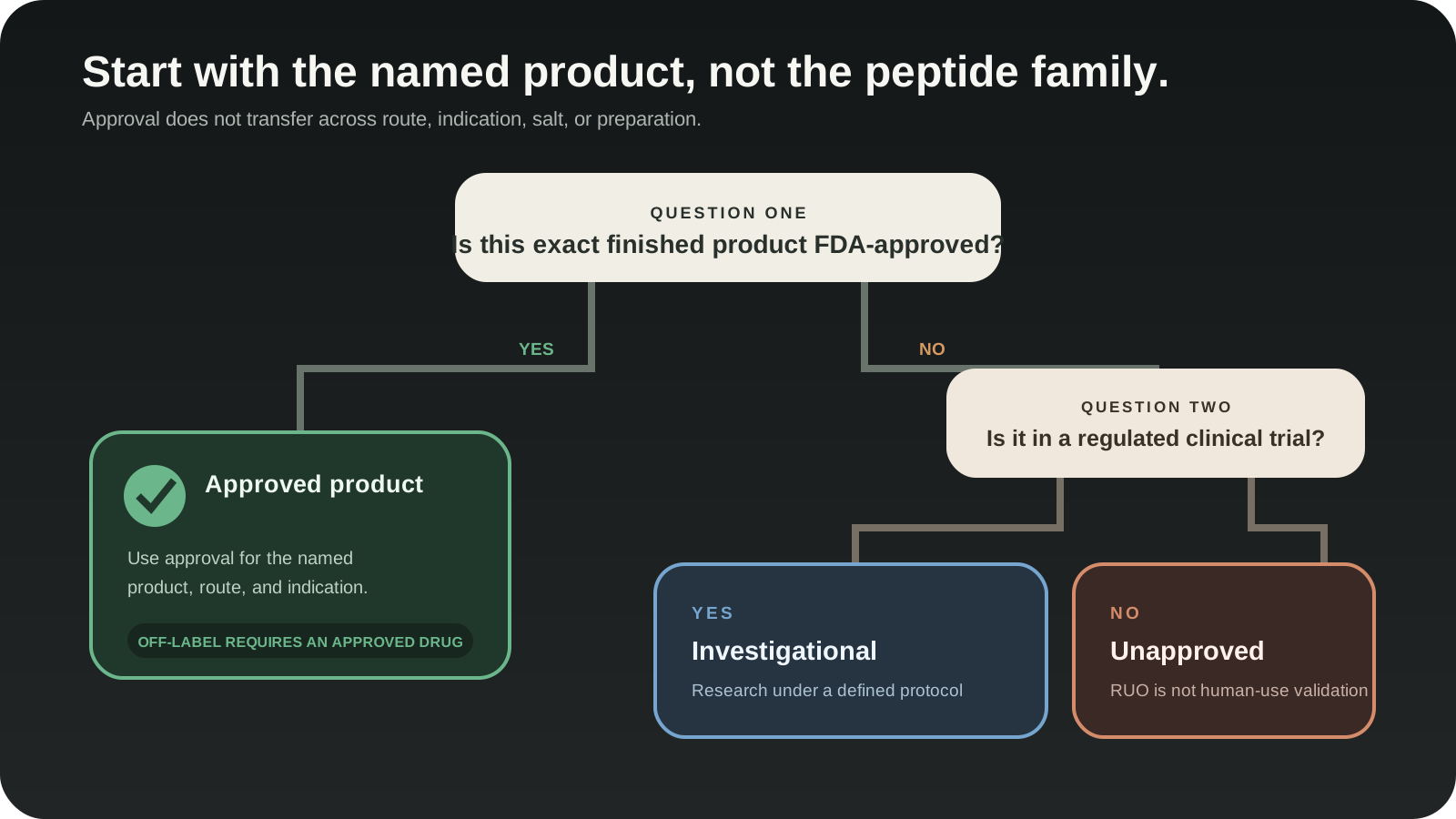
Research use only does not mean safe for humans. RUO is a legal label for lab reagents, not a quality standard, and it explicitly states the product hasn't been validated for diagnostic or therapeutic use in people.
Buying unapproved peptides for personal use is not legally protected. Purchasing outside a regulated pharmacy pathway leaves you unprotected, and the FDA treats unapproved peptides sold for human use as misbranded, adulterated drugs.
Off-label prescribing does not cover research peptides. Off-label use only applies to drugs that already have at least one FDA approval. BPC-157 has zero, so a physician legally cannot prescribe it off-label.
Removal from category 2 is not FDA approval. This has been the most common error since April 2026. Removal lifts a prohibition-style designation and says nothing about whether a compound works. It's a regulatory pathway decision, not a clinical endorsement.
Not all peptides carry the same risk profile. Semaglutide has trial data on tens of thousands of patients. BPC-157's human safety evidence comes from a handful of small studies. Treating those two risk profiles as equivalent is a mistake.
Compounded peptides are not identical to FDA-approved versions. Compounded products carry no guarantee of matching identity, purity, potency, or safety compared to manufactured drugs, and quality depends entirely on the individual pharmacy's standards.
Sources
- Trends in peptide drug discovery
- Once-Weekly Semaglutide in Adults with Overweight or Obesity
- Oral Semaglutide at a Dose of 25 mg in Adults with Overweight or Obesity
- Tirzepatide for the Treatment of Obstructive Sleep Apnea and Obesity
- Tirzepatide as Compared with Semaglutide for the Treatment of Obesity
- Transcellular stomach absorption of a derivatized GLP-1 receptor agonist
- Triple-Hormone-Receptor Agonist Retatrutide for Obesity: A Phase 2 Trial
- Coadministered Cagrilintide and Semaglutide in Adults with Overweight or Obesity
- CagriSema did not demonstrate noninferiority to tirzepatide in REDEFINE 4
Educational content only. Not medical advice.