Peptide Guides
Vetting Research Peptides: How to Read a COA, HPLC Data, and Third-Party Test Reports
A practical breakdown of how to evaluate a research peptide vial before buying it: what a real certificate of analysis contains, how HPLC purity numbers should be interpreted, why mass spectrometry identity confirmation matters as much as purity, how independent third-party testing works, and the red flags that signal a vendor is cutting corners.
Published by PeptideSchool Editorial Desk
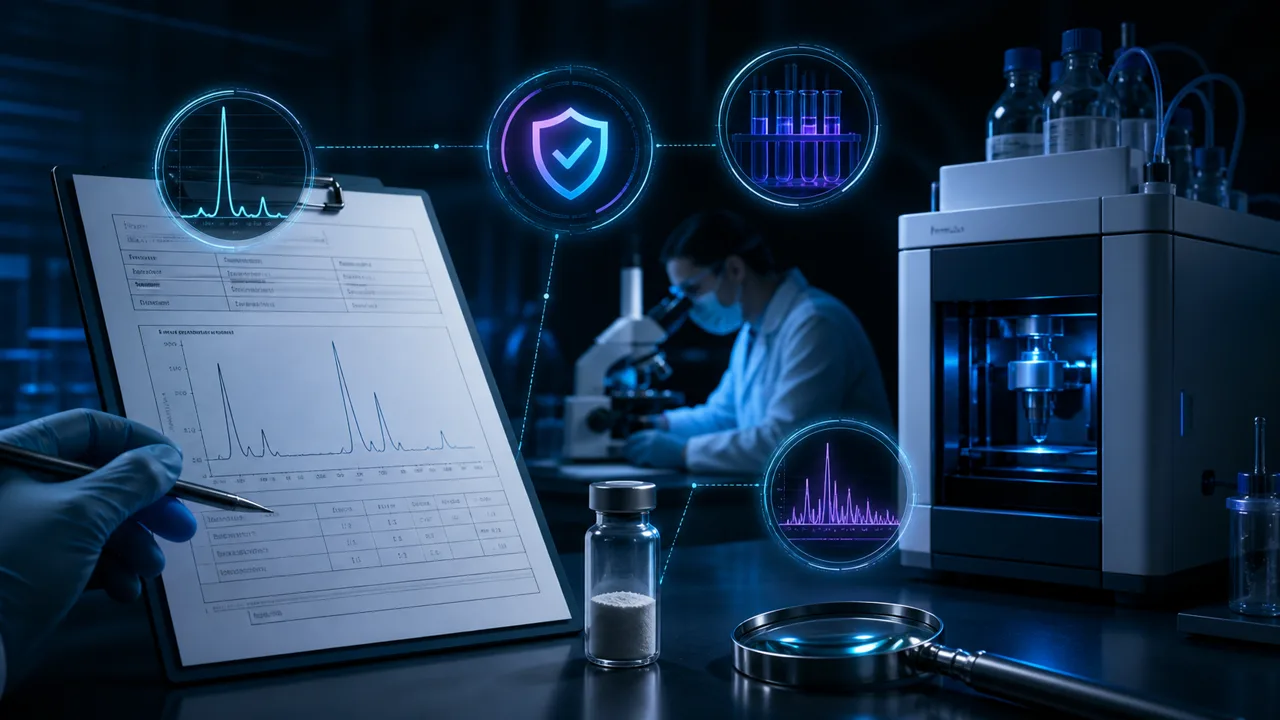
The Vial Label Tells You Almost Nothing
A research peptide vial label gives you three things: the compound name, the mass in milligrams, and a lot number. That is it. It says nothing about purity, nothing about whether the molecule inside is what the label claims, nothing about residual solvents left over from synthesis, and nothing about whether the contents degraded somewhere between the lab and your doorstep. All of that information, if it exists at all, lives in a certificate of analysis written for that specific lot, not in anything printed on the vial.
Scroll through almost any research-peptide listing and you will see the same handful of claims repeated: '>99% pure,' a logo with a percentage stamped on it, a stock photo of a vial under studio lighting. None of that is laboratory evidence. It is marketing copy. A single vendor might sell ten different lots of the same peptide across a year, each one produced by a different contract synthesizer, each with its own purity profile. One purity number on a product page cannot possibly describe ten separate manufacturing runs. Only a per-batch certificate of analysis can do that.
Most research peptides ship lyophilized, meaning freeze-dried. The vial starts as a peptide solution, gets frozen, then sits under vacuum while the ice sublimates directly into vapor, leaving dry powder behind. This process extends shelf life by removing the water that would otherwise drive hydrolysis, the chemical breakdown of peptide bonds. But the powder that arrives at your door can still carry truncated sequences, deletion products, oxidation byproducts, or leftover synthesis solvents, and none of it is visible to the eye. A vial that is 99% pure target peptide looks exactly the same as one that is 80% target plus a mixture of junk.
Because of this, vetting a research peptide really comes down to three independent signals working together: a certificate of analysis tied to the exact lot you are buying, an independent third-party test on that same lot if one exists, and the vendor's track record of disclosure across many lots over time. Each signal is weak on its own. Stacked together, they tell you something real.
What a Real Certificate of Analysis Contains
A legitimate COA is a one-to-two page lab document with a predictable structure. The header names the named testing laboratory, a real company with a verifiable address, along with the customer who submitted the sample and a unique report number. The sample section lists the compound name, the batch or lot number, the manufacturer, and the dates the sample was received and tested. The methods section states exactly which analytical techniques were used, typically HPLC for purity and mass spectrometry for identity, sometimes joined by Karl Fischer titration for water content or gas chromatography for residual solvents.
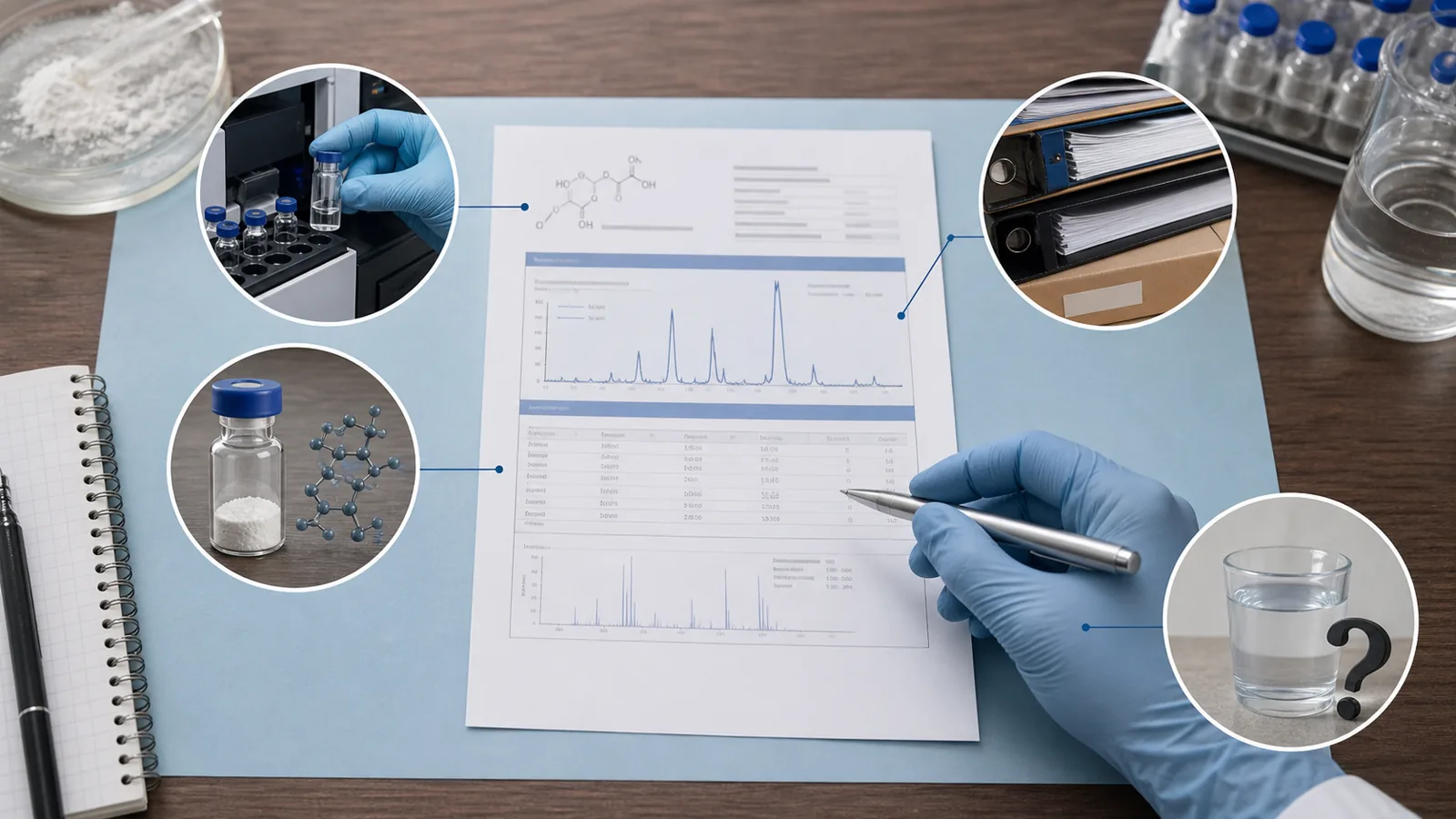
The results section draws the most attention, and it is also the easiest part to fake. A results section that shows nothing but a single number, 'purity: 99.2%,' with no supporting chromatogram, is far weaker than one showing the full HPLC trace, naming the column and gradient used, and reporting the observed molecular weight from mass spectrometry next to the expected weight. A good chromatogram shows one tall primary peak with any minor peaks clearly labeled by retention time. Oddly, a flat baseline with zero labeled impurities is itself a warning sign, because real syntheses almost never come out perfectly clean.
Every legitimate COA carries a batch or lot number that matches the number printed on your vial. If a vendor hands you a COA whose batch number does not match what shipped, that document tells you nothing about the vial in your hand, it describes a different batch entirely. This mismatch is one of the most common signs of a careless or dishonest vendor, and it takes about ten seconds to check.
HPLC Purity, Explained Without the Jargon
HPLC, high-performance liquid chromatography, is the workhorse purity test in peptide chemistry. A tiny amount of dissolved sample gets pushed through a long, thin column packed with chemically active particles. Different molecules move through that column at different speeds depending on how they interact with the packing material. A detector at the end tracks how much material exits at each moment, drawing a graph called a chromatogram, where each peak represents one chemical species.
For peptides, the detector almost always reads UV absorbance at 214 nanometers, the wavelength where the peptide bond itself absorbs light. That makes 214 nm sensitive to essentially any peptide-like molecule, including truncated sequences, deletion products, and oxidation byproducts. So when a COA says '98% HPLC purity at 214 nm,' it means 98% of the chromatogram's total area came from the main peak, and the remaining 2% came from everything else combined. That leftover 2% is not automatically identified. Figuring out what it is requires additional methods, and high-resolution mass spectrometry can even uncover impurities that coelute directly underneath the main peak, hidden from a standard HPLC trace entirely.
Industry references commonly cite 95 to 98% purity as the normal working range for research-grade peptides, with 99%+ reserved for clinical-grade material that has gone through additional rounds of preparative HPLC purification. Higher purity costs more because every extra purification pass loses product yield. A bare number is never the whole story. The chromatogram itself tells you whether the impurity profile is something benign, like a small cluster of closely related peptide fragments, or something that should worry you, like large unidentified peaks with no explanation.
Mass Spectrometry: Confirming It Is the Right Molecule
HPLC answers one question: how much of this mixture is the main peak? It does not answer a more important question: is that main peak the molecule I paid for? That second question belongs to mass spectrometry. An MS instrument ionizes the molecules in a sample, then measures their mass-to-charge ratio using time-of-flight detection or magnetic deflection. For peptides, the dominant signal is almost always the protonated molecule, and the instrument can report its mass down to fractions of a dalton.
Every peptide has a theoretical molecular weight, calculated by adding up its amino acid residues and subtracting the water lost each time a peptide bond forms. BPC-157 comes out to roughly 1419.55 Da, TB-500 sits around 4963.49 Da, and melanotan-II lands near 1024.18 Da. An observed MS reading within about plus or minus 0.5 Da of the theoretical value is strong evidence the dominant molecule in the vial is the intended peptide. A reading off by 18 Da points to a hydrolyzed product. Off by 16 Da suggests oxidation. Off by a full residue mass suggests an amino acid got dropped somewhere during synthesis.
This is exactly why a COA reporting both HPLC purity and a matching MS molecular weight carries far more weight than HPLC alone. You can be 99% pure and still be 99% pure in the wrong molecule entirely. Published analytical work on falsified biotech preparations has documented this exact failure mode, products whose identity did not match the label at all, and it is a big part of why third-party testing exists as a check in this market.
Third-Party Testing: The Independent Check
Every COA posted on a vendor's own website was paid for by that vendor. That does not automatically make it fraudulent, but it does mean the party paying for the test and the party selling the product are the same entity, which is an obvious conflict of interest. Third-party testing removes that conflict. A customer ships an unopened or freshly opened vial to an independent analytical lab that has no relationship with the seller, the lab runs its own HPLC and MS on a fresh sample, and the resulting report goes straight to the customer.
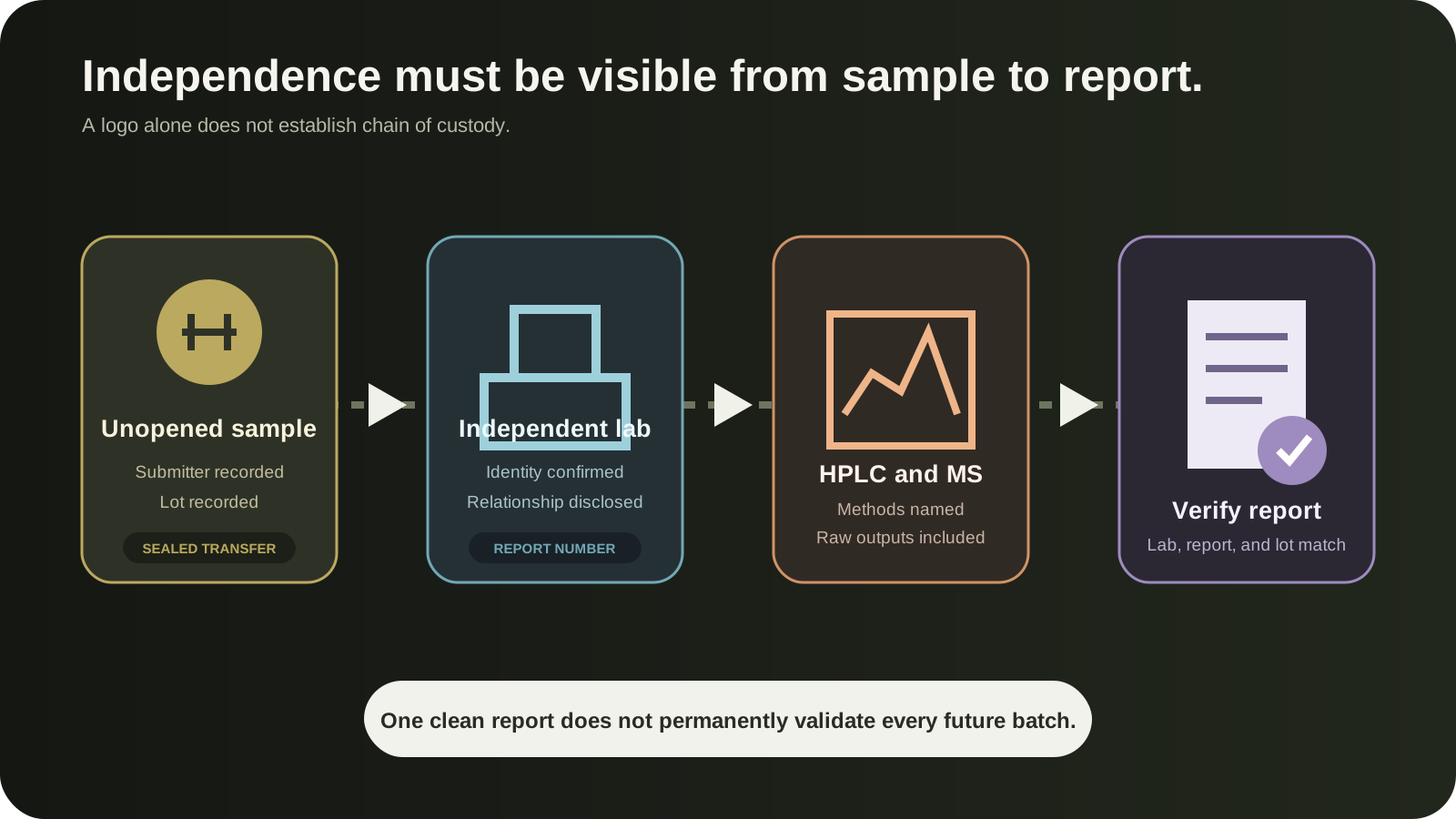
A credible independent lab should be easy to verify without relying on its logo. Look for a real business identity and contact channel, a report number the lab can confirm, the date the sample arrived, a description of chain of custody, the exact analytical methods used, and raw outputs such as the HPLC chromatogram and observed mass spectrum. The report should name the submitted sample without quietly presenting the vendor's label as proof of identity.
Independence also needs to be visible. The report should disclose who submitted and paid for the sample, and the laboratory should not share ownership or an undisclosed commercial relationship with the seller. Accreditation to a relevant testing standard can strengthen confidence, but accreditation alone does not prove that a specific report is genuine or that the tested vial matches the lot a buyer receives.
Community archives and report aggregators can help surface patterns, but they are starting points, not validators. Download the original report, confirm it with the issuing laboratory when possible, match the report number and lot number, and check that the chromatogram and mass result are present. No archive covers every batch, and one clean report never settles a vendor's quality permanently.
Red Flags That Should Slow You Down
The failure patterns in this market are not subtle once you know what to look for. A vendor publishing one generic 'example COA' instead of a per-batch certificate is telling you, in plain terms, that the document has nothing to do with the tested lot you will receive. A COA with an HPLC number but no mass spectrometry data leaves the identity question completely open. A chromatogram showing one flawless peak with zero labeled impurities is more likely fabricated than genuine, since real synthesis runs almost always leave some trace behind. And a price sitting at half the market rate for a peptide that requires expensive solid-phase synthesis is almost always a sign of cut corners somewhere in purification or testing.
Claims of 'pharmaceutical grade' or 'clinical grade' attached to products sold legally only as research chemicals are not harmless marketing flourishes, they can amount to regulatory violations. The FDA does not consider a peptide pharmaceutical-grade unless it is produced under current good manufacturing practice by a registered facility for an approved drug product. A research-chemical seller making a clinical-grade claim is either misinformed or hoping the buyer will not check. It also pays to look at the same product across multiple storefronts. If the photos, descriptions, and even the COA template are identical across half a dozen unrelated sites, you are looking at one underlying supplier reselling under different brand names.
Pattern visibility from aggregator sites matters here too. If you cannot find a single independent third-party report on any lot a vendor has sold in the past year, that absence is information in itself. Legitimate vendors generally accumulate at least a handful of independent reports over time simply because customers commission them and post the results publicly.
Storage and What Testing Cannot Tell You
A clean COA describes the tested sample at the time of analysis. It does not prove what is in a different vial or what remains after shipping and storage. Heat, moisture, light, oxygen, time, formulation, and repeated temperature changes can all matter, but the rate is sequence- and product-specific. A universal shelf life cannot be inferred from the purity number.
That is why a COA is necessary but not sufficient. Chain of custody, lot matching, packaging, shipping conditions, and a product-specific stability record matter too. Storage instructions should come from validated data for that peptide and formulation. A blanket rule such as 2 to 8 degrees Celsius for every lyophilized peptide, or one fixed lifetime after reconstitution, is not supported across the category.
A Simple Checklist Before You Order
None of the verification steps in this guide require lab equipment on your end. What they require is discipline about what evidence you demand, and the patience to compare that evidence across vendors before you buy. Here is the minimum sequence worth running before any research purchase.
First, request a lot-specific COA and confirm that the lot on the document matches the vial. Second, look for a named laboratory, test date, sample identifier, method details, chromatogram, and a mass result that matches the expected molecular species. HPLC wavelength, column, mobile phase, and mass-spectrometry method can vary, so one instrument setting should not be treated as universal. Third, verify the report directly with the issuing laboratory when possible. Fourth, check whether the document reports identity as well as purity. Fifth, treat price and community reports as prompts for more verification, not proof for or against the batch.
This sequence still cannot guarantee the contents of the vial you receive. The strongest check is independent testing of the same lot with documented chain of custody, and even that is a snapshot rather than a human-use safety determination. The checklist is useful because it exposes missing evidence; it does not convert an unapproved product into an approved one.
Quick answers
Common questions
What should a useful peptide COA include?
A useful report identifies the exact batch, the laboratory, the test dates, the methods used, and the results. A polished page without those connections is weak evidence.
What is the difference between HPLC and mass spectrometry?
HPLC helps assess separation and purity. Mass spectrometry helps confirm molecular identity. Strong documentation explains both instead of presenting one number as the whole quality story.
Does high purity mean a vial is sterile?
No. Purity, identity, sterility, and endotoxin are different questions. A strong result in one category does not prove the others.
Sources
- Absolute Quantitation of Coeluting Impurities in Peptide Drugs Using High Resolution Mass Spectrometry: Glucagon a Case Study in Pharmaceutical Development
- Identification and Quantification of Structurally Related Peptide Impurity in Linaclotide by Liquid Chromatography-High Resolution Mass Spectrometry
- ICH Q3A(R2) Impurities in New Drug Substances
- Falsification of biotechnology drugs: current dangers and/or future disasters?
- Stability of protein pharmaceuticals: an update
Educational content only. Not medical advice.