Peptide Guides
How Peptides Are Made and Why Purity Numbers Vary
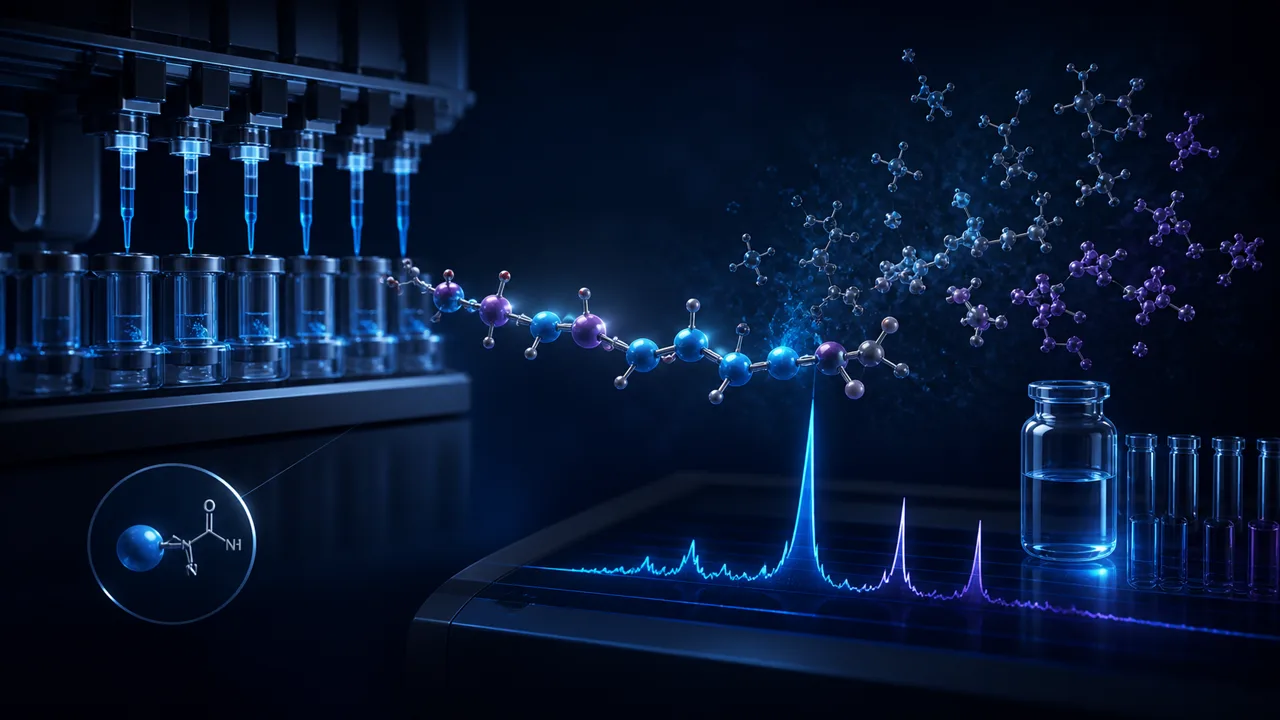
Synthetic peptides are assembled amino acid by amino acid using solid-phase synthesis, a process that never runs perfectly clean. This guide explains what a peptide is, how the build process works, why leftover byproducts show up in every batch, what a purity percentage really measures, and how labs verify quality with reference standards and combined testing methods.
Published by PeptideSchool Editorial Desk
What a Peptide Is
A peptide is nothing more than a short string of amino acids, the same molecular building blocks that make up every protein in the body. The real difference between the two categories comes down to length. Chains of roughly fifty units or fewer get called peptides. Once a chain grows longer than that and starts folding into a complex three-dimensional shape, it becomes a protein. That boundary is a convention people agreed on, not a hard scientific line, and plenty of molecules sit close enough to the cutoff that they get labeled either way.
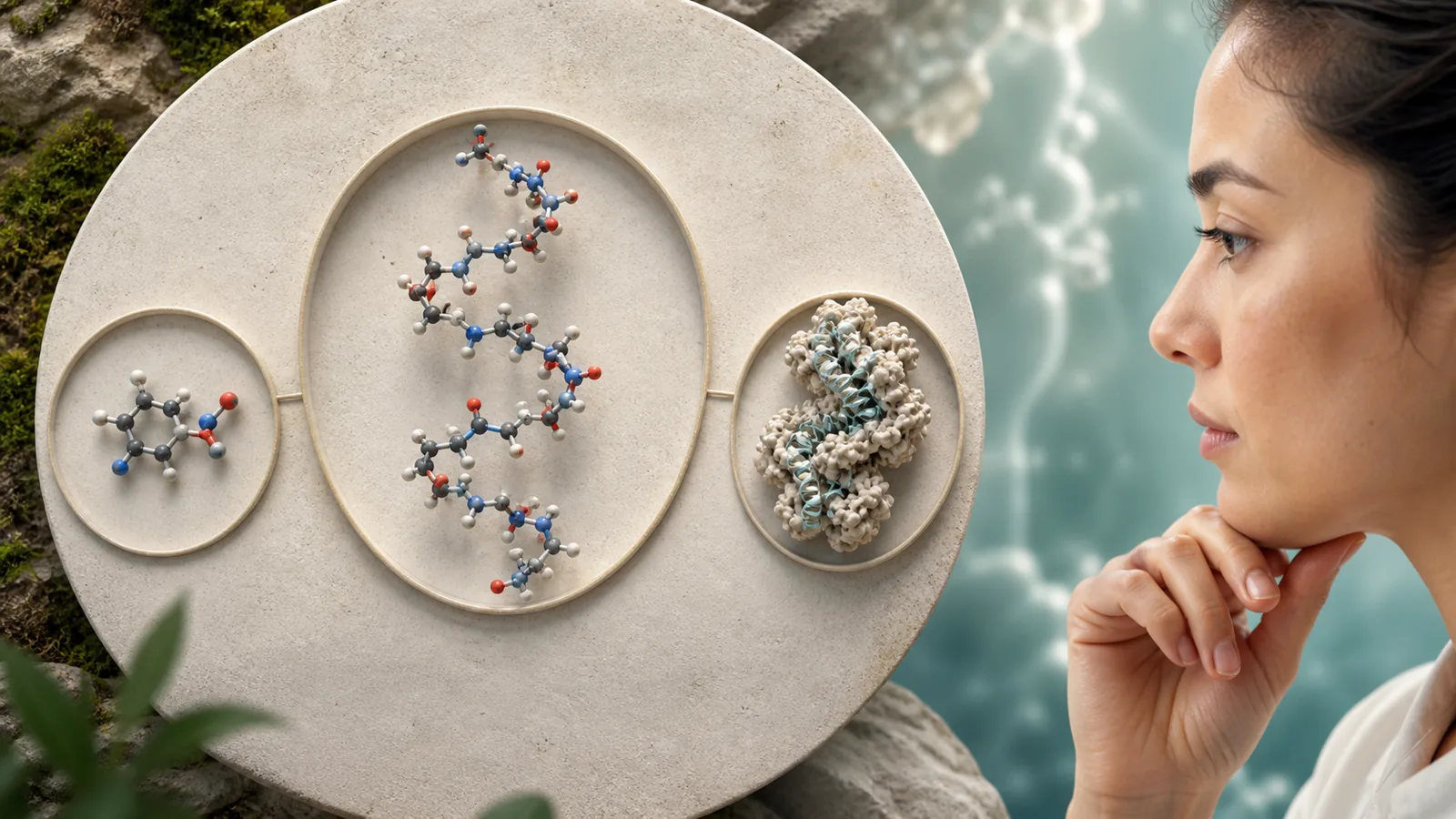
This size difference is not just trivia. It is the reason peptides can be manufactured at all. A full protein is too large and too dependent on its folded structure to assemble reliably with machinery. A short chain does not have that problem, since it can be built one unit at a time in a fixed, defined order. Chemists have known how to do this since the 1960s, when Bruce Merrifield published a method for growing a peptide chain while it stayed anchored to a solid support (PMID 4307033). That original work is the direct ancestor of nearly every synthetic peptide made today.
One thing worth holding onto before going further: a peptide is defined entirely by its exact sequence, meaning the specific amino acids in the specific order they appear. Swap even one unit and you get a different molecule, one that might behave completely differently or not function at all. Every question about purity discussed below really boils down to one thing, how many molecules in a given batch have the sequence they were supposed to have.
How a Peptide Gets Built
Nearly all synthetic peptides are produced through solid-phase peptide synthesis, shortened to SPPS. The process starts by chemically attaching the first amino acid to a tiny insoluble bead. From there, the chain grows while staying tethered to that bead, one amino acid added per cycle. Because the growing chain is stuck to something solid, everything unused or unreacted can simply be washed away between steps. That single trick is what makes the entire method practical at scale (PMID 4307033).
Every cycle follows the same basic pattern: a protective cap comes off the end of the chain, the next amino acid gets coupled on, and leftover reagents get rinsed out. Then the cycle repeats. Building a twenty-unit peptide means running through roughly twenty of these cycles, each one involving several distinct chemical steps. Modern synthesis machines automate this whole sequence, so a chain can be assembled without someone manually handling each individual step (PMID 31879919).
Once the chain reaches full length, it gets cleaved off the bead and the remaining protective groups are stripped away. What is left is a crude mixture that then goes through purification, most commonly chromatography, a technique that pushes a sample through a column so different components exit at different times. Whatever emerges at the expected timepoint gets collected, dried, and becomes the powder that ends up in a vial.
Why No Batch Comes Out Perfectly Clean
Every single coupling step in this process is a chemical reaction, and no chemical reaction runs at one hundred percent efficiency. A small portion of chains will miss an amino acid along the way or stop growing before they should. The end result is that every finished batch contains the intended peptide mixed with a family of near-identical relatives that differ by just one or two amino acids.
This is easy to underestimate. Say each coupling step succeeds 99 percent of the time, which counts as a strong result. Stretch that across a thirty-unit chain and those small failure rates start compounding. The share of chains that made it through every single step without a single misstep ends up noticeably below 99 percent. The rest are not gone, they are just not quite the molecule that was intended.
These byproducts have names that describe exactly how they went wrong. A deletion sequence skipped a unit somewhere along the chain. A truncated sequence stopped growing partway through and never finished. Others still carry a leftover protective group, or had a sensitive amino acid subtly damaged by the harsh chemistry involved in the process.
What makes these byproducts genuinely hard to deal with is how closely they resemble the target molecule. Researchers working with synthetic human C-peptide needed high-resolution mass spectrometry, paired with liquid chromatography, just to accurately identify and quantify the structurally related impurities in their samples (PMID 29862433). If separating these compounds demands that level of instrumentation in a research lab, it is not something a supplier can reasonably shrug off.
What a Purity Percentage Really Tells You
A purity figure represents the share of material that showed up as the target peak on a chromatogram, the graph produced when a sample gets separated through chromatography. It reflects what an instrument detected under one specific set of conditions. That is a genuinely useful number, but it is a measurement result, not a guarantee of what is in the vial.
When a certificate lists 99 percent purity, it typically means the target peak made up 99 percent of the total signal area under one particular testing method. That is a real and useful data point, but it is far narrower than most people assume when they read it.
Two gaps matter here. First, a purity number by itself says nothing about identity. It tells you one component dominated the sample, not that this component is the peptide named on the label. Confirming identity requires a separate test, usually mass spectrometry, checking that the molecular weight lines up with what the sequence predicts. Second, a testing method only catches what it was designed to catch, so an impurity that co-elutes with the target, meaning it exits the column at the same moment, can hide entirely inside the main peak.
Regulatory review of generic peptide products treats identity, content, and impurity profile as separate questions entirely, assessed through a combination of orthogonal methods rather than any single number (PMID 39089363). A percentage with no named method, no batch reference, and no supporting data behind it is a claim, not a real characterization.
Why the Leftover Fraction Matters
That remaining percent is not inert filler sitting around doing nothing. It consists of molecules similar enough to the target that they were built alongside it in the same reaction, and regulators evaluate some of them for immunogenicity, meaning the chance the immune system reacts to the substance. Their similarity to the real molecule is exactly what makes them worth checking.
The instinctive read on "1 percent impurity" is that some tiny irrelevant scrap tagged along. The full picture is less comforting. Those molecules are structurally related to the target peptide itself, because they came out of the same reaction using the same building blocks.
That closeness is why the topic gets serious formal attention. Peptide-related impurities are evaluated for immunogenicity, and the assessment frameworks built around synthetic peptide drugs exist precisely because impurities differing only slightly from the parent molecule can still get flagged by the immune system (PMID 37467878). Analysis of generic teriparatide products applied this exact kind of scrutiny to impurities found in real marketed drugs (PMID 41445733).
Two things are worth keeping separate here. This research applies to regulated pharmaceutical products manufactured under strict standards, where impurity profiles get documented and controlled. Material sold outside that regulatory system carries the same underlying chemistry without the same oversight. None of this says a specific impurity will cause harm in a specific person. It says the question is real enough that regulators demand an answer, which is a very different claim than a supplier just asserting a number.
How Quality Gets Verified
Genuine verification compares a batch against a reference standard, a thoroughly characterized sample that defines what the correct molecule is supposed to look like. Labs combine separation techniques with mass measurement to confirm identity and quantify whatever else is present. A certificate that skips named methods and a traceable standard tells you very little.
The reference standard anchors this entire system. It is a well-characterized batch that serves as the definition of correct material, and every other batch gets measured against it. Without one, a lab can report that two samples differ, but it cannot say which one is right. Building these standards is treated as foundational infrastructure for synthetic peptide quality, not a bureaucratic formality (PMID 36949371).
Layered on top of that reference point sits a set of complementary tests: chromatography to separate components and quantify their proportions, mass spectrometry to confirm the molecular weight matches the intended sequence, and additional checks for water content, residual solvents, and counter-ions. Regulatory guidance for generic peptides expects this full combination rather than reliance on any single test, since each method is blind to something the others catch (PMID 39089363).
For a reader trying to judge a product, the practical version comes down to a short list of questions. Does the certificate name the named methods used, or does it just report bare numbers? Is it tied to a specific batch, or is it generic across the whole product line? Was testing done by the seller itself or by an independent lab? A document reporting a percentage with no method, no batch, and no traceable standard is marketing material dressed up in the shape of a lab report.
Quick answers
Common questions
Why do peptide purity numbers vary?
Peptide synthesis builds a sequence step by step, and no chemical step is perfectly efficient. Incomplete sequences, side reactions, and handling can leave related material in the final batch.
Does a high HPLC purity number confirm the correct molecule?
Not by itself. HPLC describes separation and relative purity. Identity requires another method, commonly mass spectrometry, plus a clear connection to the tested batch.
Why does the remaining fraction matter?
The material outside the main peak can include truncated sequences, modified residues, or other synthesis byproducts. A percentage is more useful when the testing method and impurity profile are clear.
Sources
- Solid-phase peptide synthesis
- Automated solid-phase peptide synthesis
- Identification and accurate quantification of structurally related peptide impurities in synthetic human C-peptide by liquid chromatography-high resolution mass spectrometry
- Reference standards to support quality of synthetic peptide therapeutics
- Analytical considerations for characterization of generic peptide product: a regulatory insight
- Immunogenicity risk assessment of synthetic peptide drugs and their impurities
- Immunogenicity risk assessment of peptide-related impurities identified in generic teriparatide products
Educational content only. Not medical advice.