Peptide Guides
How Peptide Reconstitution Math Works: A Step-by-Step Guide
This guide explains the math behind reconstitution and the handling concepts that appear in product instructions. It shows how vial amount and diluent volume determine concentration, how U-100 syringe units map to milliliters, and which checks catch unit errors. The correct diluent and mixing method still come from the exact product or pharmacy instructions.
Published by PeptideSchool Editorial Desk
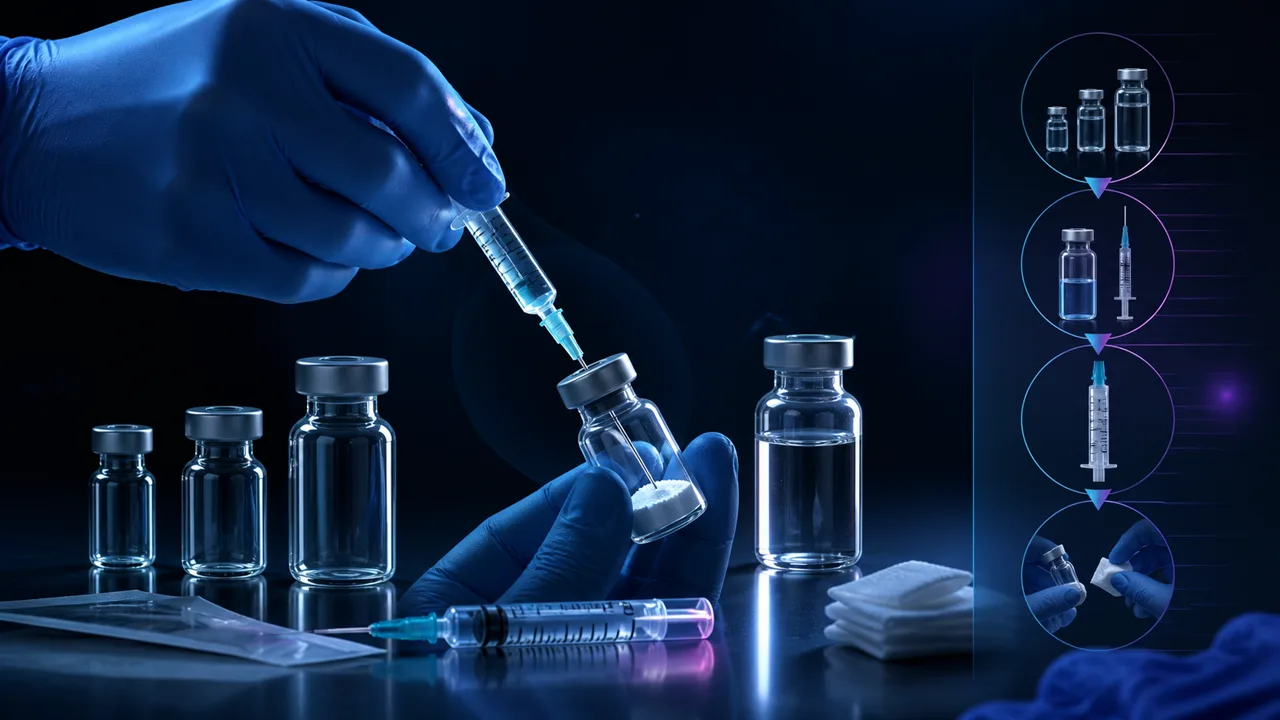
What This Guide Covers
This page includes the same core math a reconstitution calculator uses, so you can get the answer here and understand it. You need only three numbers: the amount named on the vial, the volume of diluent added, and the amount you want to convert. The worked examples below show every unit change instead of hiding the calculation behind a button.
Some peptide products are supplied as lyophilized powder because a dry formulation can slow degradation. The correct diluent, volume, mixing method, storage range, and in-use time are product-specific. Use the manufacturer or dispensing pharmacy instructions for those choices rather than assuming every vial uses bacteriostatic water.
Nothing in this guide tells you what dose to use or how much to take. That decision belongs to a licensed clinician. What follows is the mechanics: the equipment, the math, and the handling.
What a Reconstitution Setup Includes
A reconstitution setup starts with the exact product instructions, the supplied or specified diluent, a syringe that can measure the required volume, a clean work area, alcohol swabs when the instructions call for them, a sharps container, and a label for the date and final concentration. Not every product uses the same water, syringe, or repeated-access vial.
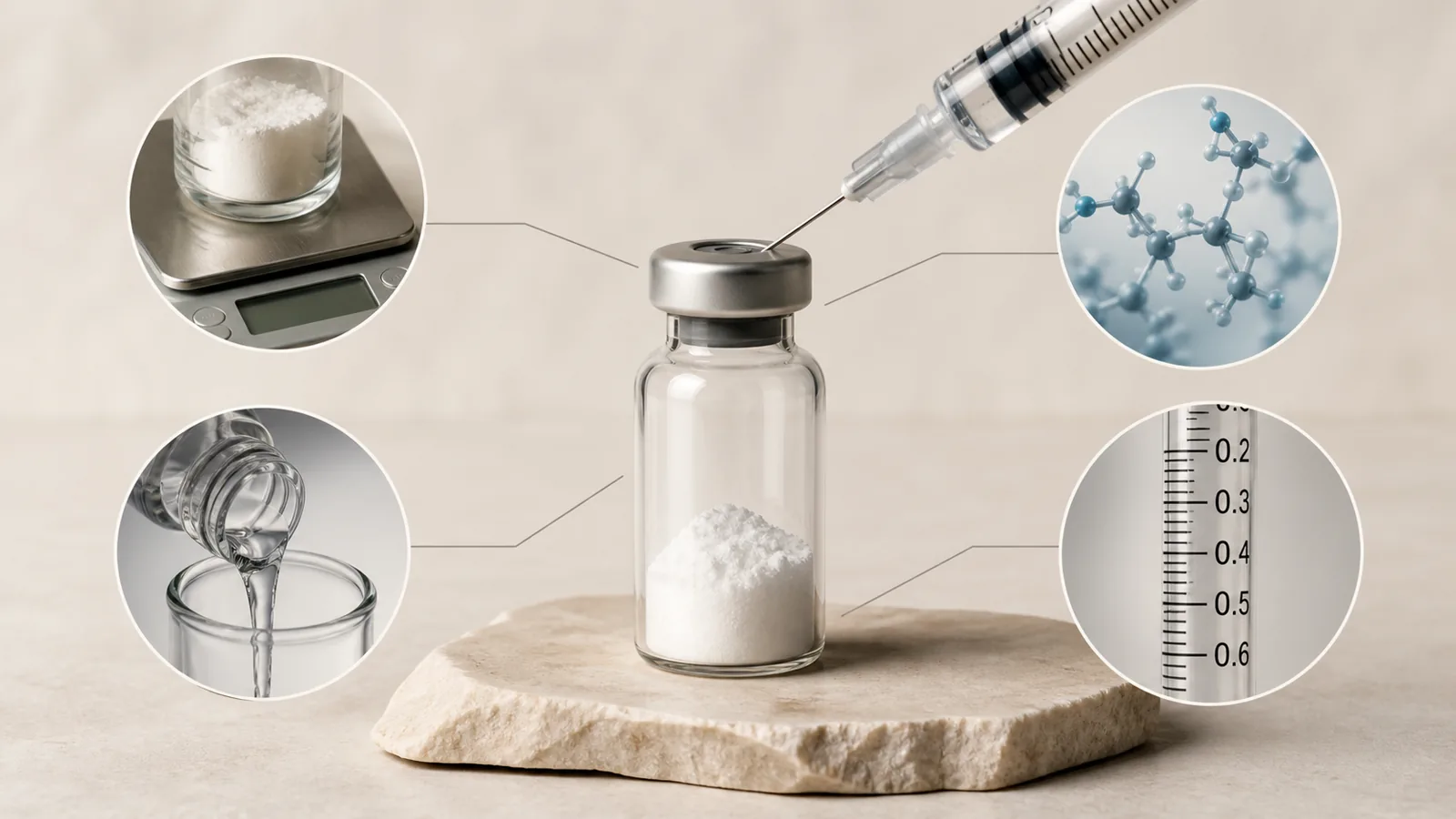
Bacteriostatic Water for Injection contains 0.9% benzyl alcohol and is packaged for repeated withdrawal. Sterile Water for Injection has no antimicrobial preservative. Neither is interchangeable by default with saline, a manufacturer-supplied diluent, or another vehicle. The product instructions determine the correct choice.
The math starts only after the vial amount and diluent volume are known. Supplier documentation and clean handling answer different questions: analytical records concern identity and quality claims, while aseptic handling reduces contamination during preparation.
How Syringe Units Work
A standard insulin syringe holds one milliliter split into 100 marks, so each mark equals 0.01 milliliter. That is the one fixed number in this entire process. Everything else you calculate follows from the ratio of powder to water.
Concentration is just milligrams of peptide divided by milliliters of water. Since each unit mark is one hundredth of a milliliter, multiplying that concentration in mg/ml by 10 gives you micrograms per unit mark, which is the figure the calculator displays. Adding more water never changes how much peptide sits in the vial. It only spreads that same quantity across more liquid, which shifts where a given amount lands on the syringe barrel.
A calculator built around these two relationships lets you pick a vial size and a water volume and immediately see the resulting concentration, a drawn syringe scale to match, and the five stages of the reconstitution process itself laid out.
Calculate Concentration and Syringe Units Here
Step 1: concentration in mg/mL equals vial amount in mg divided by water volume in mL. A 10 mg vial mixed with 3 mL produces 3.33 mg/mL. Step 2: convert the amount you are checking into milligrams. For example, 250 mcg equals 0.25 mg. Step 3: volume in mL equals the amount in mg divided by concentration in mg/mL. In this example, 0.25 divided by 3.33 equals 0.075 mL. Step 4: on a U-100 syringe, units equal mL multiplied by 100, so 0.075 mL equals 7.5 units.
Use this compact formula: syringe units = desired amount in mg divided by vial concentration in mg/mL, multiplied by 100. If your amount is in micrograms, divide by 1,000 first. This is a volume conversion only. It does not decide what amount is appropriate.
| Vial | Water added | Concentration | 0.10 mg converts to | 0.25 mg converts to | 0.50 mg converts to |
|---|---|---|---|---|---|
| 5 mg | 2 mL | 2.5 mg/mL | 4 units | 10 units | 20 units |
| 10 mg | 2 mL | 5 mg/mL | 2 units | 5 units | 10 units |
| 10 mg | 3 mL | 3.33 mg/mL | 3 units | 7.5 units | 15 units |
Run a three-point error check before trusting any result. Confirm that milligrams and micrograms were not mixed, confirm the syringe is U-100, and multiply the final mL result by the concentration to see whether you get back to the original amount. If the reverse calculation does not match, start over.
The Mistakes That Keep Showing Up on Social Media
The common errors are mixing milligrams with micrograms, reading a U-100 syringe as though “units” were a drug dose, using a diluent not named in the instructions, reusing a syringe, contaminating a stopper or needle, and applying a forceful mixing method when the formulation calls for gentle handling.
Agitation can increase aggregation in some protein and peptide formulations, but the correct method is still product-specific. Follow the supplied instructions. If they say to swirl gently, do not shake. If the directions are missing or the solution does not clear as described, stop rather than improvising.
A preservative lowers microbial growth risk in a multi-dose container; it does not make repeated entry risk-free and it does not extend chemical stability. Use a new sterile syringe for each entry and follow the labeled or pharmacy-assigned in-use limit.
What Bacteriostatic Water Is
Bacteriostatic Water for Injection is sterile water with 0.9% benzyl alcohol. The preservative is designed to inhibit microbial growth after repeated withdrawals from its own multi-dose container. It does not sterilize another product and does not prove that a reconstituted peptide remains stable for a particular number of days.
Sterile Water for Injection contains no antimicrobial preservative and is labeled as a single-dose container. Some products instead specify saline or a supplied diluent. Use only the diluent named for the exact product or by the dispensing pharmacy.
Once water is added, formulation-specific chemical and physical stability still controls the usable period. A separate storage decision guide can help organize the label, date, and exposure history, but it cannot invent a shelf life when product data is missing.
The Sterility Checklist Before You Start
Sterile compounding standards are built around careful preparation, not speed. Clean hands, disinfected stoppers, a fresh sterile syringe, and needle tips that never touch anything non-sterile. If a needle does touch a non-sterile surface, the standard move is to replace it, not try to salvage the step.
Treat reconstitution as something that should feel slow and organized. Wash your hands. Disinfect the peptide vial stopper. Disinfect the bacteriostatic water stopper. Use a new sterile syringe. Keep the needle tip away from counters, fingers, and packaging at every point. Compendial sterile compounding standards rest on exactly this logic: surface disinfection, aseptic handling, and defined limits on how long a preparation stays usable once it is made.
Set up your work area before you open anything. Have your alcohol pads, sharps container, the vial, the water, the syringe, and a label all within reach. Write the reconstitution date, the water volume you used, and the resulting concentration directly on the vial or its storage bag, so you are never trying to reconstruct that arithmetic from memory a week later.
A Concentration Math Sanity Check
The calculator turns vial size and water volume into a concentration, but the underlying idea is simpler than the math looks: the milligrams inside the vial never change just because you add water. More water only changes how many milligrams sit in each milliliter, which shifts where a given quantity lands on the syringe scale.
The single idea that prevents most calculation errors is that adding water does not add or remove any peptide. A vial contains what it contains, full stop. Water changes concentration, concentration changes what volume corresponds to a given quantity, and that changes where it falls on the syringe barrel. Nothing about the actual contents of the vial changes at any point.
If a result looks off, stop and re-enter the numbers rather than trying to talk yourself into it. Most mistakes here come from mixing up milligrams, micrograms, milliliters, and syringe units, which are four different scales that all end up sitting in the same sentence. Treat vial size, water volume, and concentration as three separate numbers and check each one on its own instead of trusting a single mental shortcut.
What to Do After Reconstitution
Let the powder finish dissolving before you draw anything out of the vial. Gentle swirling is not shaking: the goal is to wet the cake and let it dissolve without foaming it up. Inspect the solution for particles, cloudiness, or any unexpected color change before you store it. A well-made lyophilized formulation should reconstitute into a clear solution, and slow or incomplete dissolving is itself a signal worth paying attention to rather than ignoring.
Store the vial according to that specific peptide's stability profile and the water you used. Keep it upright where you can, minimize how long it sits at room temperature, and resist the urge to keep handling it just to check on it. Every access is another chance for warming, contamination, or a label smudging off.
Freezing a reconstituted solution is not a free way to extend its life either. Freezing exposes proteins and peptides to concentration effects, pH shifts, and ice interfaces, all of which are themselves destabilizing stresses. How well a formulation survives that depends heavily on its exact composition.
If the arithmetic ever feels unclear, stop before you draw anything. Go back and check vial size, water volume, and concentration as three separate numbers. If it still does not add up, ask a pharmacist or clinician rather than guessing your way through it. If you are new to this whole area, a peptide basics course covers how peptides work from the ground up.
Quick answers
Common questions
What determines concentration after reconstitution?
Concentration comes from the amount in the vial and the total volume of diluent. The article shows how those two inputs connect before any syringe-unit conversion is made.
How do U-100 syringe units relate to milliliters?
A U-100 scale contains 100 units in 1 mL. That makes 10 units equal to 0.1 mL, but the amount represented by that volume still depends on the concentration in the vial.
Can one diluent or storage rule be used for every product?
No. The math can be checked consistently, but the correct diluent, handling method, and storage instructions must come from the exact product or pharmacy documentation.
Sources
- Stability of protein pharmaceuticals: an update
- Instability, stabilization, and formulation of liquid protein pharmaceuticals
- Antimicrobial preservative use in parenteral products: past and present
- Rational design of stable lyophilized protein formulations: some practical advice
- Physical stability of proteins in aqueous solution: mechanism and driving forces in nonnative protein aggregation
- Protein stability during freezing: separation of stresses and mechanisms of protein stabilization
- A specific molar ratio of stabilizer to protein is required for storage stability of a lyophilized monoclonal antibody
Educational content only. Not medical advice.