Peptide Guides
Peptide Storage Decision Guide: Label, Date, and Exposure Check
There is no universal shelf life for a peptide. This guide explains common degradation pathways and turns the product label, expiration or beyond-use date, and exposure history into a green, yellow, or red handling decision.
Published by PeptideSchool Editorial Desk
Why storage instructions are product-specific
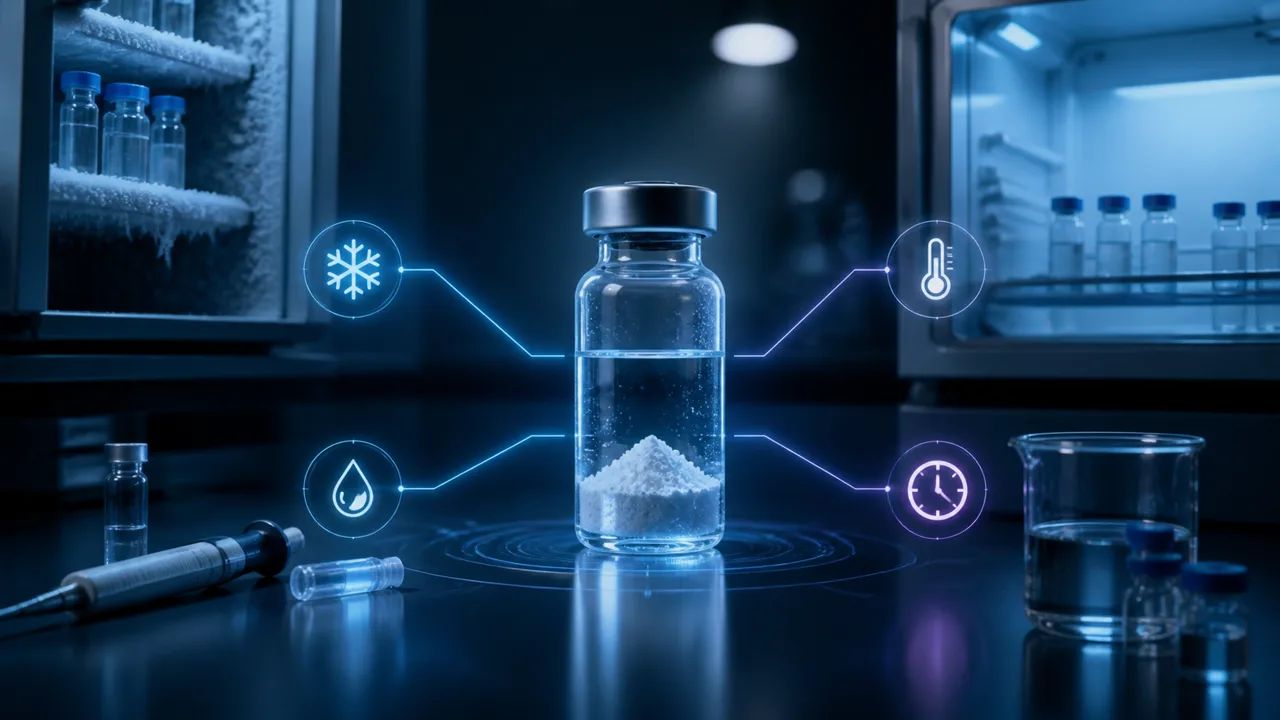
Peptides can change through hydrolysis, oxidation, deamidation, and physical aggregation. Temperature, light, water, pH, oxygen, formulation ingredients, and the container can all change the rate. That is why stability data belongs to a finished formulation, not to the peptide name alone (PMID 20143256).
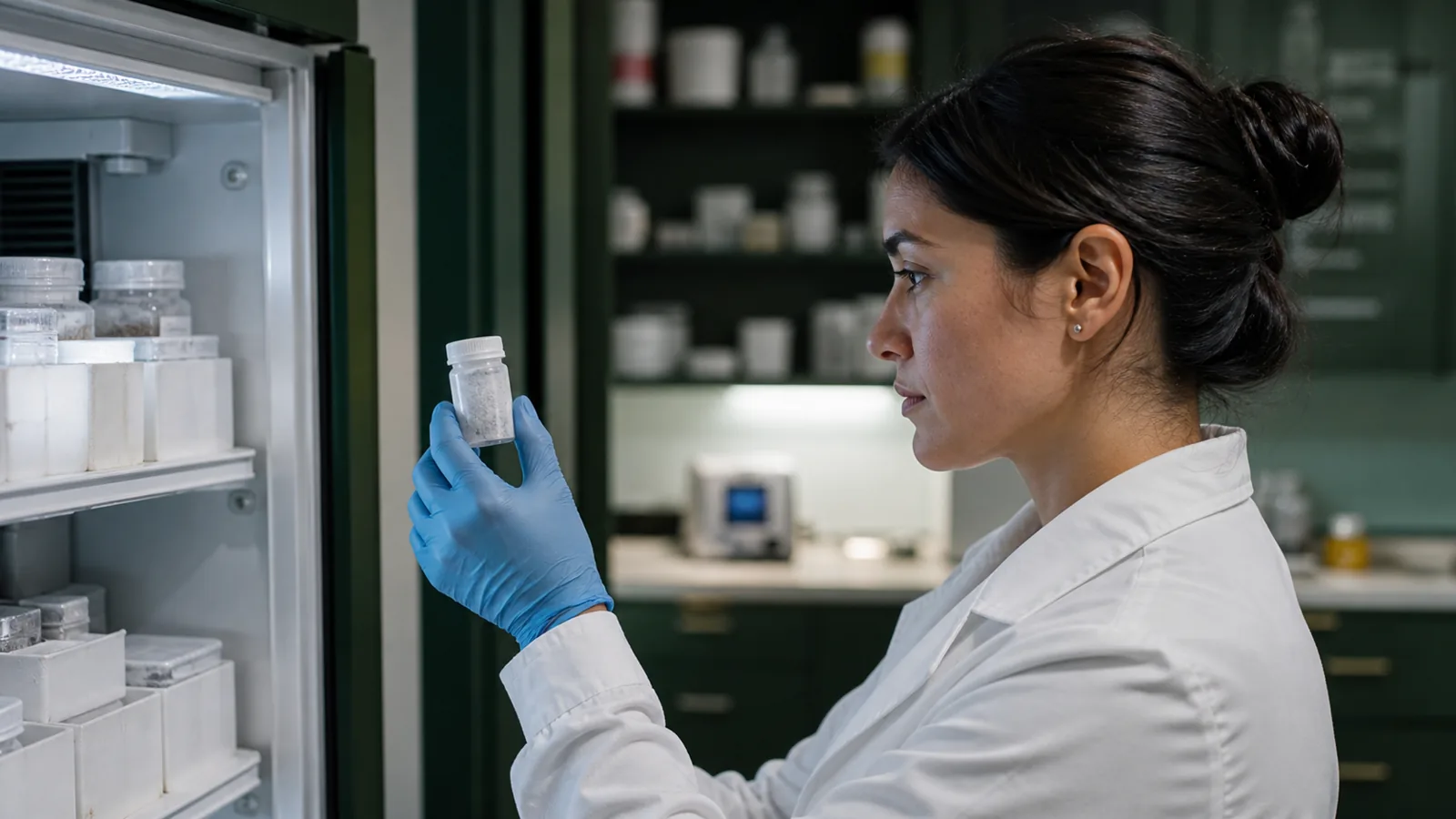
A vial can look normal even when potency or purity has changed, so appearance is only one check. The usable limit comes from the manufacturer’s label, pharmacy beyond-use date, or product-specific stability data. A generic online countdown cannot replace those instructions.
Dry formulations are often more stable than solutions because removing water slows several degradation pathways. “Often” is the important word. Lyophilization does not make every powder stable at room temperature, and reconstitution does not create one universal countdown.
The three things that destroy peptide stability
Heat can accelerate chemical degradation, but the rate depends on the molecule and formulation. A common rule of thumb says some reactions speed up as temperature rises, yet that rule cannot calculate the remaining potency of a vial or prove that one short excursion caused a specific loss (PMID 20143256).
Light can drive photo-oxidation in susceptible amino acids and formulations, which is why many labels specify protection from light (PMID 22083792). Follow the product’s packaging and label rather than assuming every peptide has the same light sensitivity.
Contamination is the third. Once a peptide is reconstituted, the solution becomes a nutrient-rich environment. If bacteria get introduced during a sloppy reconstitution, they multiply, produce endotoxins, and break the peptide down from the inside. This is why sterile technique during mixing matters as much as temperature control afterward. If you have not gone through the reconstitution process yet, it is worth reading a step-by-step guide on the math and sterile technique before pulling out a vial, and a reconstitution calculator can handle the dilution math so you are not eyeballing it.
Powder versus liquid: why the stability gap is so wide
Freeze-drying, or lyophilization, removes most of the water that drives hydrolysis. That is why a dry formulation is usually more stable than the same molecule in solution, but it does not create one universal shelf life. Formulation ingredients, residual moisture, container closure, manufacturing controls, and the individual sequence all matter (PMID 10460913).
The water used for reconstitution changes microbial control, not the molecule's verified chemical expiration date. Bacteriostatic water contains 0.9% benzyl alcohol, while sterile water has no antimicrobial preservative. A formulation study found that benzyl alcohol could affect aggregation in a reconstituted protein, which is a useful reminder that a preservative is not a blanket stability guarantee (PMID 15614819).
Use the product label, manufacturer stability data, or a dispensing pharmacy's beyond-use date as the time limit. If none exists, this guide cannot responsibly invent one from the peptide name alone. A date repeated in a forum is not a substitute for formulation-specific testing.
Why smaller peptides hold up better
Sequence length can influence the number of chemical and physical failure points, but size alone does not predict a usable shelf life. Amino-acid composition, pH, concentration, excipients, oxidation sensitivity, and aggregation behavior can matter more than the raw residue count.
LL-37, for example, has documented aggregation behavior in aqueous systems (PMID 14567625), while much smaller peptides can still be unstable if their sequence or formulation is oxidation-prone. Treat size as one clue for a formulation scientist, not as a countdown clock for a vial.
Handling real-world temperature swings
Most storage advice assumes ideal, lab-clean conditions. Real life is messier. Vials sit in shipping boxes in transit, get left on a counter while you search for supplies, or ride in and out of a freezer that gets opened multiple times a day. A single brief warm-up is not the same as weeks of sustained heat, but these little excursions add up over time.
Lyophilized powder tolerates this kind of rough handling far better than reconstituted liquid, simply because there is so little water around to drive hydrolysis. Once you add water, the peptide becomes much more sensitive to temperature swings, contamination risk, and its own inherent chemistry. The practical goal is to minimize thaw-warm-refreeze cycles and keep the vial in its most stable state as much of the time as you can. Label the reconstitution date the moment you mix it. Do not trust your memory a week later.
Use the Storage Decision Calculator
This calculator gives a handling decision, not an invented potency percentage. Start with four inputs: the form (dry or reconstituted), the official storage instruction, the labeled expiration or pharmacy beyond-use date, and any exposure event such as heat, freezing, light, contamination, or an unknown period outside controlled storage.
Green means every condition still matches the official instruction, the date has not passed, and no contamination or appearance change occurred. Keep following the label and record each exposure. Yellow means the date is still open but an excursion occurred, the storage history is incomplete, or the label is unclear. Quarantine the vial and ask the manufacturer or dispensing pharmacy whether stability data covers that exact excursion. Red means the labeled date has passed, sterility may have been broken, the solution changed color or clarity, particles appeared, or the exposure cannot be reconstructed. Do not use a calculator to talk yourself around a red result.
A quick worksheet makes this concrete. Write: form, official temperature range, protect-from-light instruction, expiration or beyond-use date, date first opened or reconstituted, longest known excursion, number of freeze-thaw cycles, and any visual change. If every field is known and within instructions, the result is green. One unknown or excursion is yellow. A passed date, contamination event, or appearance change is red.
No equation can recover missing stability data. Temperature rules such as a reaction speeding up with heat describe general chemistry, not the remaining potency of a specific vial. The calculator is useful because it prevents false precision and tells you exactly which fact is missing.
Daily habits that protect your peptides
Keep the product within the labeled temperature range and protected from light when the label requires it. Do not freeze a liquid unless the instructions explicitly allow freezing. When mixing is required, follow the product instructions for whether to swirl, roll, or use another method rather than applying one rule to every formulation.
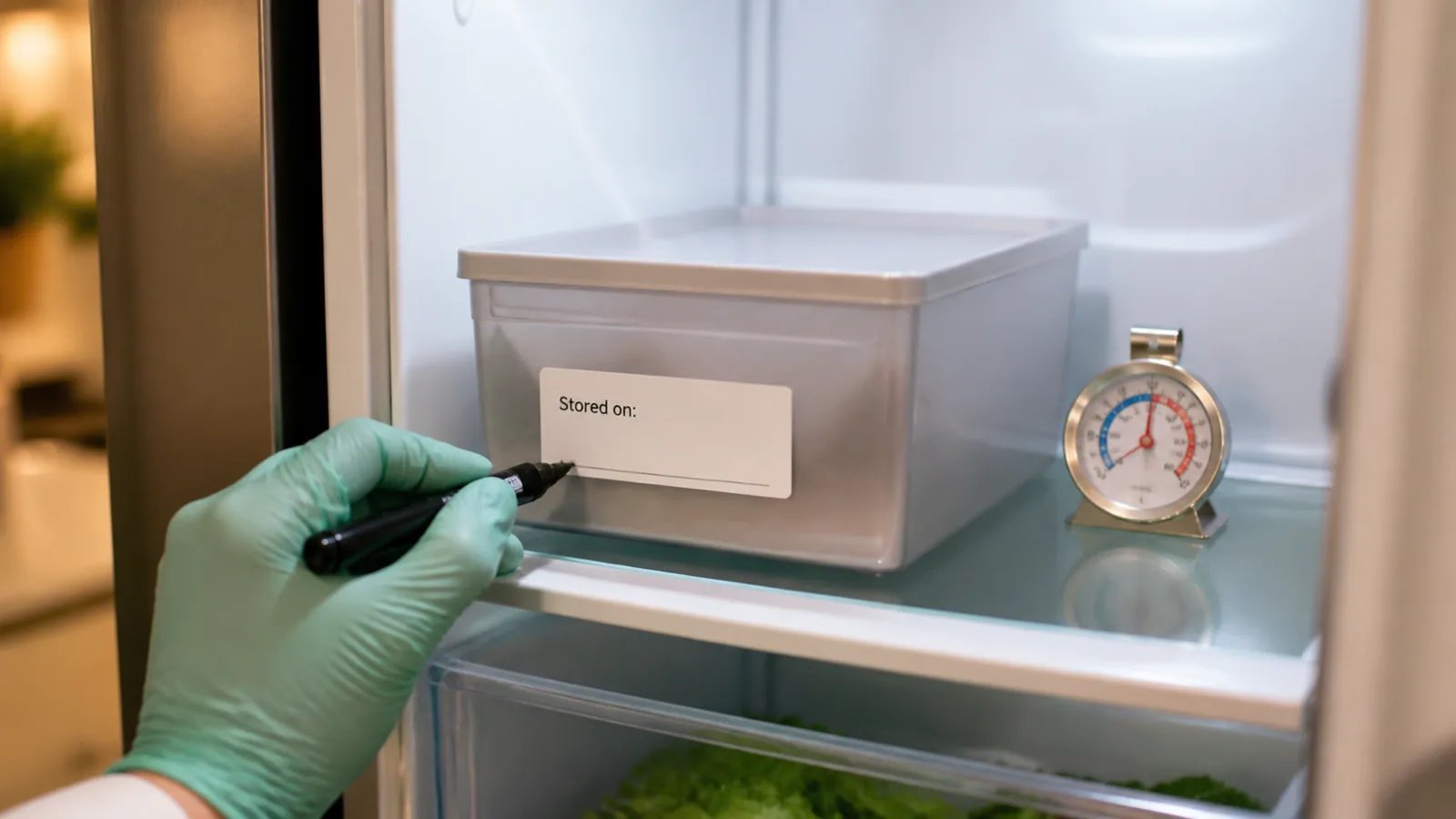
If you need to access a vial repeatedly through the day, get your supplies organized before you open the fridge or freezer door, so the vial spends less time warming up while you hunt for an alcohol swab. And do not rely on how the solution looks as your only check. Cloudiness, floating particles, or a color shift are clear red flags, but plenty of degradation, especially oxidation and deamidation, happens invisibly, with no visual change at all. Time, temperature discipline, sterile technique, and knowing your reconstitution date are far better safeguards than eyeballing the vial.
Why labeling every vial matters
A simple label solves a surprising number of problems at once. Write down the peptide name, vial strength, reconstitution date, how much water you used, the resulting concentration, and where it is stored. If you have several vials going at once, separate them into individual bags or add clear labels so a nearly empty vial never gets mistaken for a fresh one. For a sense of what a legitimate supplier should be providing on their documentation in the first place, it is worth reviewing a guide on vetting research peptides by COA and HPLC results.
When sterility is in question, be conservative. If the stopper got touched by something unclean, the vial sat somewhere warm for an unknown stretch, or the solution's appearance changes even slightly, do not try to save it by tossing it back in the fridge. These calculators and guidelines estimate stability under known conditions. They cannot undo contamination or confirm that potency is intact once something has gone wrong.
The same logic applies when traveling. Protect the cold chain, limit how often the vial gets handled or exposed to room air, and keep a record of any time it spent outside ideal storage. Treat unknown exposure as a real quality concern rather than something to shrug off. Conservative handling keeps your options open and takes the guesswork out of the decision, and labeling everything is what makes that possible in the first place. A dedicated guide on traveling with peptides covers TSA rules, cold-chain packing, and international regulations if you need the full checklist.
Quick answers
Common questions
Is there one standard shelf life for every peptide?
No. Stability depends on the product, formulation, label instructions, expiration or beyond-use date, and what happened during storage and handling.
What information matters most when checking storage?
Start with the product label, the relevant date, and the exposure history. Temperature, light, moisture, repeated handling, and time in solution can all change the decision.
Does refrigeration create a universal storage timeline?
No. Refrigeration can slow some degradation pathways, but it does not replace product-specific instructions or create the same usable timeline for every formulation.
Sources
- Stability of protein pharmaceuticals: an update
- Forced degradation of therapeutic proteins
- Instability, stabilization, and formulation of liquid protein pharmaceuticals
- Effects of benzyl alcohol on aggregation of recombinant human interleukin-1-receptor antagonist in reconstituted lyophilized formulations
- Physical stability of proteins in aqueous solution: mechanism and driving forces in nonnative protein aggregation
Educational content only. Not medical advice.