Peptide Guides
Peptide COA Safety Checker: An Eight-Question Review
A Certificate of Analysis can help you test a supplier’s documentation, but it cannot prove that a vial is safe or authentic. This guide shows how to match a COA to a batch, check the laboratory and methods, and grade the paperwork without confusing a polished document with product approval.
Published by PeptideSchool Editorial Desk

Why a COA matters, and what it cannot prove
A Certificate of Analysis, or COA, is one useful layer in evaluating a peptide product. It can report identity, purity, and selected contamination testing for a named batch. It cannot prove that the document is authentic, that the vial came from the tested batch, or that the product was manufactured and stored correctly after testing. Treat it as evidence to verify, not as a seal of safety.
If you are still working out whether peptides fit your situation at all, that is a separate and earlier question worth settling first before you get into sourcing mechanics.
A COA comes from a testing lab and typically covers HPLC purity analysis, mass spectrometry identity confirmation, and endotoxin testing. Without it, you are simply trusting a label. And that trust gap is not hypothetical. A published review of impurities found in peptide medicines catalogs exactly what tends to show up alongside the intended molecule when peptides are made through solid-phase synthesis: deletion and insertion sequences from incomplete coupling steps, racemized residues and the mirror-image compounds they create, oxidized side chains, leftover protecting-group adducts, dimers, larger clumped molecules, and residual trifluoroacetate salts left over from purification. The same review points out these impurities can throw off conclusions in early research work, not just in finished commercial product. That is exactly the blind spot a buyer with no COA is standing in.
Think of an eight-question review as the fastest way to turn a vague gut feeling about a supplier into a graded assessment, A through F, showing exactly where they meet the bar and where they fall short. One caveat worth holding onto the whole way through: the grade describes the paperwork. It is not a verdict on the actual vial sitting on your desk. Good documentation lowers your risk. It does not eliminate it.
What a Real COA Contains
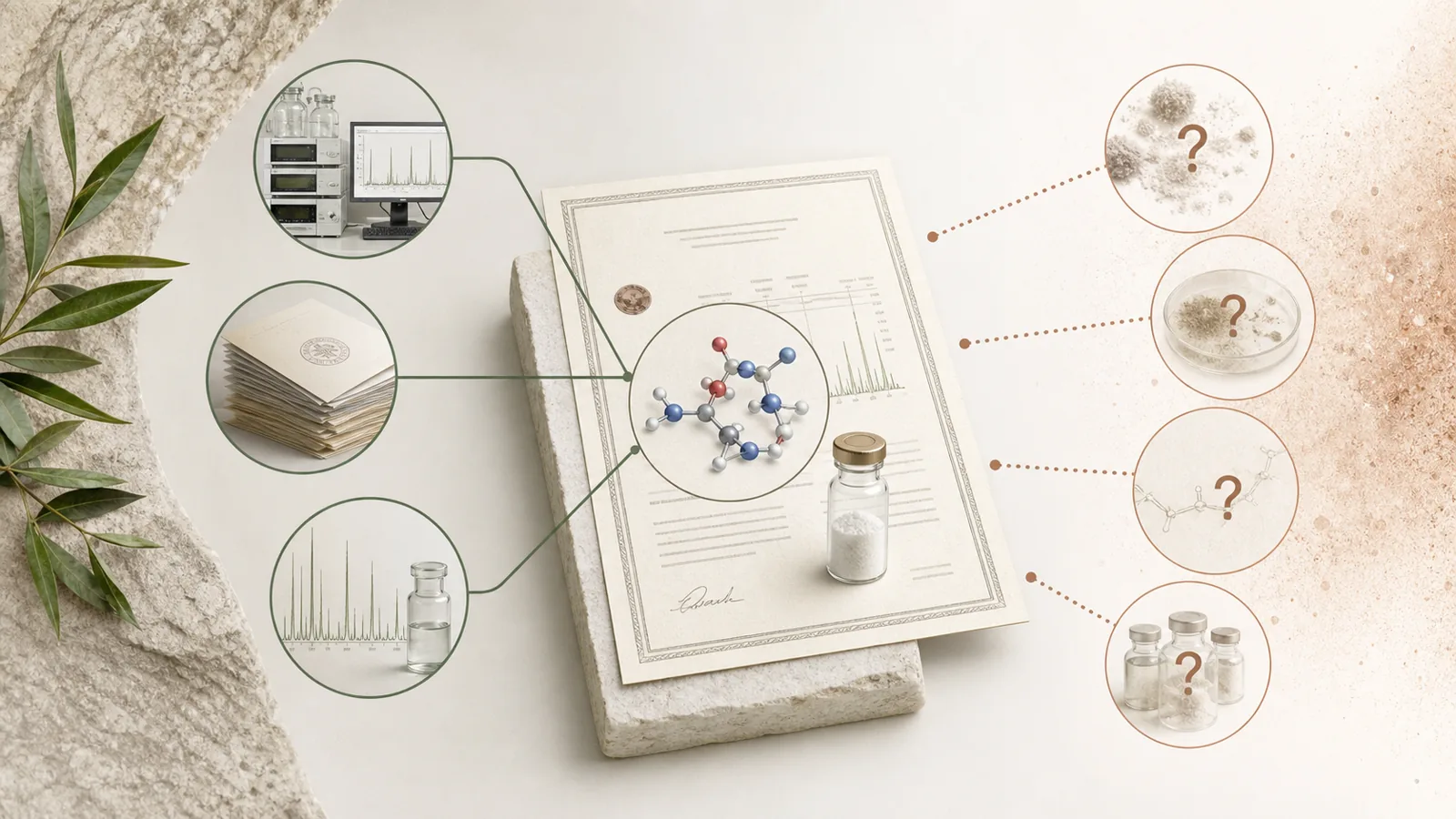
A complete COA follows a fairly predictable structure across seven blocks: lab identification, sample and batch identification, HPLC purity, mass spectrometry identity, endotoxin results, sterility results, and batch dates. Each block is answering a different question, and if one is missing, that absence tells you something on its own.
Laboratories format these reports differently, so do not expect every COA to look identical. But all seven categories of information should be findable somewhere on a legitimate document. The fastest way to catch a problem is to read the blocks in the order they matter most. Start with the header, since it tells you who ran the testing and whether that lab has any independence from the seller. Move to the sample block, which tells you which batch was tested. Then get to the analytical results, which tell you what the testing found.
Here is the catch: if any one of those three layers is missing, the other two cannot make up for it. An eye-popping 99% purity figure attached to no batch number is describing a peptide you cannot prove you ever received.
The Red Flags Worth Worrying About
Not every warning sign carries equal weight. A batch mismatch or a document tied to no identifiable laboratory breaks traceability and should stop the review. Missing mass-spectrometry, chromatographic, endotoxin, or sterility information matters when the product specification or seller claim requires that test. Evaluate the COA against the claim being made rather than applying one universal panel to every product.
The strongest red flags are missing traceability and missing analytical evidence: no batch-specific COA, a lot number that does not match the product, an unidentified or unverifiable laboratory, no suitable identity test, no method behind the purity result, and no sterility or endotoxin result when those claims are made. The appropriate methods and acceptance limits depend on the product specification. A low price or a small online footprint may prompt more questions, but neither proves poor quality by itself.
Endotoxin testing deserves its own callout because it is the flag people wave away most often. Pyrogens, the fever-triggering contaminants that include bacterial endotoxin, survive standard sterilization procedures. Once they are in the bloodstream, reactions can range from fever all the way to septic shock. The LAL test that shows up on a COA detects endotoxin specifically, which is genuinely useful, but it is narrow. A passing LAL result does not rule out other, non-endotoxin pyrogens. That is exactly why sterility testing shows up as its own separate line item on a proper COA rather than getting folded into the endotoxin result.
Verifying a COA Without a Chemistry Degree
You do not need a lab background to do this well. Start with traceability. The peptide name, batch number, test date, and supplier label should all point to the exact same lot. If the product page lists one lot number and the COA shows a different one, that document is closer to generic marketing filler than proof about the actual vial in front of you.
From there, check whether the document shows real test outputs instead of just assertions. A purity percentage with no HPLC chromatogram attached is a claim, nothing more. An identity claim with no mass spectrometry behind it is incomplete. For anything meant to be sterile or injectable, endotoxin and sterility data need to be present, not just implied by a vague phrase like 'lab tested.'
It also helps to understand that a purity number is a property of the testing method, not purely a property of the peptide itself. A study comparing five different chromatographic systems on cationic peptides found that the column choice, the acidic modifier used, and even the column temperature all changed the apparent purity result, and that a poorly chosen system can produce misleading numbers for basic peptides. The same research showed that adding a mass spectrometry detector lets a lab identify both the peptide and its impurities, and confirm whether a peak that looks pure is. That is exactly why '98% by HPLC' with no method stated is weaker evidence than the number alone suggests, and why mass spectrometry is not some optional extra you can skip.
This is also the whole reason pharmacopoeial standards exist. USP General Chapter 621 and Ph. Eur. 2.2.29 lay out how chromatography should be performed and reported, and USP General Chapter 85 covers the bacterial endotoxins test specifically. A COA that names the method it followed is telling you something meaningful that a COA reporting a bare, unexplained number is not. One more detail worth knowing: endotoxin acceptance limits are calculated from the maximum dose per kilogram of body weight, not from a single fixed number per milligram of peptide. A limit quoted with no reference to dose does not tell you much on its own.
Why Independent Testing Changes the Math
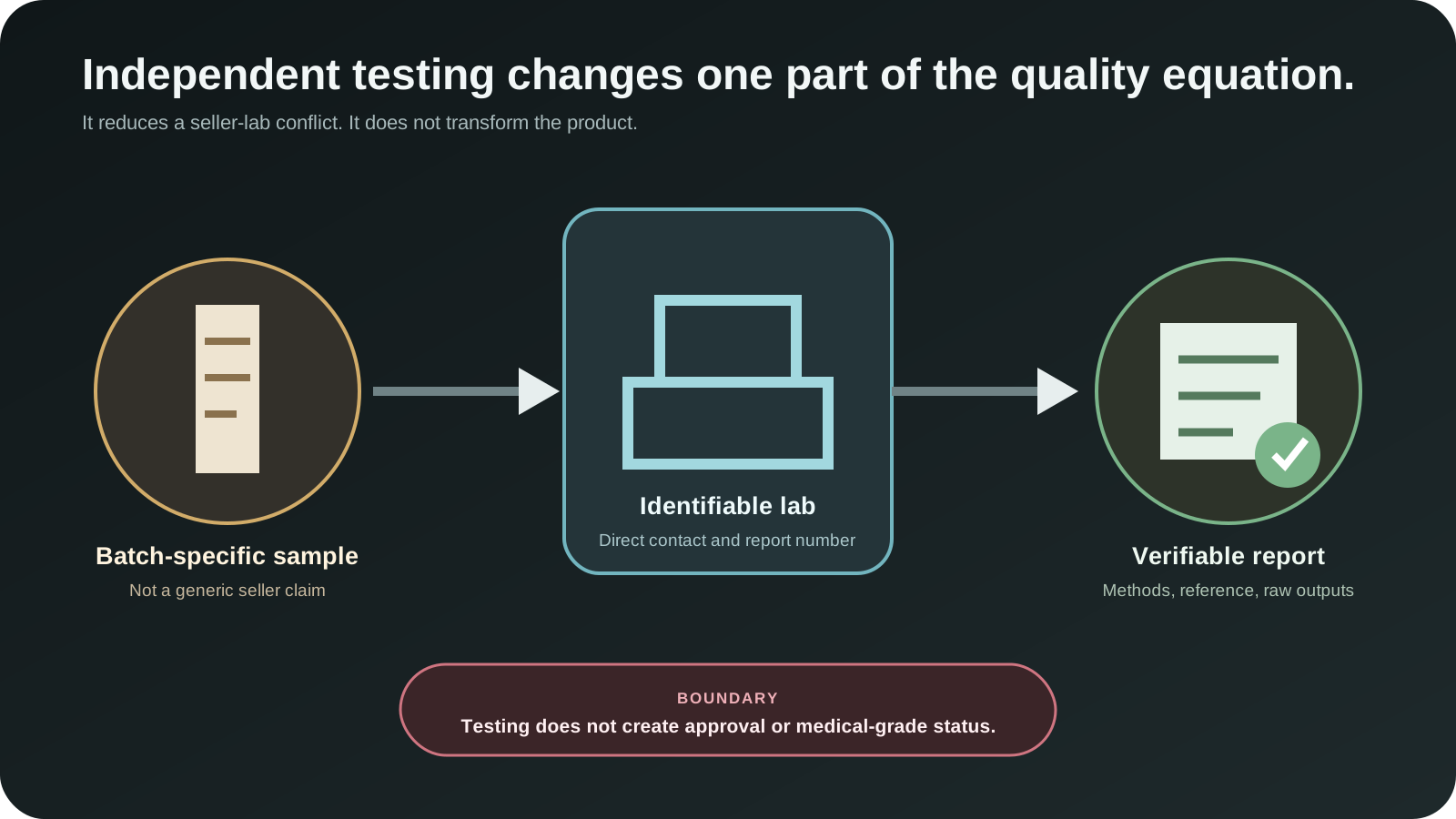
Independent testing will not turn a research chemical into a medical-grade product. What it does is remove one specific conflict of interest. A third-party lab has far less incentive to inflate a purity figure, quietly drop a failed test run, or reuse an old passing document across future batches. The strongest arrangement available to a buyer is batch-specific testing from a lab you can identify and contact directly.
There is a deeper reason independence matters here too. A purity or content figure only means something in relation to a well-characterized reference standard. Research describing how peptide reference standards get established shows that the value assigned to a standard comes from combining results across multiple laboratories, using a two-step process that assigns a value first to bulk material and then to the vialed material, with identity confirmed separately through methods like NMR and mass spectrometry. A single unverified number from an in-house lab carries none of that structure behind it.
The broader industry principle at play is that quality gets built into a manufacturing process, not tested into a finished batch after the fact at the last minute. That is the core idea behind quality by design in biopharmaceutical manufacturing. A buyer obviously cannot audit a supplier's internal process, so documentation ends up being the only proxy available to you. This is why a rigorous checker weights missing documentation so heavily. Peptide quality failures are frequently invisible to the eye. A vial can look completely normal while quietly containing truncated sequences, residual solvents, the wrong concentration, or bacterial byproducts. Documentation is imperfect, sure, but without it there is genuinely no way to tell quality control apart from branding.
Run the Eight-Question A to F Checker
Give each answer 1 point for yes, 0.5 for partial or unclear, and 0 for no. First, is there a complete COA for the exact batch? Second, can you identify the testing laboratory independently of the supplier? Third, do the peptide name, batch number, and dates match the product? Fourth, does the report show an HPLC method and chromatogram rather than only a purity claim? Fifth, does mass spectrometry confirm identity? Sixth, is an endotoxin result shown when the product is presented for sterile use? Seventh, is a separate sterility result shown when sterility is claimed? Eighth, can you verify the report date, analyst or approver, and laboratory contact details?
Use the total as a documentation grade: A is 7.5 to 8 points, B is 6.5 to 7, C is 5 to 6, D is 3 to 4.5, and F is below 3. Three failures override the arithmetic and produce an F: no COA, a batch mismatch, or a laboratory that cannot be identified. Those failures break traceability, so a polished purity number cannot rescue the file.
Here is what to do with the result. An A means the paperwork is unusually complete, but the document still needs to be authentic. A B means one small gap needs a direct answer. A C means pause and request the missing records. A D means the documentation is too incomplete to support a confident decision. An F means stop. The grade is deliberately strict because it measures whether the claims can be checked, not whether the supplier's website looks credible.
Keep the completed worksheet with the COA and batch number. If a future batch changes, run the eight questions again. Documentation quality belongs to a batch, not permanently to a brand.
What a Grade Is Trying to Prevent
The point of grading a supplier is not to crown some mythical perfect vendor. It is to screen out avoidable unknowns before they become your problem. A high grade simply means the supplier is showing you documents that let you ask better follow-up questions. A low grade means too many basic controls are missing or cannot be verified at all.
One framing worth keeping front of mind: treat 'research use only' as a risk label, not a loophole to work around. Plenty of peptides discussed online are not approved medicines for the claims people attach to them, and supplier quality varies wildly across the market. If a product is genuinely being considered for a medical purpose, the right path runs through a licensed clinician and a regulated pharmacy, not a gray-market workaround with a COA taped on.
Document Tricks That Should Make You Slow Down
A few sloppy or deceptive patterns show up again and again. Watch for cropped screenshots instead of full documents, a COA with no laboratory address listed anywhere, missing analyst signatures, identical chromatograms reused across completely different products, and purity values that come out suspiciously round across many separate batches. None of these individually proves fraud. But each one is a legitimate reason to slow down and ask directly for batch-specific documentation before you buy.

When a supplier does answer these questions clearly, hang onto the paper trail. Saving batch numbers, invoices, and COAs over time makes future comparisons easier and helps you notice if a supplier's documentation quality starts slipping. That history becomes part of your own ongoing safety file, and it is worth building even if your first few purchases go fine.
Quick answers
Common questions
What can a Certificate of Analysis actually tell you?
A COA reports testing results for a stated batch. It can help evaluate identity, purity, and selected quality checks, but the document alone cannot prove that a vial is authentic, sterile, or safe.
Why should the COA match the exact batch?
A report for another lot does not describe the vial in front of you. The batch or lot number is the link between the paperwork and the material that was tested.
Why are HPLC and mass spectrometry both useful?
HPLC helps describe purity and separation. Mass spectrometry helps confirm molecular identity. One result should not be treated as a substitute for the other.
Sources
Educational content only. Not medical advice.