Peptide Guides
How Long Do Reconstituted Peptides Last? A Real Storage Guide
Reconstituted peptides run on two separate clocks: a sterility clock and a chemical stability clock. This guide walks through the 28 day multi-dose vial default, why bacteriostatic water helps only one of those clocks, what refrigeration actually does and does not do, why room temperature storage is risky without product-specific data, and a practical framework for deciding when a vial should be kept or thrown out.
Published by PeptideSchool Editorial Desk

The Short Answer
CDC infection-control guidance says an opened multi-dose vial should generally be dated and discarded within 28 days unless the manufacturer gives a different period. That is a contamination-control default for multi-dose vials, not proof that every peptide remains chemically stable for 28 days.
Bacteriostatic Water for Injection contains 0.9% benzyl alcohol as a preservative for repeated withdrawals. That preservative helps control microbial growth after puncture, but it does not establish the stability of whatever peptide is mixed into the vial.
Approved products show how formulation-specific the answer can be. Current U.S. labeling allows an Ozempic pen to be kept for 56 days after first use under its stated temperature limits. Mounjaro labeling gives different windows for single-dose and multi-dose presentations. Follow the exact label for the exact product, and use the shorter limit whenever storage conditions were not maintained.
Why Bacteriostatic Water Only Solves Half the Problem
Bacteriostatic water lowers contamination risk because it contains benzyl alcohol and is designed for a vial that gets accessed more than once. But that preservative does not make peptide chemistry universal or automatically stable. It addresses the microbial side of the equation. The potency side still depends entirely on the specific peptide's formulation, the pH of the solution, temperature exposure, light exposure, and how carefully the vial is handled.
DailyMed labeling describes bacteriostatic water for injection as sterile water containing 0.9% or 1.1% benzyl alcohol as a bacteriostatic preservative, packaged specifically as a multiple-dose container meant for repeated withdrawals. That is why it is generally preferred over plain sterile water for any vial that will be drawn from more than once. Plain sterile water carries no antimicrobial preservative at all, so once that vial has been punctured, it does not carry the same safety margin.
Here is the catch: benzyl alcohol does nothing to stop chemical degradation. A peptide solution can stay perfectly clear to the eye while its potency is quietly dropping, because most of the degradation pathways mentioned above are invisible without lab testing. Wang's review of liquid protein and peptide formulation makes the point plainly: these products are stabilized case by case, and there is no single storage recipe that applies across every peptide molecule. What works for one peptide's formulation may not transfer to another.
What refrigeration does and does not do
Refrigeration slows down both microbial growth and many chemical reactions, but it does not stop either one. The right move is to store reconstituted preparations at the labeled refrigerator range, typically 2 to 8 degrees Celsius when directed, keep the vial away from light, avoid warming it up and cooling it back down repeatedly, and never freeze it unless the specific product instructions say freezing is fine.

Cold storage helps mainly because heat accelerates chemical reactions. The standard medical refrigerator range of 2 to 8C (36 to 46F) shows up consistently, including in FDA labeling for approved peptide medicines. Ozempic (semaglutide), for instance, is refrigerated before first use and then carries a labeled 56 day post-first-use window under specified conditions. Mounjaro (tirzepatide) has its own separate labeled storage instructions with defined room-temperature allowances. The takeaway is not that raw research peptides inherit these same windows. It is that stable, dated peptide products earn those specific windows through formulation work and real stability testing, something a reconstituted research vial mixed at home has not gone through.
Home refrigerator behavior matters more than people expect. The door section warms up every time it opens. The back wall can get cold enough to freeze delicate liquids without you noticing. Light exposure and physical shaking both add stress to the peptide. If a vial keeps warming up to room temperature and then going back in the fridge, whatever date is written on the label starts to mean less, because the vial never stayed under the storage condition that date assumed.
Room Temperature and Travel Deserve Extra Caution
Do not assume a reconstituted peptide is fine at room temperature unless that exact product has room-temperature stability data behind it. A brief accidental exposure is a different situation than planning to store a vial at room temperature on purpose. If you are traveling, an unopened lyophilized (freeze-dried) powder is almost always the easier and safer thing to transport compared to a vial that has already been mixed into liquid.
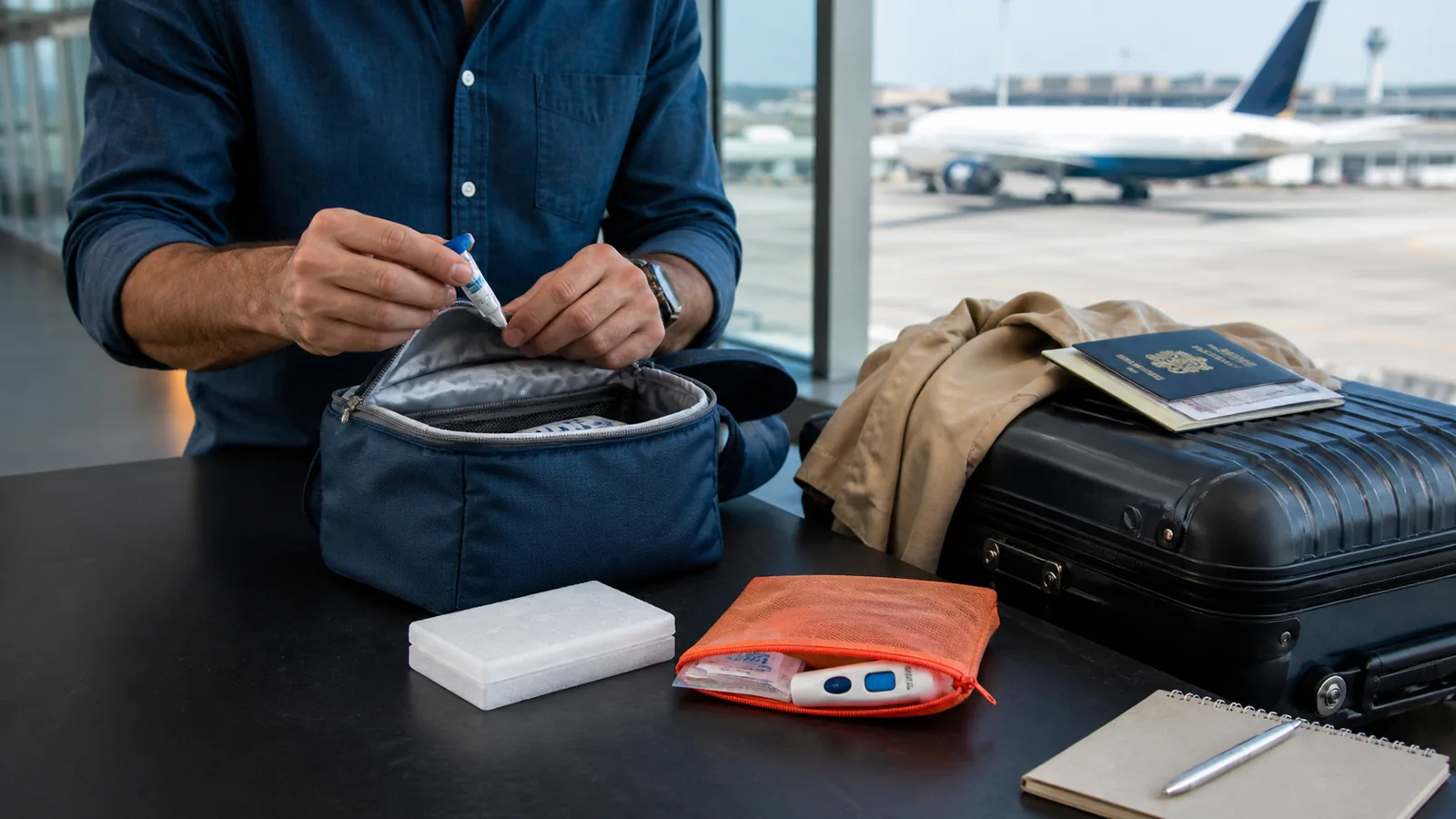
This is where a lot of casual internet advice falls apart. Certain FDA-approved peptide products can handle defined room-temperature windows because they were manufactured, buffered, preserved, filled, and specifically tested for that scenario. A reconstituted research vial mixed up in someone's kitchen has none of that testing behind it. If there is no label, no pharmacy instruction, no certificate of analysis, and no stability statement covering room temperature for your exact product, the safe assumption is that any time at room temperature counts as an excursion, not a storage plan.
If travel is unavoidable, the cleanest approach is usually to carry the dry lyophilized vial and only reconstitute it once you have reliable refrigeration available. If a liquid vial absolutely has to travel, protect it from heat, freezing, direct light, and any long stretch without refrigeration, and treat an unknown temperature history as a reason to throw it out rather than try to salvage it.
Deciding Whether to Keep or Discard a Vial
Only keep a reconstituted vial when you know the product instructions, the reconstitution date, the storage temperature it has lived at, and its full sterility history. If any of those pieces are missing or uncertain, or if the opened-vial date has already passed, or if the solution's appearance has changed in any way, discard it. A clear looking solution does not prove the peptide is still potent.
The simplest system that avoids guesswork is to label the vial the moment you mix it. Write down the reconstitution date, which diluent you used, how much water went in, the concentration if you know it, and the discard date. If you do not have a confirmed discard date, default to the strictest rule available to you: the manufacturer's opened-vial date if one exists, a pharmacy's beyond-use date if the product was compounded, or the CDC and USP style 28 day opened multi-dose vial default as your outside sterility boundary.
Discard earlier than any of those dates if sterility looks questionable for any reason. That includes drawing from the vial with a nonsterile needle, a damaged septum, a cap that popped off, a cloudy solution, visible particles floating in it, an unexpected color shift, or a vial that sat somewhere warm long enough that you are just guessing at this point. Guessing is not an acceptable standard for a sterile injectable product. When you are unsure, use a peptide storage calculator as a general handling framework, and then defer to the product's actual label or a qualified professional for the final call.
Sources
- Stability of protein pharmaceuticals: an update
- Instability, stabilization, and formulation of liquid protein pharmaceuticals
- Designing formulation strategies for enhanced stability of therapeutic peptides in aqueous solutions: a review
- Injection Safety: Preventing Infections in Health Care Settings
- Bacteriostatic Water for Injection, USP
- Ozempic prescribing information
- Mounjaro prescribing information
Educational content only. Not medical advice.