Peptide Guides
Traveling with Peptides: TSA, Cold Chain, and Customs Rules
A practical guide to TSA screening, temperature control, customs checks, and hotel storage for prescribed peptide medicines. Product labels and destination law matter more than generic internet rules, especially for reconstituted or unapproved products.
Published by PeptideSchool Editorial Desk
Start with the product, label, and destination
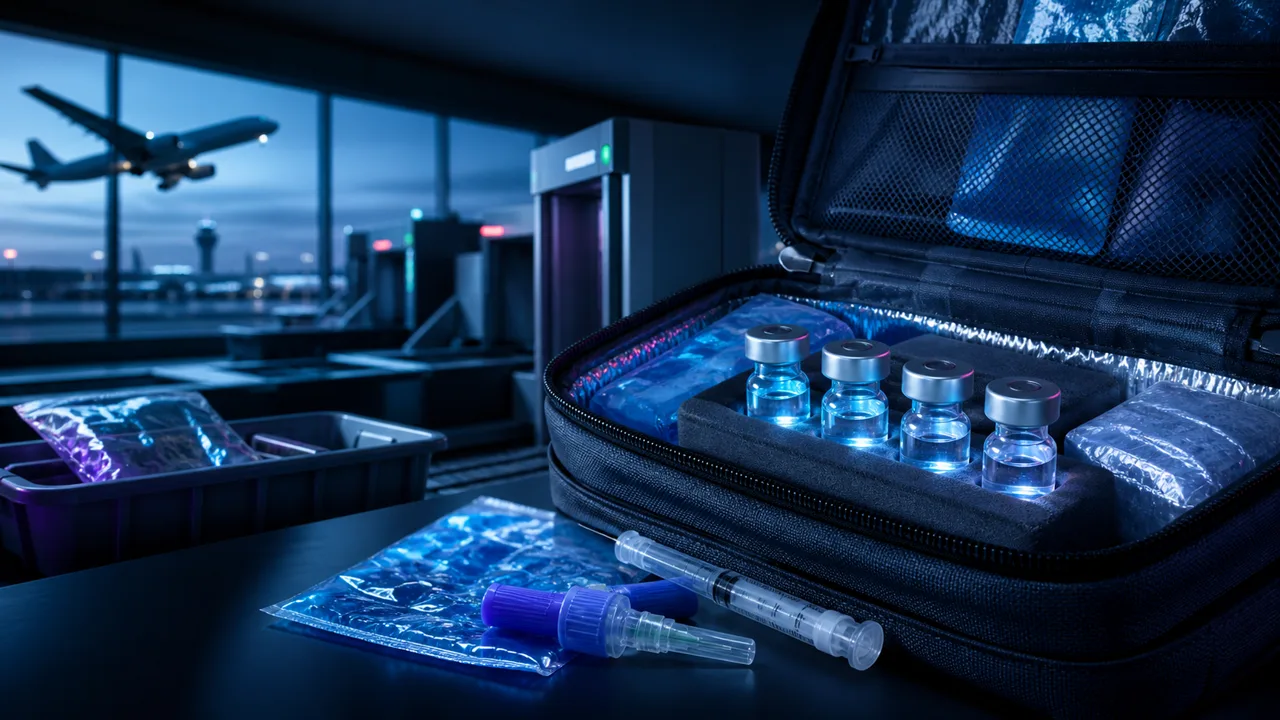
Travel planning starts with three facts: what the product is, what its label requires, and whether it is lawful at the destination. A sealed FDA-approved pen in original packaging is a different case from a pharmacy-compounded vial, and both are different from an unapproved product sold for research use.
TSA explains how medication, syringes, and cooling accessories are screened in the United States. It doesn't decide whether a drug is legal to possess, prescribe, or admit through another country's border. Before packing, check the product's current label, the airline's handling rules, and the destination government's medication-import page.
Getting through TSA with vials and syringes
TSA permits medically necessary liquids above the usual 3.4-ounce limit when they are declared for screening. Medication should be separated from other belongings so the officer can inspect it. Unused syringes are allowed when accompanied by injectable medication, and used syringes belong in a sharps container.
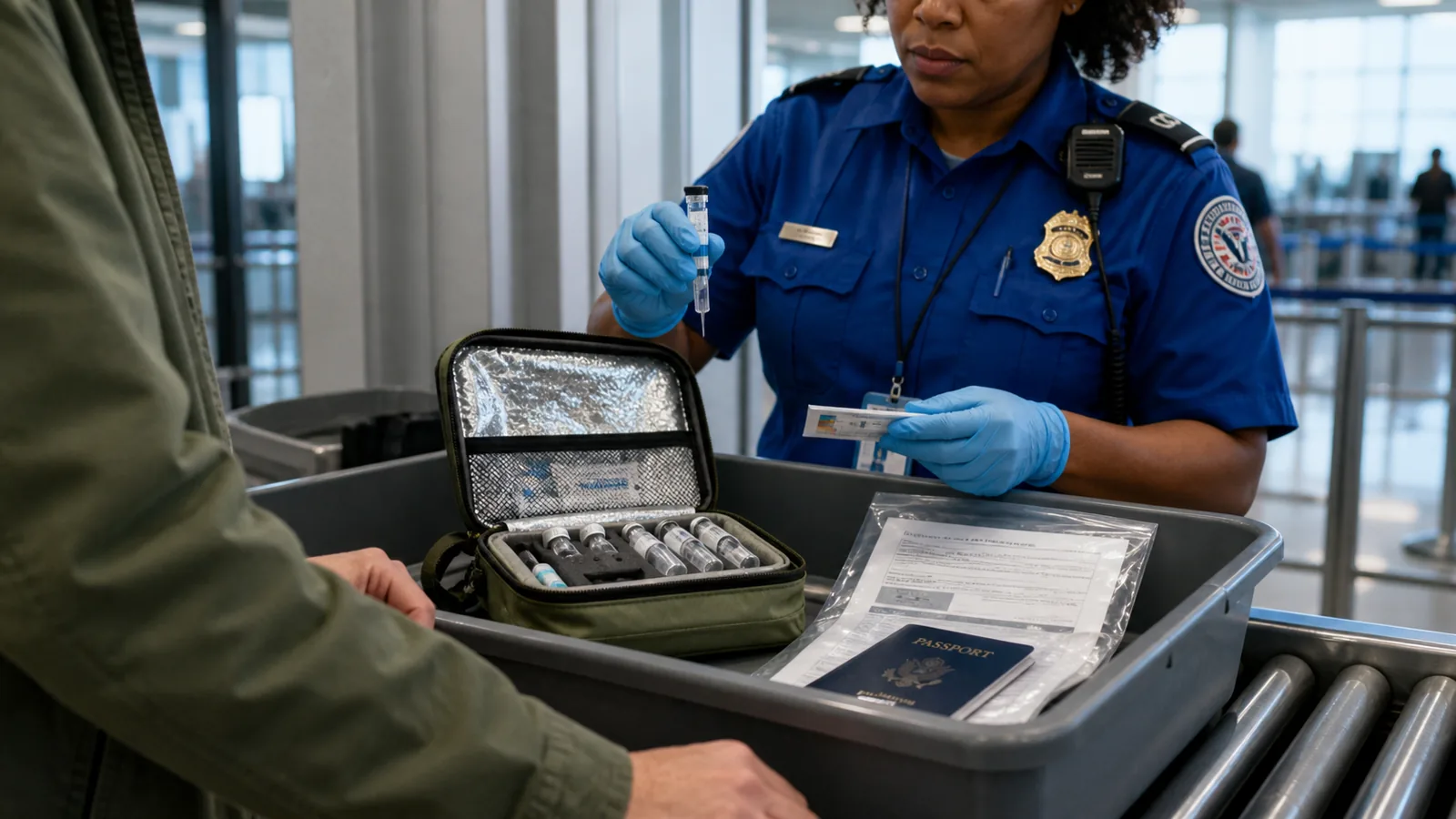
Cooling packs are also permitted for medically necessary items. TSA says frozen gel packs must be completely solid at the checkpoint; partially melted packs may receive additional screening. A prescription label and supporting documentation can make the process easier even though TSA is screening for transportation security rather than deciding whether a medication is legally prescribed.
For assistance with the screening process, TSA Cares accepts requests before travel. The officer at the checkpoint still makes the final screening decision.
Build extra time into the airport plan. Medication may need separate visual or explosive-trace screening, and a partially thawed cooling pack can receive more attention than a fully frozen one. Keep the cooler easy to open without disturbing the medication, and tell the officer before screening if the item must not be opened, X-rayed, or handled in a particular way. TSA may use an alternate screening process when one is available, but the officer decides what is needed.
The screening rule covers medically necessary items, so documentation should match the way the product is being presented. A pharmacy label, prescription copy, and a short clinician letter are practical even when TSA doesn't require every traveler to show them. They also help if an airline, local officer, or customs official asks a different question later in the trip.
Cold chain: the part people get wrong
Peptide and protein products can degrade through oxidation, deamidation, hydrolysis, and aggregation. Temperature is only one factor. Formulation, concentration, pH, light, agitation, and the container all affect stability, which is why one peptide's travel window can't be copied onto another.
Lyophilization often improves stability by removing water, but it doesn't create a universal room-temperature shelf life. A dry vial still needs product-specific instructions. Once a product is reconstituted, follow the manufacturer label or the dispensing pharmacy's written storage and beyond-use directions rather than a time window borrowed from a forum.
Approved products publish tested storage limits. Current Ozempic labeling, for example, gives a defined post-first-use window and temperature range. Mounjaro has its own presentation-specific instructions. Those limits apply only to the named manufactured product, not to a raw ingredient, a compounded vial, or another peptide with a similar name.
Research on human insulin shows why brief exposure and prolonged heat shouldn't be treated as the same event. Some studies found acceptable activity across defined warm conditions, while others found loss with sustained high heat. Insulin is also a specific, well-characterized formulation. Its data can't establish the remaining potency of a different product.
Better cooling than a plain ice pack
A cooler should hold the labeled range without freezing the product. A bare ice pack can create cold spots, especially when a pen or vial touches it directly. Use the cooler's instructions, keep medication separated from the cold source, and use a temperature indicator when the product requires a narrow range.
Phase-change packs designed for a stated temperature band may control temperature more evenly than ordinary ice, but the pack doesn't decide the correct range. The drug label does. After freezing, overheating, or an unknown excursion, contact the manufacturer or dispensing pharmacy with the exact time and temperature history.
Crossing borders: four rules to verify
There is no universal personal-use exemption. Check four items on the destination government's website: whether the active ingredient is controlled or prescription-only, how much may enter for personal use, which documents are required, and whether advance authorization is needed.
Original labeled packaging, a prescription copy, and a clinician letter using the generic drug name can make review easier, but they don't override local law. A “research use only” label doesn't turn an unapproved product into personal medication at the border.
Rules can differ for a flight connection and the final destination. If official guidance is unclear, ask the destination embassy or health authority in writing before departure. A social post, vendor email, or a smooth trip someone took last year isn't legal clearance.
A five-minute packing check
Put the medication in original labeled packaging and photograph the label, prescription, and storage instructions. Keep a paper copy too. Pack only the amount permitted for the trip and destination.
If cooling is required, precondition the cooler as its maker directs, prevent direct contact between the medication and the cold pack, and confirm the range before leaving home. Place unused syringes with the injectable medication and carry a hard-sided sharps container for anything already used.
Write down who to call after an excursion: the product manufacturer, dispensing pharmacy, or prescriber. Visual inspection can catch particles, cloudiness, or discoloration, but a clear solution doesn't prove full potency or sterility.
Once you land: hotel storage and spotting a bad vial
Do not assume a hotel mini-fridge holds a medical storage range. Check it with a thermometer before placing medication inside, keep the product away from a freezer plate or cooling vent, and ask whether power shuts off when the room key is removed. If the refrigerator cannot hold the labeled range, ask the hotel about secure medication storage or use the validated travel cooler while arranging another option.
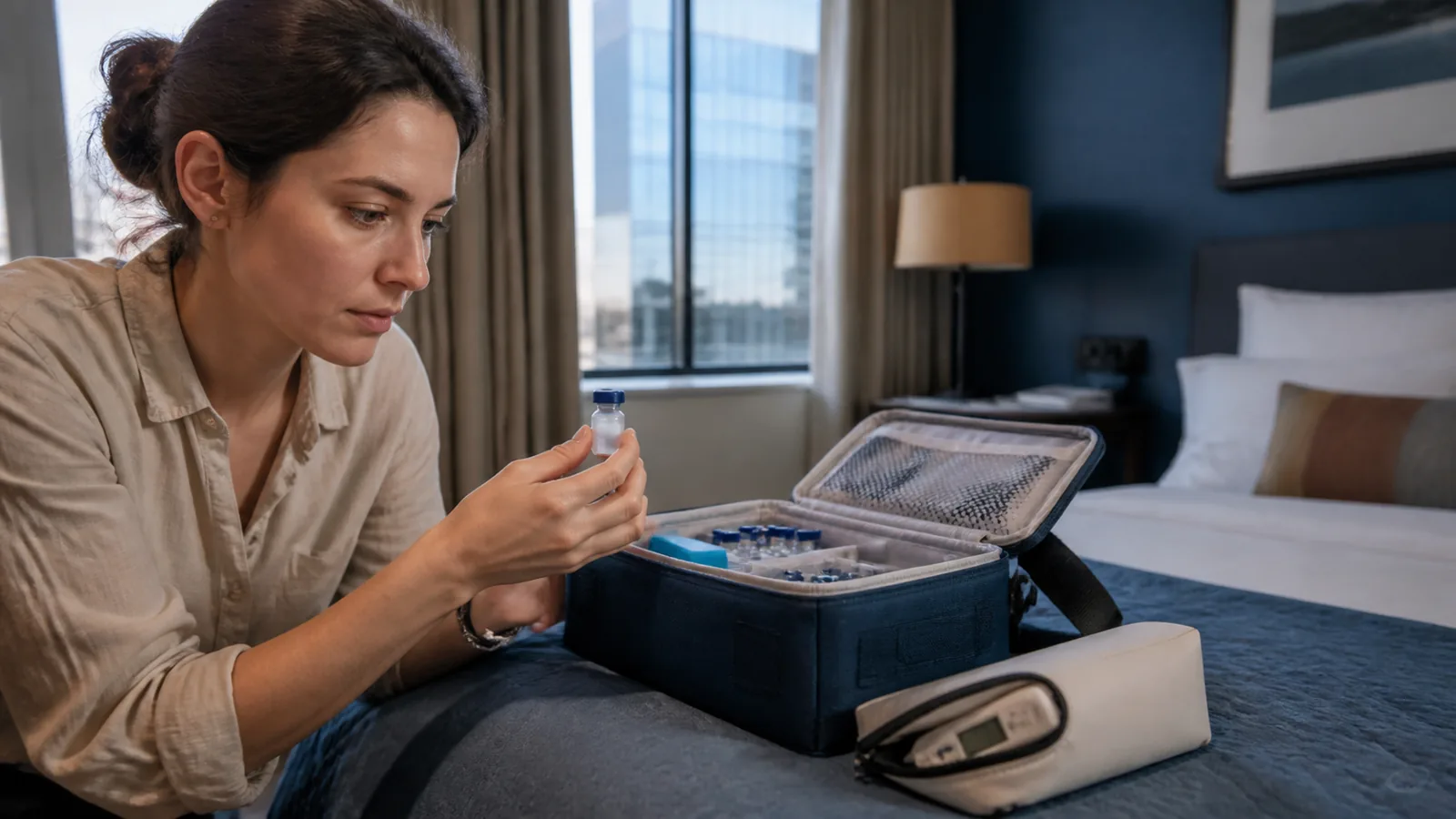
Hotel refrigerators vary widely and may run outside a product's labeled range. Check the temperature before relying on one, keep medication away from the freezer plate, and ask the hotel what secure medication-storage options it can provide. Record the date and storage conditions so you are not relying on memory later.
If you think a vial went through a temperature swing during travel, look for visual warning signs: cloudiness or turbidity in a solution that used to be clear points to aggregation or contamination, yellowing or darkening suggests oxidation, visible particles or clumps mean instability, and any unusual odor suggests microbial growth or chemical breakdown. The harder problem is that degradation often shows no visible signs at all. Deamidation and oxidation can quietly cut potency while the solution still looks perfectly clear, and aggregation can start well before you would ever see it. When you are not sure, the safer move is to discard the vial and start a fresh one rather than inject something that might already be compromised.
Keep a simple excursion log with the local time, highest or lowest observed temperature, and how long the product may have been outside range. That information is far more useful to a pharmacist or manufacturer than saying the vial “got warm.” Do not guess a new expiration date or reset the clock after returning the product to the refrigerator.
Quick answers
Common questions
What should be checked before traveling with a prescribed peptide medicine?
Check the product label, the prescription documentation, the temperature requirements, the carrier rules, and the law at the destination. International rules may differ from domestic screening rules.
Should temperature-sensitive medication go in checked luggage?
Checked luggage can be delayed, lost, or exposed to uncontrolled temperatures. The article explains why a documented carry-on plan is usually easier to monitor, subject to the applicable travel rules.
Is there one safe room-temperature window for every product?
No. The allowable window depends on the exact formulation and its official instructions. A generic internet timeline should not replace the product label or pharmacy guidance.
Sources
- Thermal stability and storage of human insulin
- Stability of protein pharmaceuticals: an update
- Forced degradation of therapeutic proteins
- The practical aspects of insulin at high altitude
- Factors affecting the physical stability (aggregation) of peptide therapeutics
- TSA travel tips for medications and medically necessary liquids
- Personal Importation
- Ozempic prescribing information
- Mounjaro prescribing information
Educational content only. Not medical advice.