Wellness
How Botox Works: The Real Mechanism Behind the Injection
Botox is a large bacterial protein, not a peptide, that cuts a specific rope in a nerve's release machinery so a muscle can't fire. This piece walks through the mechanism step by step, why the effect fades on a clock, why a small share of long-term users stop responding, how newer formulations like Daxxify and Letybo compare, whether topical Argireline creams can match an injection, and the full range of approved medical uses beyond wrinkles.
Published by PeptideSchool Editorial Desk
What Botox Is
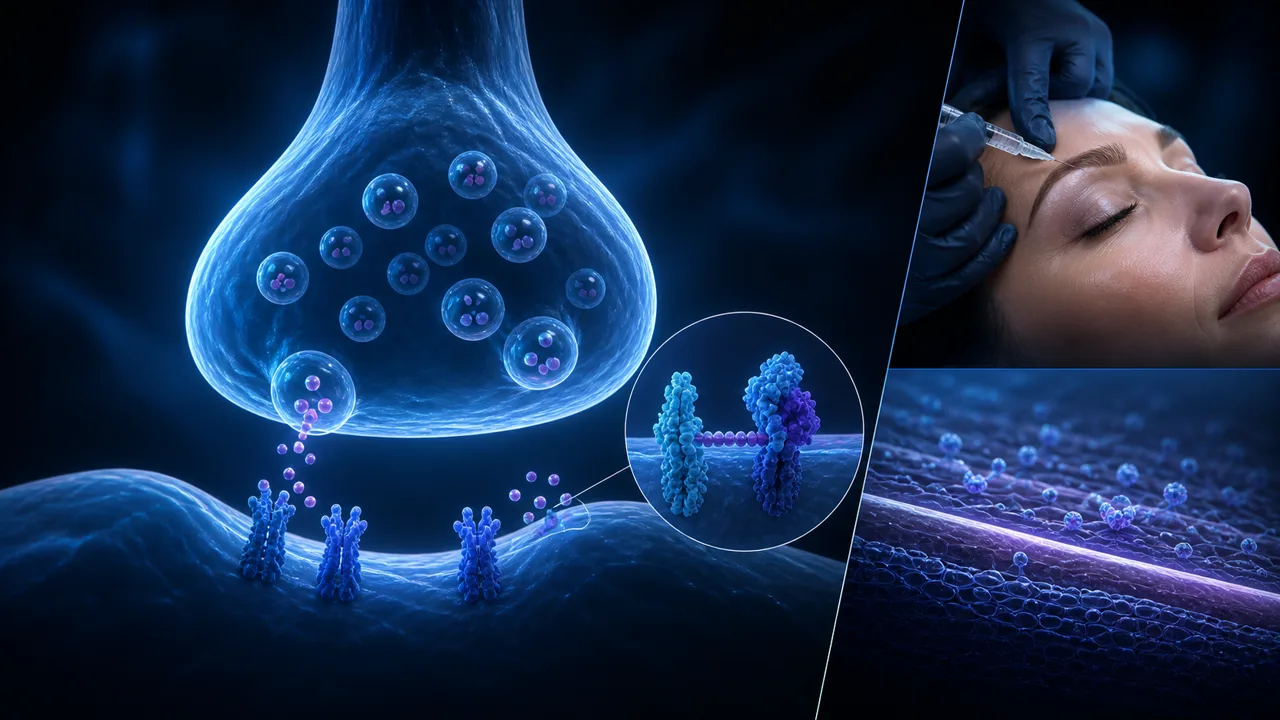
You have seen the brand name on every medspa menu, but underneath the marketing, Botox is a genuinely large molecule made by a bacterium called Clostridium botulinum, the same organism responsible for foodborne botulism poisoning. Used in tiny, purified doses, that toxin becomes the most studied wrinkle treatment on the market.
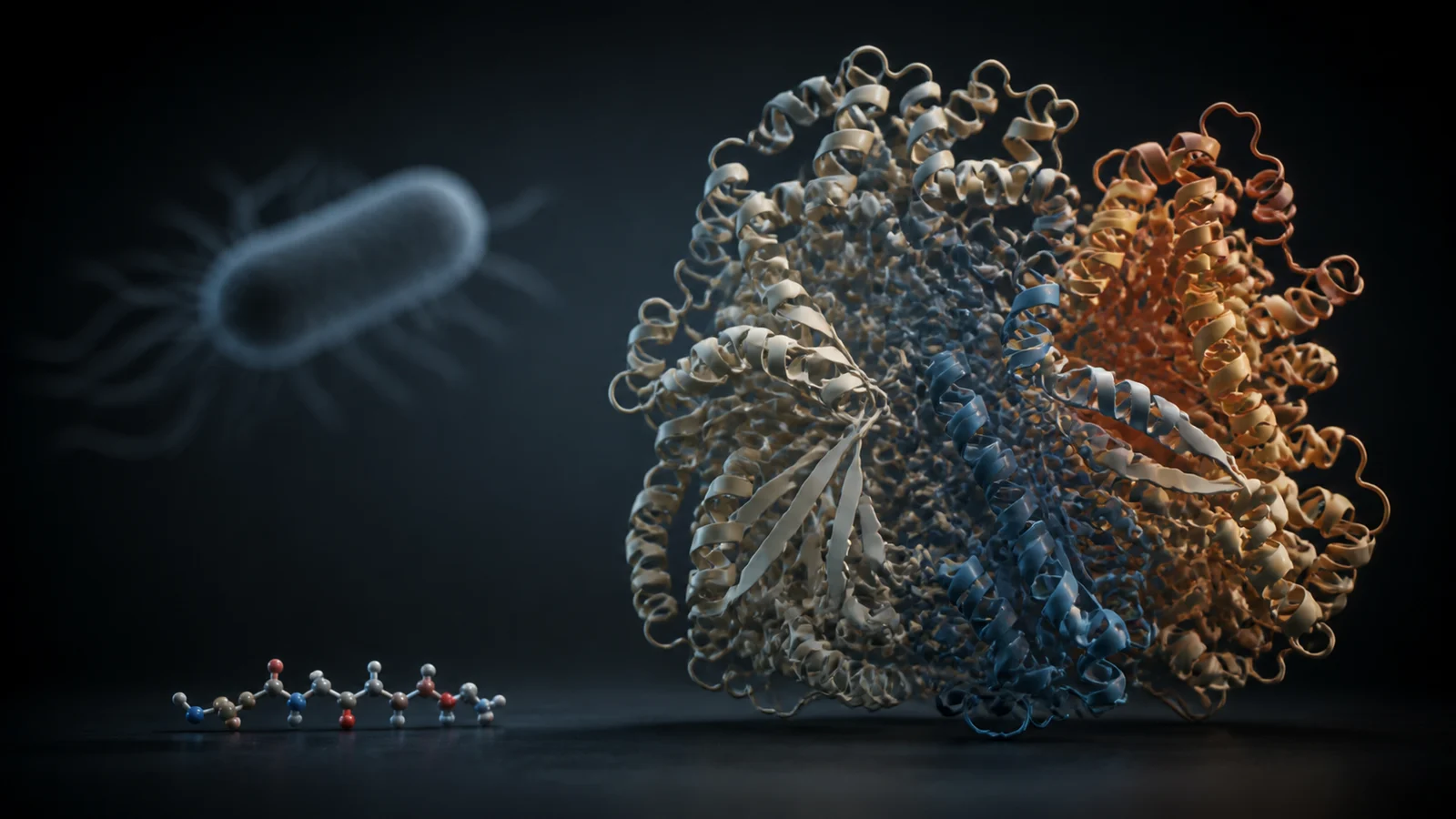
Is it a peptide? Technically, no. Peptides are short chains of amino acids, usually under 50 links long. Botox is a 1,295-amino-acid chain, which puts it in protein territory rather than peptide territory. It is roughly 100 times the size of a typical small therapeutic peptide. But it disables nerves through a mechanism similar to how many peptides operate, which is why it keeps coming up in the same conversation.
The brand landscape looks crowded but traces back to the same toxin family. Botox was FDA approved for cosmetic use in 2002. Dysport and Xeomin use different formulations, Daxxify uses a peptide-stabilized formulation designed for longer duration, and Letybo received FDA approval in 2024. Their units are not interchangeable, even though type A products act through the same core SNAP-25 mechanism.
How Botox Paralyzes a Muscle: The Three Moves
Nerves talk to muscles by releasing a chemical messenger across a tiny gap. Botox jams that entire system, and it does it in three distinct steps.
First, the toxin boards the nerve. A nerve ending sits right next to the muscle it controls, and Botox is pulled inside that ending almost like a key turning a lock. This step is remarkably selective. Botulinum toxin enters nerve cells and largely ignores everything else in the body (Lalli et al., 1999, PMID 10413679).
Second, it cuts one specific rope. Nerve cells release their messenger using a rope-and-pulley system that biologists call SNARE, built from three separate proteins. Botox carries molecular scissors that snip just one of those ropes, a protein named SNAP-25 (Osen-Sand et al., 1996, PMID 8708006). Different botulinum toxin types cut different ropes in this system. Type A, the version in standard Botox, cuts SNAP-25, and that particular cut happens to be unusually stable, which is a big part of why type A lasts as long as it does.
Third, the message never arrives. Without an intact SNAP-25 rope, the nerve cannot release acetylcholine, the chemical that tells a muscle to contract (Schiavo, Matteoli, and Montecucco, 2000, PMID 10747206). The muscle stays relaxed for as long as that rope stays cut, which for type A runs roughly three to four months. Wrinkles caused by that muscle's repeated folding soften because the muscle has stopped pulling on the skin above it.
Why Botox Wears Off
The rope grows back. Nerve cells are constantly manufacturing fresh SNAP-25, and within a few weeks they also start sprouting brand-new nerve endings that route around the cut entirely. By month three or four, enough new rope is in place for the messenger to flow again, and the muscle starts moving like it used to. That is the entire reason touchup appointments exist.
This is also what makes Botox reversible in a way permanent procedures are not. The effect ages out on a fairly fixed biological clock that you cannot meaningfully speed up or slow down from the outside. Some people burn through it faster, often heavy weightlifters, people with very active facial muscles, or anyone who started with a very light dose, and they notice fading by month two. Most people land in the three-to-four-month window and settle into a fairly predictable rhythm after a few rounds of treatment.
Why Your Second Round Sometimes Works Worse
A small share of patients develop true secondary nonresponse after repeated botulinum toxin treatment. Published rates vary by indication, dose, formulation, and how nonresponse is defined. Neutralizing antibodies are one possible cause, but they are not the default explanation for a weaker cosmetic result.
Higher cumulative doses and shorter treatment intervals have been associated with greater immunogenicity risk in therapeutic use. Product handling, injection placement, muscle selection, dose conversion, changing anatomy, and expectations can also change the visible result. Computational work on HLA variants is an early hypothesis about individual susceptibility, not a clinical test that predicts who will stop responding.
If results become shorter or weaker, the useful next step is a review with the treating clinician. Timing, product, dose, technique, and the target muscle should be checked before assuming antibody resistance. Specialized testing or a different formulation may be considered in persistent cases, but the evidence does not support diagnosing resistance from appearance alone.
The New Generation: Daxxify, Letybo, and What's Next
Botox had two decades with no real competitor on duration after its 2002 cosmetic approval. That changed with Daxxify in 2022. It uses the same active toxin but pairs it with a stabilizer molecule, a 35-amino-acid peptide, that helps the toxin stay attached to the nerve longer. Phase 3 SAKURA trial data showed a median of about six months of frown-line reduction, with some patients reporting effect out to nine months (Gallagher, Bowsher, Clancy, Dover, Humphrey, Liu, and Prawdzik, 2023, PMID 36668880). The trade-off is a higher per-treatment price, a shorter real-world track record, and slightly higher reported antibody rates in early data.
Letybo, FDA approved in 2024, is a Korean-developed product marketed as a cheaper, faster-onset option aimed at first-time users, lasting around the traditional three to four months. Xeomin strips out the extra protein scaffolding that the toxin normally travels with, which in theory should lower antibody risk, although the real-world difference for most patients is still debated. All four of these products, Botox, Dysport, Xeomin, and Daxxify, share the exact same SNARE-cutting mechanism described above. They mainly differ in duration and how likely they are to trigger an immune response.
Topical "Botox" Peptides: Do They Work?
Walk down any skincare aisle and you will find serums promising Botox in a bottle or needle-free wrinkle smoothing. The ingredient behind most of those claims is a peptide called Argireline, chemical name acetyl hexapeptide-8. It targets the same SNAP-25 rope that injectable Botox targets, since it is essentially a small fragment of SNAP-25 designed to gum up the rope-and-pulley release system from the inside (Kluczyk et al., 2021, PMID 33482052). Small studies report wrinkle-depth reductions of around 30 percent over a month of daily use, which is a real effect, just a small fraction of what an injection delivers.
The bigger obstacle is getting the peptide where it needs to go. Skin's outer layer exists specifically to keep things out. When researchers measured how much topical Argireline crosses that barrier, the figure came out to roughly 0.2 to 0.3 percent, meaning the rest sits on the surface and eventually washes away (Hoppel, Reznicek, Kahlig, Kotisch, Resch, and Valenta, 2015, PMID 25497319). A serum labeled 10 percent Argireline is realistically delivering closer to 0.02 percent of active ingredient down to the muscle level, which is why the published numbers are genuine but modest.
The practical read: treat Argireline serums as a slow-compounding daily maintenance ingredient, not a substitute for an injection. They pair reasonably well with ingredients like copper peptides or retinoids, since those work through entirely different mechanisms such as collagen synthesis and cell turnover, so there is no competition for the same target. They are not equivalent to Botox, regardless of what the packaging implies.
Medical Uses Beyond Wrinkles
Botox treats a lot more than crow's feet. The FDA has approved it for chronic migraine, defined as more than 15 headache days a month, with strong supporting real-world effectiveness data (Kepczynska, Domitrz, Stepien, Michalak-Siembida, and Walczak-Ciszewska, 2026, PMID 42067810). It is also approved for excessive armpit sweating (hyperhidrosis), the eye-twitch condition called blepharospasm, neck-muscle spasms known as cervical dystonia, overactive bladder, and crossed eyes (strabismus). The underlying mechanism never changes: the muscle relaxes wherever the toxin lands.
The most surprising recent application is retrograde cricopharyngeal dysfunction, or R-CPD, which is essentially the inability to burp. For decades it went almost entirely unrecognized. People lived for years with chest pressure and bloating after eating without any name for what was happening. Online communities helped surface the condition around 2018 to 2020, and clinicians began treating it with Botox injections into a small upper-throat muscle that fails to relax during a normal burp reflex. Recent pediatric outcome data shows the injection succeeds on the first attempt in roughly 80 percent of cases (Wright, Jin, Hunter, and Tritter, 2026, PMID 41872073). One molecule, one mechanism, a surprising number of muscles it can be pointed at.
What the Evidence Says: An Honest Grade
It helps to grade the confidence level behind each claim rather than treat all of this as equally settled. For cosmetic frown lines and crow's feet, the evidence is strong, backed by decades of randomized controlled trials with consistent results. For chronic migraine prevention, also strong, supported by the PREEMPT trial program and replicated real-world cohorts.
For Daxxify's six-month duration claim, the evidence is moderate. The headline median figure includes patients who dropped out of trials for various reasons, and real-world durations may run a bit shorter than the trial number suggests. For Argireline matching Botox, the evidence is weak. The supporting studies tend to be small, often industry-sponsored, and rarely measured against an real injection as a control. For switching toxin serotypes to reverse tachyphylaxis, the evidence is weak to moderate, resting mostly on case reports and small case series rather than controlled trials.
None of this should discourage you from getting an injection if a board-certified dermatologist or plastic surgeon recommends one for a specific concern. The point of laying it out this way is to make you a sharper patient, so that when a medspa tells you Botox is just Botox, you know to ask which serotype they are using, which formulation, what dose, and what duration they realistically expect for your specific muscle group.
Sources
- Functional characterisation of tetanus and botulinum neurotoxins binding domains
- Common and distinct fusion proteins in axonal growth and transmitter release
- Neurotoxins affecting neuroexocytosis
- Immunogenicity of botulinum toxins
- Computational Immunogenetic Analysis of Botulinum Toxin A Immunogenicity and HLA Gene Haplotypes
- Clinical Immunogenicity of DaxibotulinumtoxinA for Injection in Glabellar Lines: Pooled Data from the SAKURA Phase 3 Trials
- Argireline: Needle-Free Botox as Analytical Challenge
- Topical delivery of acetyl hexapeptide-8 from different emulsions
- Real-world effectiveness of onabotulinumtoxinA as first-line treatment in chronic migraine
- Outcomes in the Management of Pediatric Retrograde Cricopharyngeal Dysfunction
Educational content only. Not medical advice.