Wellness
Why Some People Can't Burp: R-CPD Explained
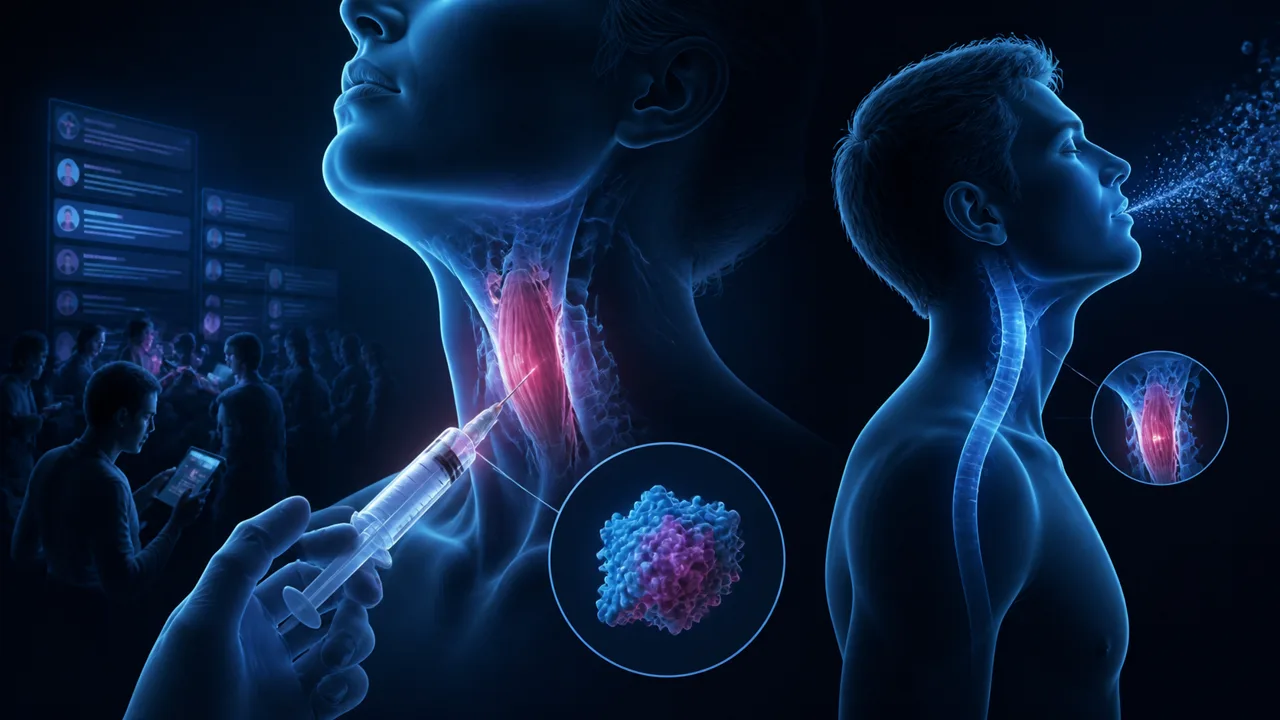
Some people have never burped in their entire lives, not once. The condition is called retrograde cricopharyngeal dysfunction, or R-CPD, and it was largely tracked down by patients on Reddit before medicine caught up. A muscle at the top of the esophagus refuses to open in reverse, trapping swallowed air and causing chronic bloating, gurgling, and gas. A single injection of botulinum toxin into that muscle restores burping in the vast majority of patients, and the effect often outlasts the drug itself.
Published by PeptideSchool Editorial Desk
How a normal burp works
Every time you swallow food, water, or even your own saliva, a small pocket of air hitches a ride down into your esophagus, the tube connecting your throat to your stomach. Most of that air ends up in the stomach, held there by a muscular ring called the lower esophageal sphincter, or LES. Under normal conditions this valve stays shut and nothing comes back up.

Once enough air builds up, stretch receptors in the stomach wall notice the pressure and send a signal up the vagus nerve, the long nerve linking the brain to the gut, heart, and lungs. That triggers what gastroenterologists call a transient lower esophageal sphincter relaxation. The bottom valve pops open for a moment and the trapped air rises into the esophagus.
But the air still has to get out through a second gate. At the very top of the esophagus sits the upper esophageal sphincter, controlled by a C-shaped strap of muscle called the cricopharyngeus. It wraps around the esophagus just behind the voice box and stays clenched at rest so food and air do not leak backward into the throat. When the rising column of air stretches the upper esophagus, a second reflex relaxes that muscle for a split second, and the air escapes into the throat. That escaping puff of air is the burp.
The whole relay, bottom valve opening, air rising, top valve opening, air escaping, takes about one second. Two sphincters, two reflexes, one coordinated release. This sequence was mapped out by Kahrilas and colleagues in 1986 using manometry, pressure sensors threaded down the esophagus, and their description still stands as the foundational account of how humans vent swallowed air.
What goes wrong in R-CPD
Retrograde cricopharyngeal dysfunction, sometimes called no-burp syndrome or abelchia, is what happens when the second half of that relay breaks down. The cricopharyngeus muscle still works perfectly in one direction. It relaxes on cue every time you swallow, letting food and liquid through. But run the process backward, when air needs to come up instead of food going down, and the muscle simply refuses to let go.
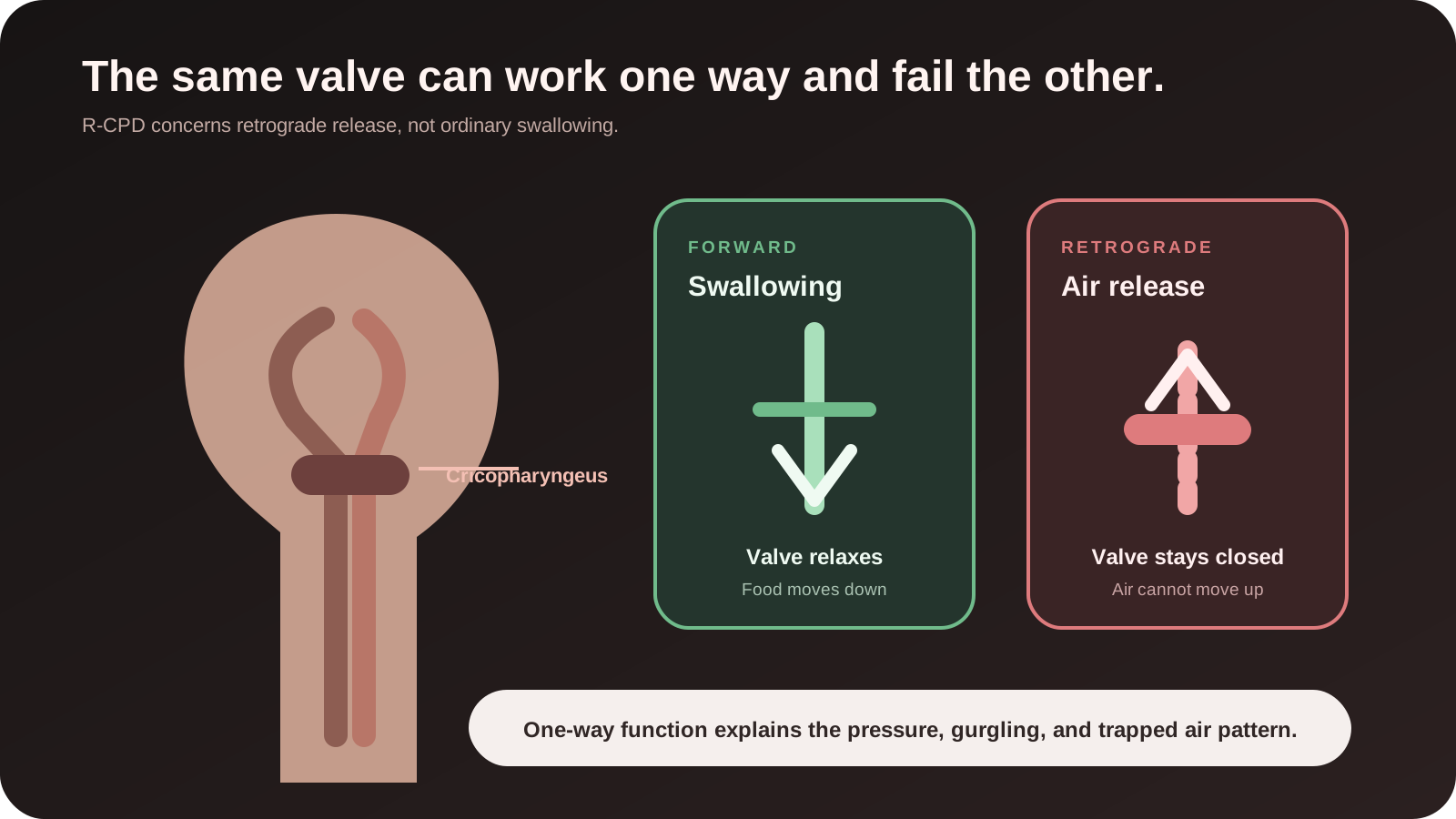
The result is a valve that was built to work two ways but only opens one. Air goes into the stomach with every meal and every sip, and the only way out is downward through the intestines. A systematic review covering 637 patients found that 100% reported being unable to burp, 83% had chronic bloating, 75% experienced gurgling sounds from the chest and neck, and 71% dealt with excessive flatulence. Patients often describe the gurgling as sounding like something trying to escape, loud enough that coworkers and dinner companions notice.
The social cost of this is real. A Reddit-distributed survey of 199 R-CPD patients found average self-reported embarrassment scored 3.4 out of 5, anxiety and depression scored 3.1, and negative impact on relationships scored 2.6. Many patients said they fasted before important events or scheduled quiet time alone after meals just to deal with the pressure. Carbonated drinks, beer, soda, sparkling water, were often avoided entirely because the extra gas made things unbearable.
What makes this condition especially frustrating is how long it hides in plain sight. About 55.5% of patients report symptoms starting in childhood, yet the average age at diagnosis is around 30. Along the way, R-CPD gets routinely mistaken for irritable bowel syndrome, acid reflux, anxiety, or just chalked up to being different. Only half of surveyed patients had ever mentioned the symptoms to a primary care doctor, and 90% of those who did said they got no useful help.
How Reddit diagnosed a condition medicine missed
This is not a new complaint. The Roman naturalist Pliny the Elder, writing roughly 2,000 years ago, described a man named Pomponius who could never belch. A medieval poet wrote about the same thing 840 years ago. Clinical case reports trickled in during the 1980s, and Kahrilas himself noted dysfunction of the belch reflex back in 1986. But nobody stitched these isolated cases into a recognized, treatable syndrome.
The connection finally happened on Reddit. The subreddit r/noburp was created in 2014, and it grew slowly as people who had never once burped in their lives found each other for the first time. The pattern that emerged was remarkably consistent across thousands of strangers: lifelong inability to burp, chronic bloating, chest gurgling, excessive gas, and a long trail of doctors who had no answers. By the time Dr. Robert Bastian, an Illinois laryngologist, published his landmark 2019 paper formally naming the condition R-CPD, and reporting that all 51 of his patients regained the ability to burp after a botulinum toxin injection, the online community already understood exactly what it had.
The patient community has continued to share clinician names and treatment experiences across countries. That patient-led path to recognition has also been documented in the clinical literature. The durable point is not a live subreddit count or a provider directory. It is that a consistent patient pattern pushed a poorly recognized disorder into formal study.
One protein, one muscle, one fix
The treatment is a single injection of botulinum toxin, the same protein sold under brand names like Botox, Dysport, and Xeomin, placed directly into the cricopharyngeus muscle. Clinicians use 50 to 100 units, more than double what is typical for smoothing forehead wrinkles. It is delivered either under general anesthesia during a brief upper esophagoscopy or in an office setting using EMG guidance, where a needle reads electrical signals to confirm it has hit the right muscle.
The mechanism is the same one behind cosmetic Botox. The toxin enters the nerve terminal at the neuromuscular junction, the point where nerve meets muscle. Once inside, its light chain acts as a protease, an enzyme that cuts other proteins, and it cleaves a docking protein called SNAP-25. SNAP-25 is part of the SNARE complex, the machinery that fuses vesicles carrying acetylcholine, the chemical messenger for muscle contraction, with the nerve terminal membrane. Without intact SNAP-25, those vesicles cannot dock, acetylcholine cannot release, and the muscle cannot contract. The cricopharyngeus goes limp for several months while the nerve terminal slowly grows back.
The clinical numbers back this up. In Bastian's follow-up study of 200 patients, 99% gained the ability to burp and 95% reported substantial relief from bloating, gurgling, flatulence, and social anxiety. A 2024 prospective study of 108 patients found no meaningful difference in outcomes between operating-room injections and in-office ones. And a systematic review pooling 637 patients across 17 separate studies put the overall initial success rate at 87%.
Why the fix outlasts the drug
Here is the part that genuinely puzzles researchers. Botulinum toxin is not permanent. The protein breaks down, the cleaved SNAP-25 gets replaced, new nerve sprouts grow in, and muscle contraction eventually returns. In cosmetic use that means wrinkles reappear after three to four months. Yet in R-CPD, roughly 80% of patients keep burping normally well past six months, long after the drug itself has worn off.
The leading explanation is neuroplastic adaptation, meaning the nervous system learns a new motor pattern. Many R-CPD patients have literally never experienced a burp before treatment. The injection opens a window of several weeks where the cricopharyngeus is physically unable to clench, and air escapes freely for the first time. During that window, the brainstem reflex circuits appear to get the chance to encode the reverse-relaxation pattern for good. When the drug wears off and normal muscle tone returns, the newly learned reflex sticks around.
For the roughly 20% of patients who do relapse, a repeat injection resolves symptoms about 76% of the time. A small number of patients who fail multiple rounds of injections can move on to a partial cricopharyngeal myotomy, a minimally invasive procedure where a surgeon divides about 80% of the muscle fibers using a CO2 laser through the mouth. That approach shows 67% long-term resolution in these harder cases. One molecule, one mechanism, and for most people, a lasting fix from a drug that was never meant to last.
What to do if you recognize this pattern
If lifelong inability to burp appears alongside chronic bloating, chest or neck gurgling, and excess gas, R-CPD is worth raising with a clinician. Laryngologists and ENT physicians with swallowing or upper-esophageal experience often evaluate it, and gastroenterology or motility specialists may also be involved. Familiarity with the disorder matters more than the specialty label alone.
Diagnosis is primarily clinical and may include throat examination, swallowing studies, or specialized pressure testing when the picture is unclear. Some clinicians also use response to a botulinum toxin injection as supporting evidence. Improvement strengthens the diagnosis, but one response is not a perfect standalone test.
Access, setting, insurance coverage, and cost vary widely by clinician and country. A patient-maintained provider list can help generate names, but credentials, experience, current pricing, and coverage still need direct verification with the clinic and insurer.
Sources
- Upper esophageal sphincter function during belching
- Physiologic and pathologic belching
- Inability to belch and associated symptoms due to retrograde cricopharyngeus dysfunction: diagnosis and treatment
- The long-term efficacy of botulinum toxin injection to treat retrograde cricopharyngeus dysfunction
- Abelchia: inability to belch/burp, a new disorder? Retrograde cricopharyngeal dysfunction (RCPD)
- Retrograde cricopharyngeus dysfunction: how does the inability to burp affect daily life?
- Retrograde cricopharyngeal dysfunction: a review
- Diagnosis and management of retrograde cricopharyngeal dysfunction: a systematic review
- Botulinum toxin injection for retrograde cricopharyngeal dysfunction: a prospective cohort study
- Retrograde cricopharyngeus dysfunction, a new motility disorder: single center case series and treatment results
- Retrograde cricopharyngeal dysfunction: an update of pathophysiological mechanisms and future directions
Educational content only. Not medical advice.