Wellness
Does Epsom Salt Work? What the 2026 Evidence Shows
Epsom salt is magnesium sulfate, and the sales pitch depends on magnesium crossing the skin into the bloodstream. The skin barrier and the best controlled studies say very little gets through. The relief people feel in the tub is better explained by warm water. Oral magnesium has modest evidence for sleep and soreness. A soak does not have the same evidence.
Published by PeptideSchool Editorial Desk
What Epsom Salt Is
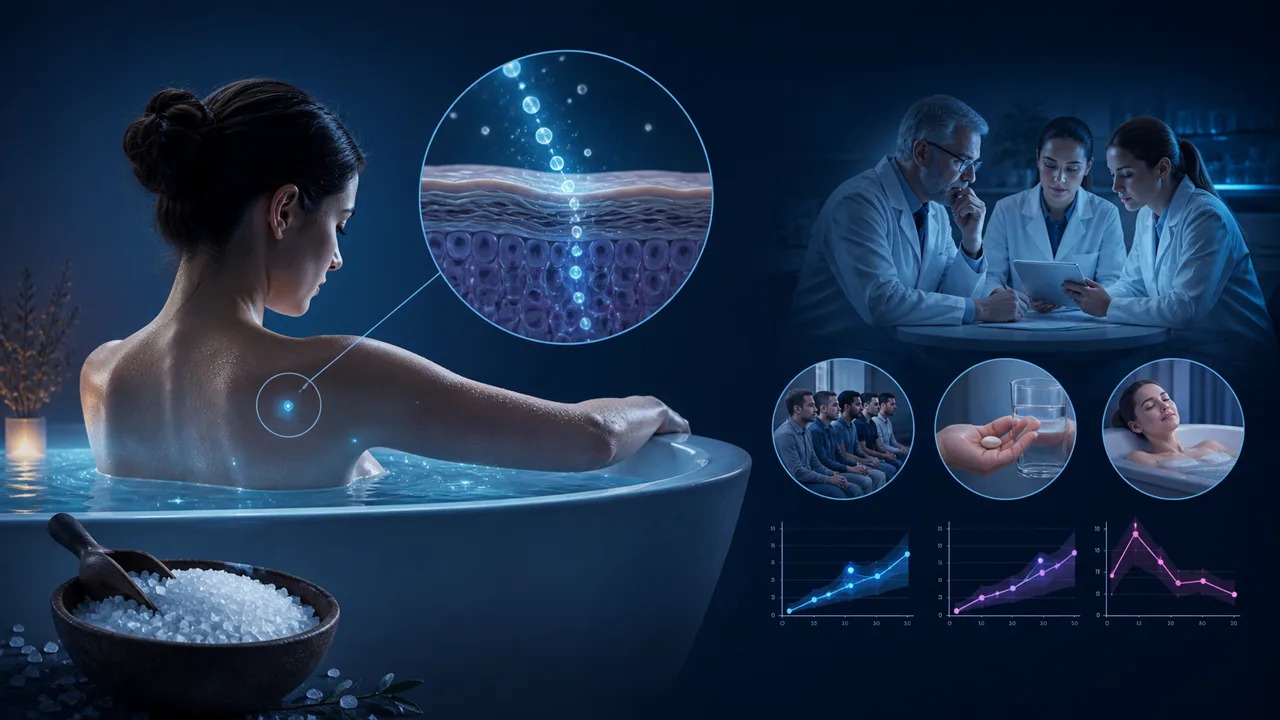
Epsom salt has nothing to do with table salt. It is magnesium sulfate, a mineral named after a bitter spring in Epsom, England, where it was first pulled out of the ground. Drop a cup into warm bathwater and it dissolves completely, splitting into a positively charged magnesium ion and a negatively charged sulfate ion.
That electrical charge is the whole story. Charged particles have a hard time crossing skin, and the entire Epsom salt bath industry is built on the claim that they manage it anyway, traveling out of the water, through your skin, and into your bloodstream to deliver calmer muscles, less stress, and better sleep. Whether that happens is a physics question first and a wellness question second, and the physics is not on the industry's side.
Can Magnesium Get Through Your Skin?
Almost certainly not in any amount that matters. The outer layer of your skin, called the stratum corneum, is a thin waxy layer of dead cells whose entire job is to block water and water-soluble molecules from moving in either direction. A charged magnesium ion is about as poor a fit for crossing that barrier as you can find. The only real shortcuts, hair follicles and sweat glands, cover roughly 0.1 to 1 percent of your skin's surface, nowhere near enough area to move meaningful magnesium into your blood.
The best controlled test we have confirms this. A 2017 randomized pilot by Kass and colleagues applied magnesium through a skin cream and tracked blood and urine levels. Across the full group there was no statistically significant rise in serum magnesium, and the researchers themselves called the study underpowered. Meanwhile, the one study the bath industry constantly cites, a small unpublished pilot tied to a University of Birmingham researcher claiming magnesium rose after repeated baths, was never peer reviewed. It exists only as a PDF hosted on a commercial Epsom salt trade site, with no control group and about 19 participants. A major review of transdermal magnesium research calls the whole approach scientifically unsupported. That is a lot of marketing sitting on one handout that never passed peer review.
The pilot study of a topical magnesium cream is useful because it measured both serum and urinary magnesium rather than relying on how participants felt. A few individual values moved, but the group result did not show a statistically reliable rise in blood magnesium. That is not proof that zero magnesium ever crosses skin. It means the study did not demonstrate absorption large or consistent enough to support the usual whole-body replenishment claim.
Is it the salt or just the warm water doing the work?
Nobody asks the obvious question: if a bath makes you feel better, how do you know the salt gets any credit? Warm water immersion by itself is a real, active intervention. It widens blood vessels and increases circulation to skin and muscle, physically loosens tight tissue, shifts your nervous system toward its rest and recovery mode, and helps trigger the natural drop in core body temperature that signals your brain it is time to sleep.
A meta-analysis on cold water immersion for muscle recovery found that water temperature and soak duration, not any additive, were what drove the results. That logic transfers cleanly to Epsom salt. The relaxation people feel is real, it is just a property of the bath, not the mineral. No trial has ever compared an Epsom salt bath against a plain warm bath at the same temperature and found the salt adds anything measurable. Until that study shows up, the salt is decoration on a warm bath that was already doing the work.
Bath research also has a built-in attribution problem. Warm-water immersion changes skin temperature, circulation, muscle tone, and the transition into sleep whether the water contains magnesium sulfate or not. To isolate the salt, a study needs the same water temperature, immersion time, setting, and expectations in both groups. Without that comparison, feeling better after an Epsom salt bath cannot tell us which part of the bath produced the change.
What about sore muscles after training?
Delayed onset muscle soreness, the stiff ache that peaks a day or two after a hard workout, is where Epsom salt earns most of its recovery reputation. The one relevant piece of evidence is a 2024 systematic review that pooled trials of oral magnesium supplements and found a modest drop in how sore people reported feeling, though the effect on real blood markers of muscle damage was inconsistent.
Notice the word oral. That review has nothing to do with soaking in magnesium, and given how little of it crosses skin, there is no working mechanism for a bath to replicate what the pill studies found. What a warm Epsom soak can genuinely do after a hard session is deliver comfortable heat that loosens stiff tissue and feels good, and that is worth something, it just is not the mineral doing it.
Stress, sleep, and where the real evidence points
Magnesium does have a legitimate, if modest, sleep story, but it belongs to the oral form. A meta-analysis of oral magnesium for insomnia in older adults found people fell asleep somewhat faster, though the researchers rated the underlying evidence as low quality. A separate double-blind, placebo-controlled trial found improved sleep time and efficiency in elderly participants taking 500 mg of oral magnesium daily. Every study people cite to defend Epsom salt for sleep used magnesium taken by mouth.
A bath's calming effect is easy to explain without invoking magnesium at all. Warm water lowers tension, quiets the body's stress response, and helps trigger the temperature drop that eases you toward sleep. Add a real wind-down ritual, dim lights, no phone, twenty quiet minutes, and you get a genuinely effective pre-sleep routine. The bath is doing the work. The salt is just along for the ride.
Oral versus transdermal magnesium: which one wins
Lined up side by side, this is not a close contest. Oral magnesium has randomized trials, a meta-analysis, and a believable mechanism behind it, since your gut is built to absorb minerals. Transdermal magnesium has a skeptical review that lands squarely on unsupported, plus a carefully run cream study that found no meaningful whole-group rise in blood magnesium. If your goal is correcting low magnesium or nudging your sleep, a supplement or magnesium-rich foods, think leafy greens, nuts, seeds, and legumes, will do far more than a tub of warm salt water.
This pattern shows up again and again with other compounds too. How something gets into your body often matters more than the substance itself, and for magnesium, skin loses to the gut every time.
Where Epsom Salt Fits in Recovery
None of this means an Epsom salt bath has no value. A warm bath can be relaxing, and relaxation may support a wind-down routine. The mistake is treating the salt as a proven magnesium-delivery or recovery system. Sleep, adequate nutrition, and sensible training progression have much broader evidence, while a plain warm soak may capture much of the comfort people attribute to the salt.
A bath also isn't a tissue-repair method. No controlled trial has shown that an Epsom salt soak speeds the healing of muscle, tendon, ligament, or a wound. Warm water may help someone feel looser and more comfortable, but comfort isn't the same as rebuilding tissue. Put the bath in the relaxation column, not the repair column.
How to use an Epsom salt bath sensibly
Keep the water comfortably warm rather than scalding and follow the product directions. Research does not establish one ideal soak time or salt concentration for recovery. Adding more salt should not be treated as a stronger dose of a proven therapy.
Do not drink Epsom salt solutions casually, since oral magnesium sulfate acts as a laxative and has medical uses with dosing constraints. Broken skin, heat intolerance, kidney disease, pregnancy, and medications that affect fluid or electrolyte balance can change the risk calculation. For an ordinary bath, the main evidence-backed benefit is the warm soak, not proven transdermal magnesium delivery.
Sources
- Myth or Reality-Transdermal Magnesium?
- Effect of transdermal magnesium cream on serum and urinary magnesium levels in humans: A pilot study
- Effects of magnesium supplementation on muscle soreness in different type of physical activities: a systematic review
- Oral magnesium supplementation for insomnia in older adults: a Systematic Review & Meta-Analysis
- The effect of magnesium supplementation on primary insomnia in elderly: A double-blind placebo-controlled clinical trial
- Can Water Temperature and Immersion Time Influence the Effect of Cold Water Immersion on Muscle Soreness? A Systematic Review and Meta-Analysis
Educational content only. Not medical advice.