Wellness
Grounding Benefits: An Honest Evidence Audit
Grounding, also known as earthing, rests on a real physics fact and a shaky biology claim. This audit walks through who funded the research, why that matters, and which two studies survive independent scrutiny: a Taiwanese sleep trial in Alzheimer's patients and an Austrian muscle-recovery study in trained athletes. Everything else in the grounding literature, from cortisol to inflammation to blood viscosity, comes from a small cluster of authors tied to the company that sells the product.
Published by PeptideSchool Editorial Desk

What grounding is
Grounding, sometimes sold under the name earthing, means putting your skin directly on the surface of the earth. The idea behind it is that free electrons sitting in the soil move into your body and neutralize inflammatory free radicals, the unstable molecules that damage cells. In real life this looks like standing barefoot on wet grass, walking on damp sand, or, in the version companies sell you, sleeping on a conductive sheet wired into the ground pin of a wall outlet.
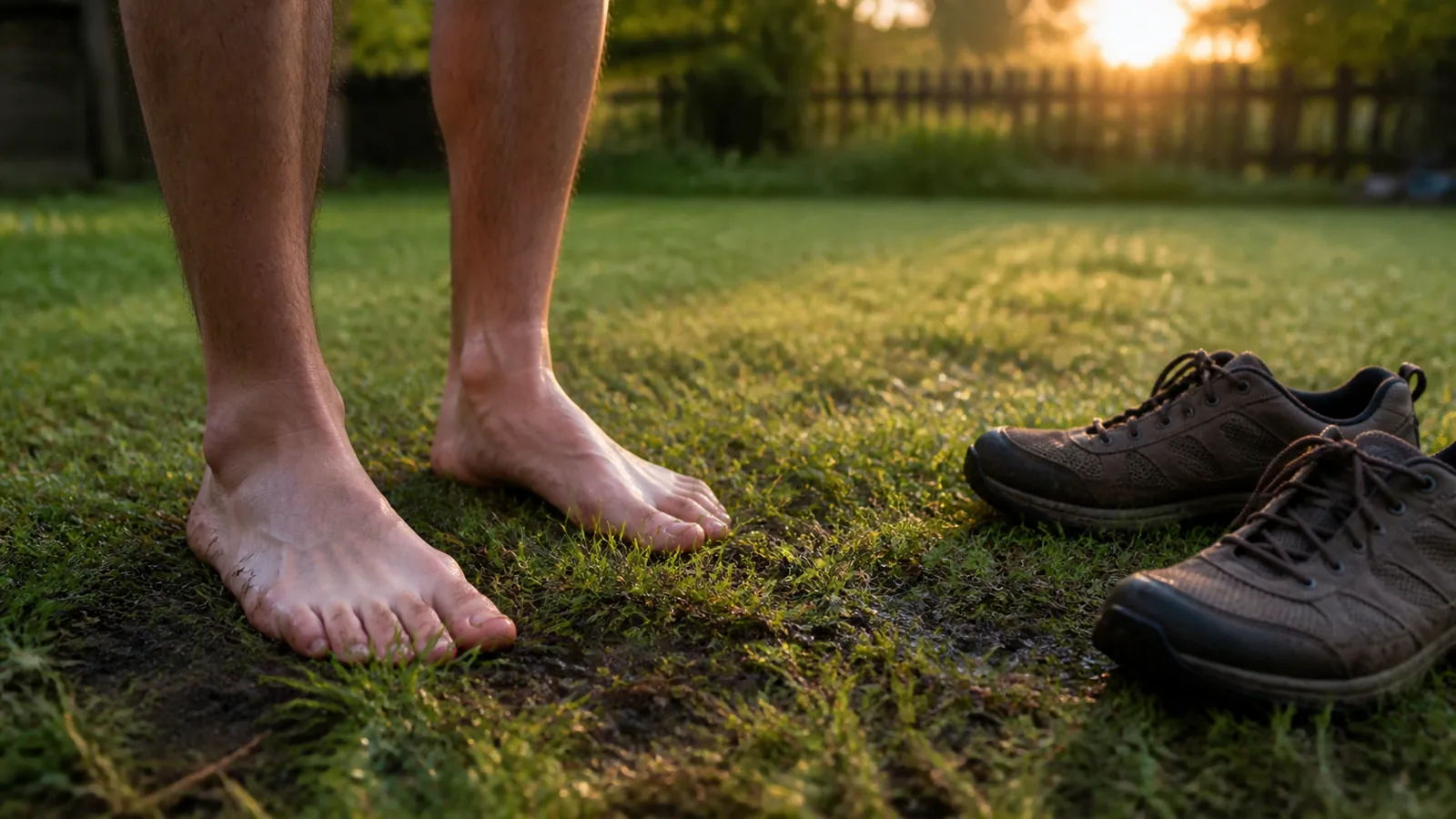
The pitch mixes a true fact with a big assumption. The true fact is boring: the earth's surface sits at close to zero volts, and your body's voltage equalizes to that when you touch the ground. Nobody disputes this. The assumption is where things get shaky. It claims that this electron exchange meaningfully lowers oxidative stress, the cellular wear and tear caused by excess free radicals, inside living tissue. That second part is the claim this audit tests, and it holds up far less well than the marketing suggests.
The electron-transfer claim is weak
The core mechanism behind grounding says that electrons from the earth flow into your body and mop up reactive oxygen species, the chemical family that includes most free radicals. Nobody has ever measured this electron flow directly inside a living person or animal. Every place this claim shows up traces back to a narrative review, an opinion-style paper that summarizes other people's work rather than running a new experiment, and those reviews were written by authors connected to EarthFx Inc., the company that sells grounding sheets and mats.

The most-cited source for this mechanism is a 2012 review in the Journal of Environmental and Public Health (PMID 22291721), and it is openly a review of earlier EarthFx-linked work, not a fresh experiment. Skin voltage does change measurably when you ground yourself, that part is real and repeats easily. What has never been shown is the next link in the chain: that any change in tissue antioxidant activity tracks with that voltage shift closely enough to explain a health outcome. Until someone measures that directly, without a company footing the bill, the mechanism stays a hypothesis rather than a finding.
Who funds the grounding research
Nearly every positive grounding study published between 2004 and 2019 traces back to a small group of repeat authors: Gaetan Chevalier, Stephen Sinatra, James Oschman, and Pawel Sokal, usually alongside a few co-authors. Most of this output is tied to EarthFx Inc., the company selling the grounding sheets, mats, and patches these same studies test. That is a textbook conflict of interest, a situation where the person running the study stands to gain financially if the results come back positive, and current reporting standards require it to be disclosed.
A conflict of interest does not automatically make a finding false. But it should lower how much confidence you place in it. Industry-funded studies from a tight cluster of repeat authors have a long, well-documented history of failing to replicate once independent researchers take a look, whether in nutrition science, cardiology, or sleep research. The right response is not to dismiss the data outright. It is to ask which findings hold up once you set the conflicted studies aside. Only two do, and they are the two worth paying attention to.
Cortisol and sleep: weak to moderate
The original grounding and sleep claim comes from Ghaly and Teplitz, 2004 (PMID 15650465), which reported that sleeping grounded normalized the overnight cortisol curve, the hormone rhythm that should peak in the morning, in a small open-label group, with subjective sleep scores improving too. The problems are familiar by now: a small sample, no blinding, EarthFx funding, and nobody has replicated it at that quality since.
The finding that changes the picture is Lin and colleagues, 2022 (PMID 35327058), a pilot randomized controlled trial in mild Alzheimer's patients in Taiwan, run by a group with no disclosed ties to EarthFx. It showed a real improvement on the Pittsburgh Sleep Quality Index, a validated self-report scale, with grounded sleeping. It is still a pilot study with a modest sample size, but it is the strongest independent sleep data anywhere in the grounding literature, which is why it earns a moderate grade instead of a weak one.
Inflammation and HRV: weak
The claim that grounding lowers inflammatory markers rests mostly on thermal-imaging photos and case reports, not on blinded trials measuring real biomarkers. The 2015 review by Oschman and colleagues (PMID 25848315) pulls together mostly small, industry-tied studies, but it is a synthesis, not a primary randomized trial. The honest read is that the direction of effect looks plausible on paper, but the trials that could confirm it simply have not been run.
Heart rate variability, the small beat-to-beat timing differences that reflect how balanced your nervous system is between stress and recovery, tells a similar story. Chevalier and Sinatra's 2011 work found shifts toward parasympathetic tone, the rest-and-digest side of the nervous system, after short grounding sessions, but the sample was small, the exposure brief, there was no active comparator, and the authors are EarthFx-linked. The 2013 blood viscosity paper (PMID 22757749) has the same shape: it used red cell zeta potential, a measure of the electrical charge that keeps blood cells from clumping together, in just ten subjects, with no placebo arm.
The independent recovery study
The 2019 study out of the University of Salzburg by Muller and colleagues (PMID 30745882) is the cleanest design anywhere in the grounding literature. It was triple-blind, meaning the subject, the trainer, and the analyst were all kept in the dark about group assignment, and it was a sham-controlled crossover. Researchers used heavy eccentric loading, the lengthening phase of a muscle contraction that causes the most microscopic damage and soreness, as a standardized stress test, then measured creatine kinase and interleukin markers. Grounded sleeping blunted those markers compared to sham.
What makes this study stand out is not the size of the effect, which was modest, but the quality of the design. Triple-blind, sham-controlled crossovers are the gold standard for testing a sleep-environment intervention, and nobody in the EarthFx cluster has ever published anything close to this quality. It came from an independent European sports-science group, tested trained athletes, and used a concrete physical stress challenge rather than a vague wellness questionnaire. That combination is why this single paper carries more weight than most of the rest of the grounding literature put together.
Grounding vs established anti-inflammation tools
Even taking the Muller result at face value, grounding has a much smaller and less replicated evidence base than established recovery practices such as adequate sleep, progressive exercise, and sufficient nutrition. The comparison should be based on breadth and independence of evidence, not a claim that all of these interventions move the same biomarker in the same way.
The useful question is where grounding fits on a priority list. If sleep, training load, and nutrition are not in place, a grounding mat is not supported as a substitute. Barefoot outdoor time may still be pleasant and inexpensive, but any effect from grounding itself is difficult to separate from movement, daylight, and time outside.
Side effects and when not to ground
For most people, the risks here are minor. Grounding outdoors on soil is low risk for healthy adults, with the main concern being cut feet or infection if you step on something sharp. Indoor grounding products, the sheets, mats, and patches wired into a household outlet's ground pin, route a low-current electrical path from the building's wiring into your body. Anyone with a pacemaker, an implanted defibrillator, or similar cardiac device should talk to the clinician managing that device before starting indoor grounding.
The EarthFx-linked blood-viscosity work has raised a theoretical question about anticoagulant use, but the evidence is too weak to quantify an interaction. Anyone using anticoagulants or managing an implanted electrical device should ask the relevant clinician before using a product that connects the body to household grounding.
How to try grounding honestly
If you want to try outdoor grounding, treat it as time outside rather than a validated dose. The studies do not establish an ideal number of minutes or sessions per week. Avoid unsafe surfaces, and do not credit a change automatically to electron transfer when daylight, walking, relaxation, and expectation are changing at the same time.
This audit is not telling you to stop grounding. It is telling you to set your expectations at the right level. Two claims survive with independent backing: sleep quality improvements in Alzheimer's patients, and muscle recovery improvements in trained athletes. Everything else, cortisol, heart rate variability, general inflammation, blood viscosity, and the electron-transfer mechanism itself, rests on small, industry-funded studies that outside researchers have not yet replicated. Keep that distinction in mind before spending real money on grounding hardware.
Sources
- Earthing: health implications of reconnecting the human body to the Earth's surface electrons
- The biologic effects of grounding the human body during sleep as measured by cortisol levels and subjective reporting of sleep, pain, and stress
- Pilot study on the effect of grounding on delayed-onset muscle soreness
- Earthing (grounding) the human body reduces blood viscosity
- The effects of grounding (earthing) on inflammation, the immune response, wound healing, and prevention and treatment of chronic inflammatory and autoimmune diseases
- The Effects of Grounding (Earthing) on Bodyworkers' Pain and Overall Quality of Life: A Randomized Controlled Trial
- Effectiveness of Grounded Sleeping on Recovery After Intensive Eccentric Muscle Loading
- Integrative and lifestyle medicine strategies should include Earthing (grounding): Review of research evidence and clinical observations
- Grounding the Body Improves Sleep Quality in Patients with Mild Alzheimer's Disease: A Pilot Study
Educational content only. Not medical advice.