Peptide Guides
What Is Peptide Education? A Beginner's Guide to Learning the Science
Peptide education is a structured way to learn the biology, evidence, regulation, and source-reading skills behind peptide claims. This guide explains the five domains a useful curriculum should cover, how to judge an article you find online, and how PeptideSchool turns one focused public answer into an organized research workspace.
Published by PeptideSchool Editorial Desk

What peptides are
Start with the smallest piece first. Amino acids are twenty small molecules your body uses as building blocks. When you eat protein, your gut breaks it down into free amino acids, and your cells then reassemble those amino acids into whatever they need next. String together somewhere between two and fifty of them and you have a peptide. Go longer than that and the field calls it a protein instead. That line is not a hard rule, it is more of a working convention researchers use to keep the vocabulary manageable.
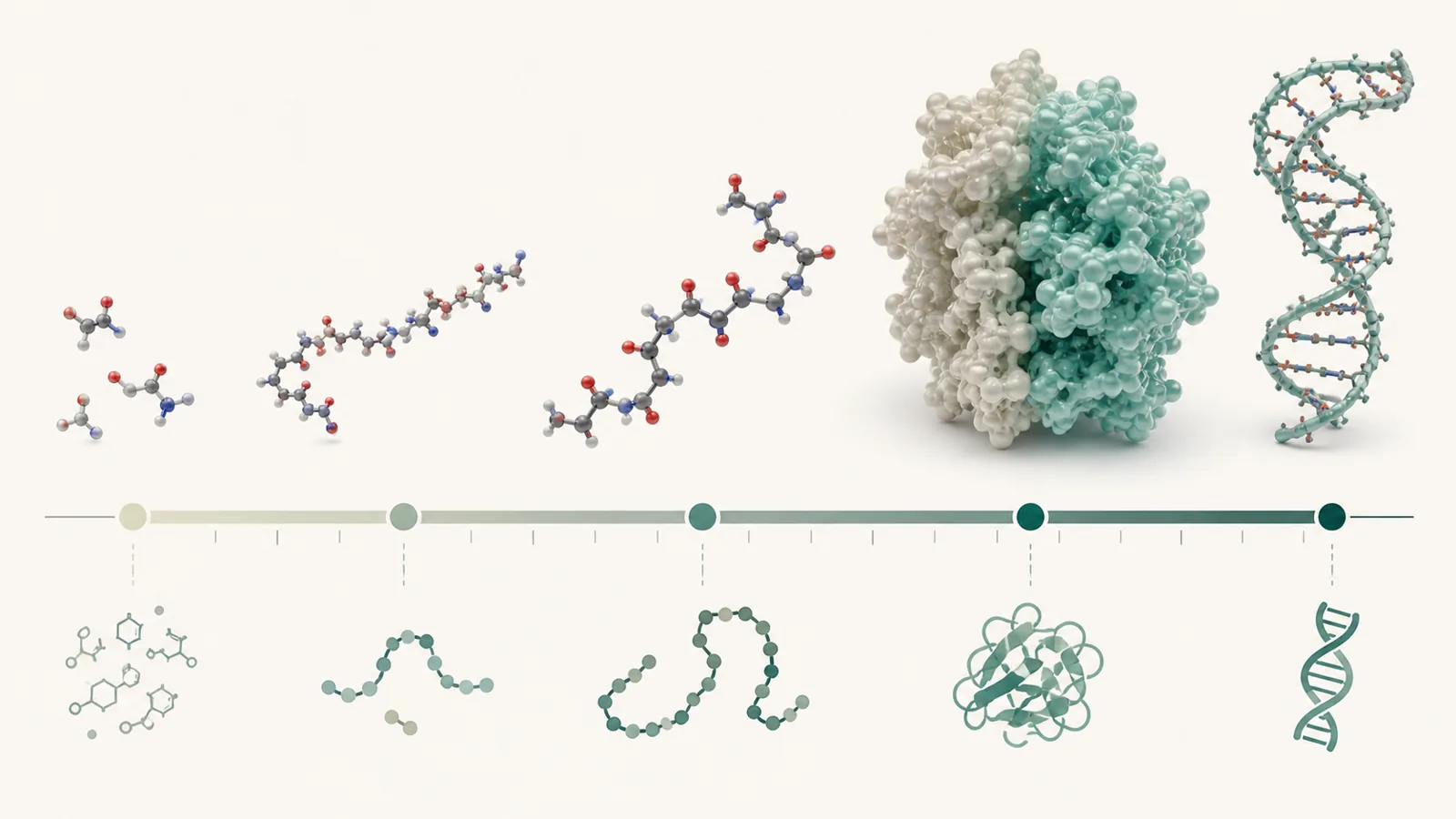
Peptides are not some lab novelty. Your pancreas releases insulin, a 51-amino-acid peptide, every time you eat. Your hypothalamus makes oxytocin, just 9 amino acids, when you hug someone. Your stomach releases ghrelin, 28 amino acids, when it is empty. Peptides are how your cells talk to each other, both across short distances and across your entire body. Two comprehensive reviews, from Lau and Dunn in 2018 and Muttenthaler and colleagues in 2021, trace how this natural signaling vocabulary eventually became the basis for modern peptide drugs.
Here is why that one paragraph matters more than it looks. It already leaned on four ideas, amino acids, cell signaling, hormones, and half-life, that most beginner content just assumes you already know. Read a forum thread instead of a structured explainer and that same paragraph turns into alphabet soup. Good peptide education builds the vocabulary first and layers the rest of the science on top of it, instead of assuming you arrived already fluent.
Why beginners need structure, not just search results
Most peptide content floating around online falls into one of two buckets: a product page trying to sell you something, or a forum thread full of anecdotes. A 2021 systematic review by Suarez-Lledo and Alvarez-Galvez found that health misinformation is widespread across social platforms, with the worst concentrations showing up in content about vaccines, drugs, and chronic disease. Peptides sit right in that danger zone, because they touch weight loss, longevity, and aesthetics, which happen to be the exact topics that generate the most influencer revenue.
Three things make peptides an especially hard subject to self-teach. First, the vocabulary is dense. Ask about peptides and within five minutes you are hearing about half-life, receptor agonism, pharmacokinetics, and primary structure. Second, the regulatory picture is genuinely messy. Some peptides are FDA-approved drugs, like semaglutide and liraglutide. Others are sold as research compounds under disclaimers that legally restrict them from human use. A lot sit in a grey zone that the FDA has been quietly reworking for years.
Third, and this is the one that causes harm, the information environment is loud and commercially motivated. Emergency department data published by Geller and colleagues in the New England Journal of Medicine documented more than 23,000 ER visits per year in the United States tied to dietary supplements, with weight-loss and energy products responsible for most of the cardiovascular events. That is the noise floor a beginner is trying to read through when they open a random peptide article. Structured education is not about telling you what conclusion to reach. It is about giving you the vocabulary and an evidence-grading framework before you hit your hundredth unsourced claim online.
The five domains a complete curriculum should cover
A genuinely complete peptide curriculum covers five things: the biology of what peptides are and how they signal, the history from 1923 insulin to today's GLP-1 market, the pharmacology of half-life and receptor selectivity, the safety and regulatory landscape, and evidence literacy, meaning the skill of reading a trial and spotting a conflict of interest. Skip any one of these five and you end up with a blind spot that a confident-sounding marketer will happily fill for you.
Picture five concentric rings. The innermost ring is mechanism, meaning what the molecule does once it reaches a receptor. You do not need to memorize every signaling pathway, but you should understand that peptides bind specific receptors the way a key fits a specific lock, and that the same receptor can trigger different effects in different tissues. That is exactly why semaglutide affects appetite through brain receptors and blood sugar through pancreas receptors at the same time.
The next ring out is history. Insulin became the first peptide drug in 1923 and was extracted from animal pancreases for decades afterward. Recombinant DNA technology in the 1980s let labs grow human-identical insulin in bacteria instead. Fatty-acid modifications developed in the 2010s produced liraglutide and later semaglutide, stretching GLP-1's natural two-minute half-life into a drug you can inject once a week, as detailed in Knudsen and Lau's 2019 review. That same engineering pattern explains most of the peptide drugs currently in the pipeline.
Third ring: basic pharmacology. How is the peptide absorbed? How long does it last in the bloodstream? Which receptor does it hit, and how selectively? Oral delivery is the hardest problem in the field. Drucker's 2020 review in Nature Reviews Drug Discovery walks through why most peptides never survive the stomach intact, and what the few oral products that do exist, like oral semaglutide and oral octreotide, had to engineer around that obstacle.
Fourth ring: safety and regulation, which is exactly where a lot of beginner content quietly fails its readers. An FDA-approved peptide has gone through phase 3 trials involving thousands of participants, plus ongoing post-market surveillance. A peptide sold as research use only has none of that behind it, and the marketing copy is frequently just a thin cover for a regulatory workaround. Understanding that distinction matters more than memorizing facts about any single peptide.
Fifth ring: evidence literacy. Henninot and colleagues counted hundreds of peptide therapeutics currently in development in their 2018 medicinal chemistry review. Most of them will fail somewhere in the trial process, which is normal for drug development generally. Learning to tell a rat study apart from a small open-label case series, or from an real randomized controlled trial, and learning to check whether a journal is indexed and whether the authors disclosed their funding, is the durable skill that keeps working long after any single course ends.
How to judge a peptide source you stumble across
When a peptide article shows up in your feed, run it through four questions before you take any of it seriously. Does it cite real primary research? A PubMed link, a DOI, or a specific journal name with year and volume is the minimum bar. A phrase like studies show, with nothing linked, is not a citation, it is a rhetorical trick dressed up as one.
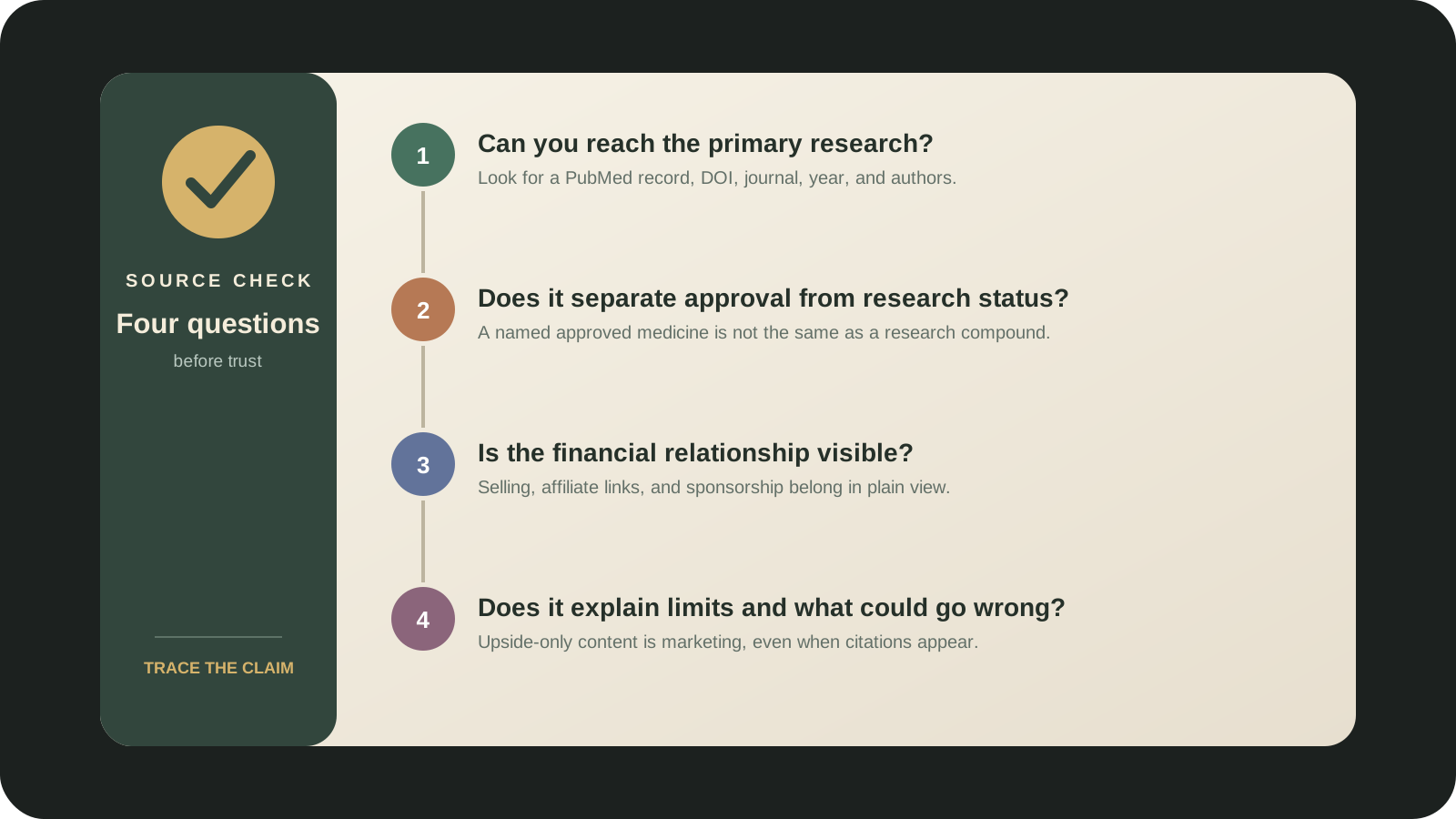
Does it distinguish FDA-approved status from research-compound status? Semaglutide and a research peptide like BPC-157 are not the same regulatory animal, and any source that treats them as interchangeable is either being careless or is trying to sell you something under a friendlier label.
Does the author disclose their financial relationship to the product? A clinic selling peptide protocols writing glowingly about peptide protocols is not a neutral narrator, even when the underlying science they cite is accurate. The same logic applies to influencer content where the affiliate link is buried below the fold instead of disclosed up front. And finally: does the piece mention what could go wrong? Trustworthy sources name side effects, drug interactions, and the people who should avoid a given compound. Content that only ever describes upside is marketing, not education, no matter how many citations it drops in.
Where a beginner should start
Most newcomers should tackle three things in order: a foundational grasp of what peptides are at the molecular level, a working vocabulary for reading research (half-life, receptor selectivity, the difference between an RCT and a case series), and a survey of the most-studied peptide families, such as GLP-1 agonists, growth-hormone-releasing peptides, and copper peptides. Depth on any one specific peptide should come after that scaffold is in place, not before it.
The natural temptation when you discover this topic is to dive straight into whatever specific compound a friend mentioned. Resist that for a week if you can. Read a foundations explainer first. Then read one peptide deep-dive. Then read a contrasting one. By the third deep-dive you start noticing the recurring pattern, a receptor, a half-life, a clinical trial, a regulatory status, and the whole field stops feeling overwhelming and starts feeling navigable.
Concretely: if you are curious about weight loss, look at how the GLP-1 mechanism and trial data are covered for semaglutide. If you are curious about recovery and soft tissue, look at how the evidence quality conversation plays out for BPC-157. If you are curious about skincare, look at GHK-Cu, a peptide your body already produces naturally, with Pickart's 2015 review serving as the technical anchor. Those three examples alone will teach you most of what the wider field has to offer, even if you never read a fourth deep-dive.
How PeptideSchool Continues the Learning
Public PeptideSchool articles handle the first job: explain one question clearly, show the source trail, and separate established evidence from early research. The Blog covers beginner guides, comparisons, wellness topics, research updates, and regulatory changes, so a reader can get oriented without working through a formal course.
Inside the app, the Peptide Library organizes compound profiles in a consistent format. A free account can explore the available overview experience. Premium opens the deeper profiles, comparisons, saved research, and tools that turn scattered reading into a reusable workspace. That is the real dividing line: the public article answers a focused question, while the product keeps the wider research organized over time.
There is no promised quiz, module sequence, or PeptideSchool certification attached to this article. The next step is concrete: choose a compound or question, open the relevant profile or comparison, and follow its evidence trail. Readers who want a scheduled study plan can use the separate beginner roadmap instead of repeating this explainer.
Sources
- Therapeutic peptides: Historical perspectives, current development trends, and future directions
- Trends in peptide drug discovery
- Prevalence of Health Misinformation on Social Media: Systematic Review
- Emergency Department Visits for Adverse Events Related to Dietary Supplements
- The Discovery and Development of Liraglutide and Semaglutide
- Advances in oral peptide therapeutics
- The Current State of Peptide Drug Discovery: Back to the Future?
- GHK Peptide as a Natural Modulator of Multiple Cellular Pathways in Skin Regeneration
Educational content only. Not medical advice.