Peptide Guides
Peptide Education for Beginners: A Clear Roadmap to Learning the Science
A four week reading plan for someone starting peptide science from zero. It builds the essential vocabulary first, then moves through receptor signaling, real compound examples, and evidence grading. Each week ends with a simple output the reader can check, so progress means being able to explain and evaluate a claim, not just recognizing more peptide names.
Published by PeptideSchool Editorial Desk

What a Peptide Is
Strip away the jargon and a peptide is a chain of amino acids linked by peptide bonds. Many teaching sources use roughly two to fifty amino acids as a convenient rule of thumb, but biology does not enforce one universal cutoff between peptide and protein. Your body uses many peptides as signals: insulin helps regulate glucose, oxytocin is involved in childbirth and social bonding, and GLP-1 participates in appetite and glucose control.
Once that clicks, every new peptide you run into becomes a lot less mysterious. Semaglutide, BPC-157, GHK-Cu, it does not matter which one shows up in your feed next. The first question is always the same: what signal is this chain carrying, and what is listening for it. Everything past that is detail work.
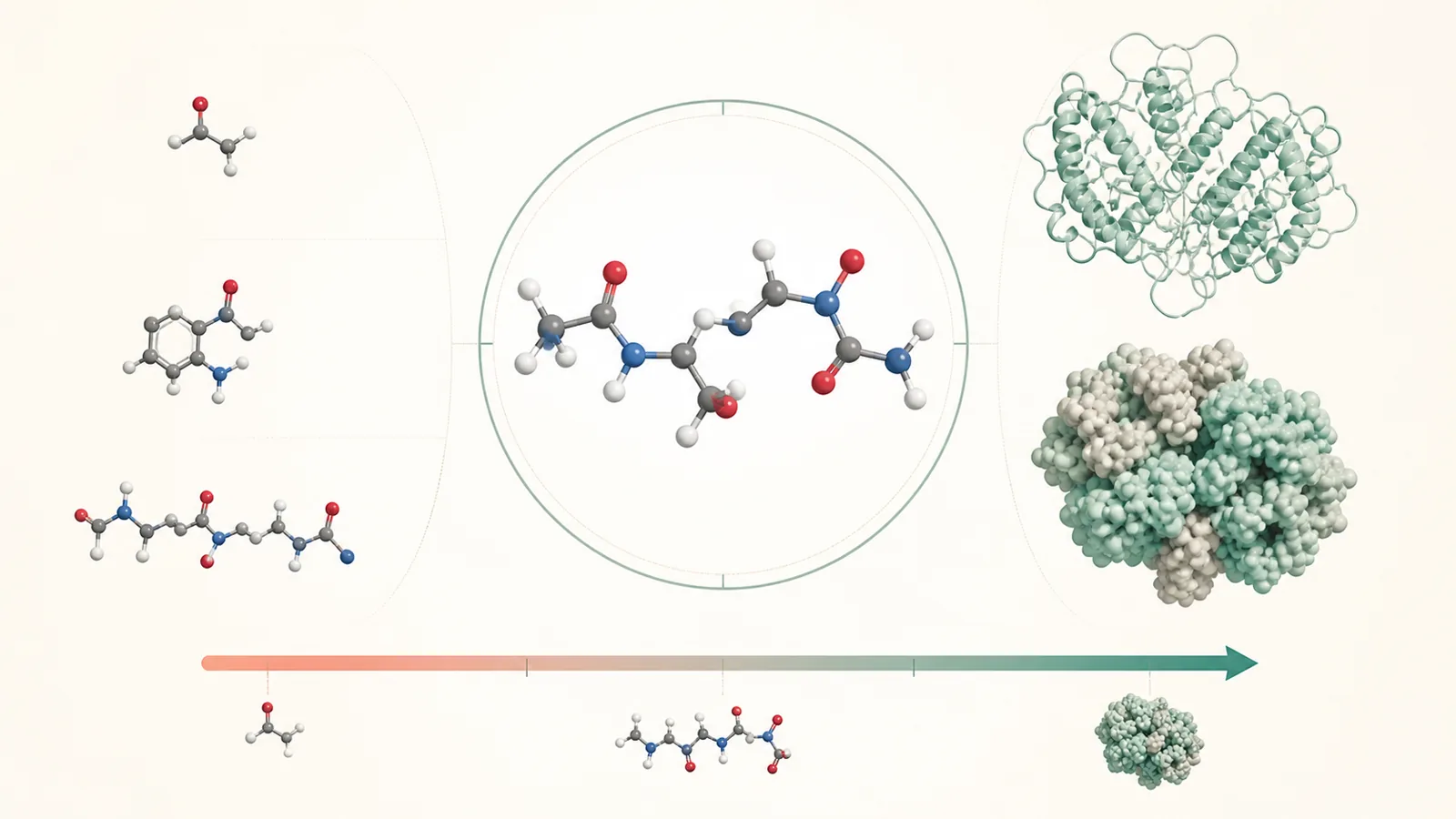
Peptides sit in the middle of a size spectrum. Proteins are the bigger cousins, usually over fifty amino acids, folded into complicated three-dimensional shapes. Small-molecule drugs like ibuprofen or metformin are much smaller, built from a handful of atoms with no amino acid backbone at all. Peptides land in between. Big enough to carry a specific message, small enough that a lab can synthesize them, and short-lived enough that the body can flip their signals on and off quickly.
Why This Matters More Now Than It Used To
Peptide education matters right now because the category grew faster than public understanding of it. GLP-1 weight loss drugs are dinner table conversation. Gray-market research peptides sell openly online. Forum threads mix FDA-approved medicines with unapproved lab compounds as though they belong in the same basket. Learning the real science is really the only honest filter available to a curious reader.
A handful of years ago, most people could name insulin and maybe oxytocin. Now a new reader can scroll through twenty peptide names in one afternoon: semaglutide, tirzepatide, BPC-157, TB-500, melanotan, GHK-Cu, selank, semax, ipamorelin, sermorelin, retatrutide, and more. These are not the same kind of thing at all. Some are FDA-approved medications backed by phase three trial data covering tens of thousands of patients. Others are research peptides with interesting animal data and no human trials behind them. Some are sold with no purity testing whatsoever.
That mismatch is exactly why a viral post can casually claim the same benefits for a rigorously trialed drug and a compound that has only ever been tested in rodents. Learning the fundamentals will not tell you what to take. What it does is hand you the vocabulary to tell those two very different situations apart.
The payoff of learning mechanisms instead of memorizing names is that new claims become easier to question. Receptor, route, half-life, evidence level, and regulatory status give you a repeatable checklist. They do not let you predict a compound's effect from its name or pathway alone.
The Four Foundations Worth Learning First
Before reading about any specific peptide, a beginner is best served by learning four things in order: amino acids, peptide bonds, peptide signaling, and receptor binding. They stack on each other. Skip ahead to specific compounds without these four ideas in place and you end up memorizing names instead of understanding how any of it works.
Start with amino acids. There are twenty standard ones, each a small molecule built on a shared backbone with a side chain that gives it personality. Some side chains carry a charge, some are oily, some are tiny, some are bulky. That personality is why glycine behaves nothing like tryptophan, and it is why a chain of amino acids can fold into something capable of doing real work. You do not need to memorize all twenty structures. Knowing they exist, that there are twenty flavors, and that the order matters is enough to move forward.
Next comes the peptide bond. Two amino acids snap together when an enzyme, or a chemist in a lab, pulls a water molecule out from between them and links their backbones with a single chemical bond. String a few dozen of those bonds together and you have a peptide. String hundreds together and you have a protein. This bond is the universal glue of biology, which is exactly why the word peptide can refer to a hormone, a signaling molecule, a fragment cut from a larger protein, or a compound designed deliberately in a lab. Underneath, they are all built the same way.
Third is peptide signaling. Your body has been using peptide chains as internal messages for hundreds of millions of years. The pancreas releases insulin, 51 amino acids long, to tell cells to absorb sugar from the bloodstream. The gut releases GLP-1, roughly 30 amino acids, to tell the brain you are full and to nudge the pancreas toward releasing insulin. The pituitary gland releases oxytocin, just 9 amino acids, during bonding and childbirth. Each of these is a specific sequence carrying a specific instruction. Grasping that peptides are messages, full stop, is the single biggest unlock for anyone starting out.
Fourth is receptor binding. A message means nothing without someone listening for it. Peptides do their work by physically docking into a receptor, a protein sitting on the surface of a cell that acts like a molecular lock waiting for the right key. When the correct peptide reaches the correct receptor, the receptor changes shape and sets off a chain of events inside the cell. That chain of events is what we call the peptide's effect. Most peptide drugs are engineered around exactly this idea: find a useful receptor, design a peptide that binds it tightly, and slow down how fast the body breaks that peptide apart.
Mistakes Beginners Make and How to Avoid Them
Four mistakes show up again and again with new readers: treating every peptide as one category, assuming natural automatically means safer, blurring the line between FDA-approved drugs and research compounds, and trying to learn from forum stories instead of mechanisms. Each one traces back to skipping the foundations above.
The first is the all peptides are similar trap. Peptide is a chemistry term, not a description of function. A peptide studied for wound healing has almost nothing functionally in common with one that regulates appetite, even if both happen to be exactly twenty amino acids long. Reading that one peptide caused a side effect and concluding all peptides carry that risk is the same logical error as trying one antibiotic, having a bad reaction, and deciding all medicine is dangerous. The category is simply too broad to generalize about.
The second is the naturalistic fallacy. Some peptides your body makes on its own are well tolerated and well understood. Plenty are not. Delta sleep-inducing peptide has been studied for decades with mixed results. On the flip side, semaglutide is a synthetic modification of a natural peptide and has been through trials involving tens of thousands of people with a well-documented safety profile. Being natural is not a safety guarantee. Evidence quality and manufacturing quality are what matter.
The third is conflating FDA-approved peptide drugs with research peptides. Semaglutide, tirzepatide, liraglutide, and tesamorelin have all gone through phase one, two, and three trials, with public adverse event reporting and manufacturing oversight behind them. BPC-157, TB-500, epitalon, and many others have not been through that process. They might have interesting preclinical data, but no human approval sits behind them. Treating these two groups as interchangeable, which forum threads often do without saying so directly, erases a massive difference in evidence and oversight.
The fourth is the more is more assumption. Peptide receptors are extremely sensitive. Natural signaling pulses last minutes and clear out fast. The peptide drugs that succeed in the clinic tend to be just stable enough to dose once a day or once a week, not maximally stable. Beginners who approach peptides with a bodybuilding style more is better mindset miss the whole point of how this signaling system was built to work.
A Four Week Study Plan You Can Follow
Use four short sessions and one review session each week. The pace is flexible. The output is not. At the end of every week, produce one page of notes in your own words. If you cannot explain the idea without copying a definition, stay with it before moving on.
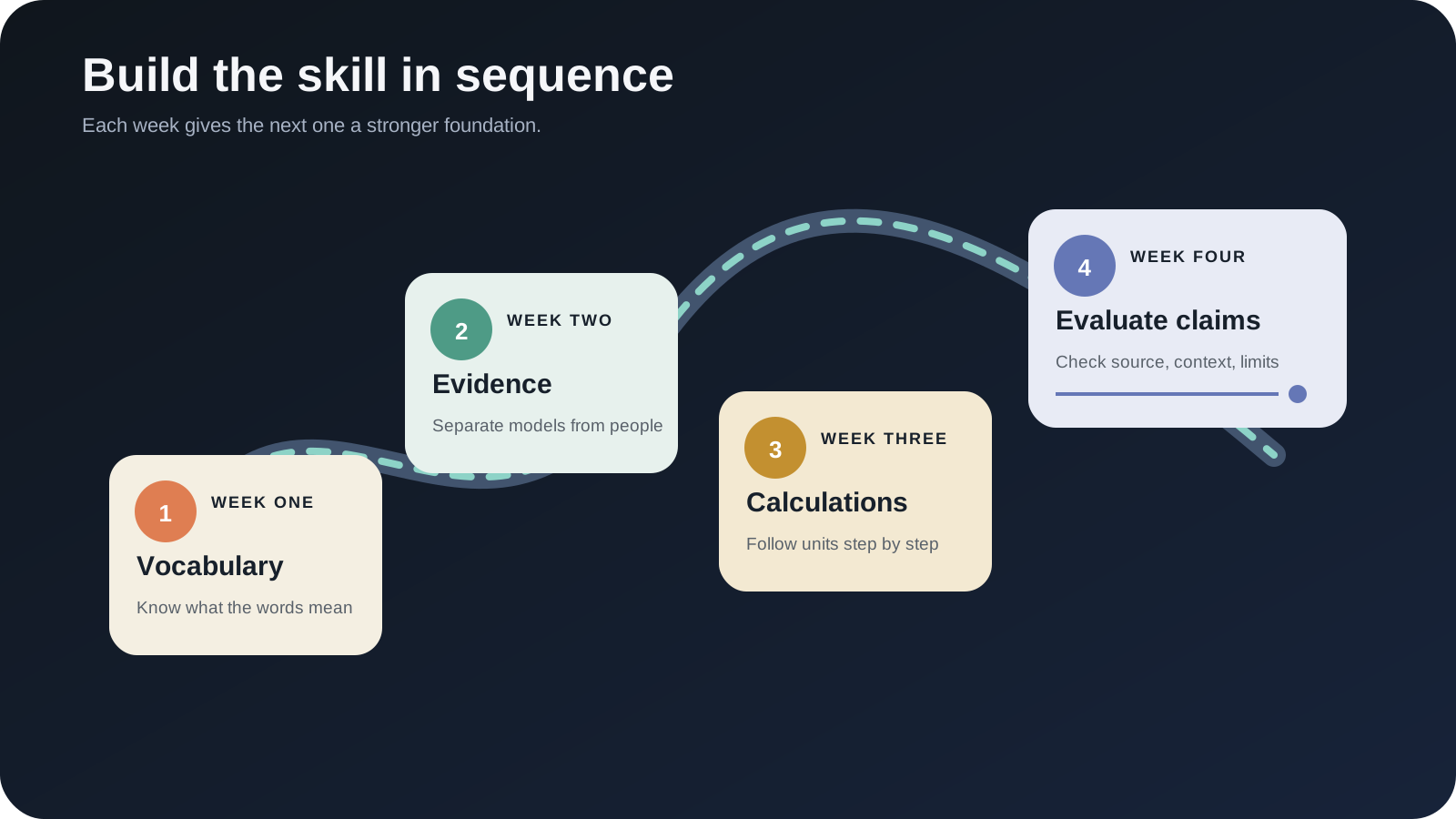
Week one covers the building blocks. Session one: learn what an amino acid is and why side chains matter. Session two: draw or describe how a peptide bond joins two amino acids. Session three: compare a peptide, a protein, and a small-molecule drug. Session four: explain insulin, oxytocin, and GLP-1 as three different messages built from the same chemical alphabet. For the review, write a five-sentence answer to the question, what is a peptide?
Week two covers signaling. Session one: learn what a receptor does. Session two: separate agonists, antagonists, and partial agonists. Session three: learn half-life and why natural peptides often disappear quickly. Session four: look at how a drug designer can change a peptide to last longer or bind more selectively. For the review, choose one familiar peptide and map the chain from molecule to receptor to cellular response.
Week three covers real examples and status. Compare one approved peptide drug, one research-only compound, and one topical cosmetic peptide. For each, record the intended use, evidence level, regulatory status, known limitations, and strongest source you can find. The point is not to decide which one is best. It is to see how three compounds that share the word peptide can live in completely different evidence categories.
Week four covers claim checking. Read one abstract, then identify the study type, population, comparison group, duration, endpoint, and main limitation. Check whether the compound has an FDA label or only preclinical research. Look for conflicts of interest and compare the article's wording with what the source measured. Finish by taking one peptide claim from social media and writing a short verdict: supported, plausible but unproven, or unsupported, with one sentence explaining why.
Quick answers
Common questions
Do beginners need a biology background to learn peptide science?
No. A clear sequence can start with amino acids, peptide bonds, receptors, and evidence levels before moving into individual compounds and more technical studies.
Where should a beginner start?
Start with the basic vocabulary, then learn how receptor signaling works and how human, animal, and laboratory evidence differ. That foundation makes later claims easier to evaluate.
What does real progress look like?
Progress means being able to explain a concept clearly, locate the original evidence, and recognize when a claim reaches beyond the study that supports it.
Sources
- Therapeutic peptides: historical perspectives, current development trends, and future directions
- Peptide therapeutics: current status and future directions
- The discovery and development of liraglutide and semaglutide
- Trends in peptide drug discovery
- Once-weekly semaglutide in adults with overweight or obesity (STEP-1)
Educational content only. Not medical advice.