Wellness
Sugar Face Guide: What Sugar Does to Skin, Teeth, and Aging
"Sugar face" is one catchy label for several different issues. Acne, glycation, dental damage, body composition, and morning puffiness do not share one cause or one timeline. This guide shows where sugar has a credible link, where the claim is overstated, and how to test a change without confusing it with sleep, sodium, alcohol, or skincare.
Published by PeptideSchool Editorial Desk
Why “Sugar Face” Became a Thing
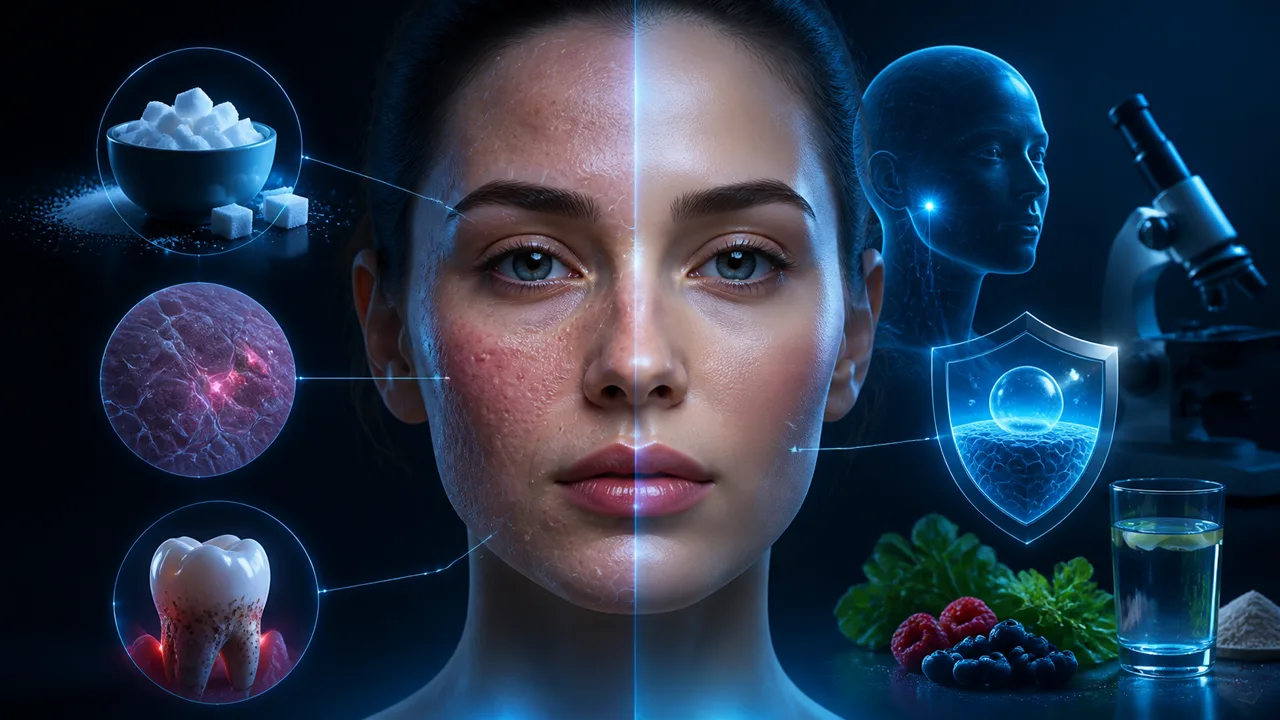
Sugar face is a catch-all term that blames one ingredient for a long list of separate problems: acne, dullness, puffiness, weight gain, and skin aging. It sticks because the story is simple. Cut sugar, look better. Reality is messier. Some of these claims hold up under scrutiny, some are real biology stretched past what the data shows, and some are mostly repeated online without much backing at all.

The useful move isn't to accept or dismiss the label. It's to separate each claim, match it to the right mechanism, and ask what kind of evidence would prove it. That is how the rest of this guide is organized.
Acne: the most practical skin link
Lower-glycemic diets have improved acne symptoms in randomized trials and systematic reviews, most likely by way of insulin and IGF-1 pathways that affect sebum production, inflammation, and skin cell turnover. The American Academy of Dermatology lists diet as one factor worth adjusting for acne-prone skin.
This does not mean sugar causes acne in everyone. Plenty of people eat sugar regularly and never develop it. What the evidence supports is narrower: acne-prone people may see improvement by cutting sugary drinks and refined, high-glycemic carbohydrates. Standard skincare, sunscreen, and dermatologist-guided treatment still matter more than any single dietary change, and current clinical guidelines treat diet as a supporting factor, not a primary treatment.
Glycation: real biology, not proof of instant aging
Glycation happens when sugars react with proteins and lipids in the body, forming advanced glycation end products, usually shortened to AGEs. Skin collagen is a likely target because it is long-lived tissue that sits around for years. Mechanistic research supports the idea that glycation can stiffen collagen and disrupt how it normally assembles, and it can also trigger inflammatory signaling in skin cells.
Here is the limit that matters: the strongest human evidence for glycation's effect on skin comes from diabetes, chronic high blood sugar, and photoaged skin, not from short trials showing healthy adults look younger after a week without dessert. Glycation is real. The claim that it visibly ages your face overnight is not supported by anything close to that.
Teeth: the clearest long-term visible effect
Sugar does not stain teeth the way coffee, tea, or tobacco do. The real mechanism is indirect and arguably worse. Oral bacteria metabolize fermentable carbohydrates into acid, and many sugary drinks are acidic to begin with. Repeated exposure to that combination raises the risk of cavities and enamel erosion.
Over years, that damage is what makes teeth look rougher, duller, shorter, or more yellow as enamel wears down, not any direct staining effect from sugar itself. If your real concern is how your smile looks, this is the strongest and most defensible sugar-appearance claim on the list. If the damage is already done, a cosmetic fix is a more useful next step than chasing another skin myth.
Facial definition: mostly a body-fat story
Sugar-sweetened beverages have a fairly consistent link to weight gain at the population level. So when someone notices their face looks leaner after cutting sugar, the simpler explanation usually wins: fewer liquid calories, lower total energy intake, and a shift in water balance, not a special mechanism where sugar specifically targets the face.
Facial definition tracks overall body composition. Cutting a high-sugar pattern can absolutely change how your face looks, but that happens through the same route as losing fat anywhere else on the body, not through some sugar-only pathway.
Puffiness: the weakest claim in the sugar face story
If your face looks fuller the morning after a sugary day, sugar is one possible factor among several, and usually not the strongest one. Sodium intake, alcohol, poor sleep, allergies, hormonal shifts, and calorie swings all cause facial puffiness on their own, and any of them can happen at the same time as a high-sugar day without sugar being the main driver.
Blaming a single dessert for next-morning puffiness ignores how many other variables move at once. If puffiness is your main complaint, it is worth looking at sleep and sodium before assuming sugar is the cause.
How to test this on yourself, honestly
Start with sugar-sweetened beverages. Soda, sweetened coffee drinks, juice-style drinks, and frequent energy drinks deliver the most sugar for the least satiety, so cutting these first gives you the biggest possible signal. Next, cut the daily processed-sugar habit: pastries, cookies, candy, or snack bars eaten every single day matter more than an occasional treat.
If acne is your specific target, also watch high-glycemic refined foods, not just added sugar, since both push the same insulin and IGF-1 pathways. Do not start by cutting whole fruit. Fruit brings fiber, water, and micronutrients that soda and candy do not, so treating fruit the same as sugary drinks is the wrong first move.
While you run this experiment, hold the other variables steady. Sleep, sodium, alcohol, skincare routine, and hormonal cycle can each fake a sugar effect on their own. Changing several things at once makes it impossible to credit sugar specifically for any result you see. Give it real time too. Acne changes are not fairly judged after 48 hours, and a couple of days is not enough to credit or dismiss cutting sugar.
How to Read a Sugar Face Before-and-After
Before-and-after photos are weak evidence unless the lighting, angle, facial expression, hydration, sleep, skincare, and time of day stay consistent. A brighter window or a slightly different head position can create more visible change than a week without dessert.
The timeline should match the claim. Water balance can shift within a day. Acne usually needs weeks. Body-fat change takes longer, and collagen remodeling takes longer still. If a post claims all four changed at once, the photo is doing more work than the biology.
The cleanest personal test is boring: choose one outcome, change one major source of added sugar, hold the obvious confounders steady, and compare consistent photos over a realistic window. That won't prove causation, but it gives you a much better signal than a dramatic detox collage.
The Practical Read
Use the outcome to choose the next move. Acne calls for a glycemic-pattern and skincare check. Dental changes call for a dentist and less frequent acid exposure. Puffiness calls for a look at sleep, sodium, alcohol, allergies, and fluid balance. A catchy label can't replace that basic sorting step.
Sugar matters as a repeated pattern, not as a one-meal catastrophe. Make the highest-leverage change first, measure the one result you care about, and keep the explanation no bigger than the evidence.
Sources
- Can the right diet get rid of acne?
- A low-glycemic-load diet improves symptoms in acne vulgaris patients: a randomized controlled trial
- A low glycemic index and glycemic load diet decreases insulin-like growth factor-1 among adults with moderate and severe acne
- Diet and acne: a systematic review
- Guidelines of care for the management of acne vulgaris
- Reaction of glycation and human skin: the effects on the skin and its components, reconstructed skin as a model
- AGEing of collagen: the effects of glycation on collagen's stability, mechanics and assembly
- Advanced glycation end products promote melanogenesis by activating NLRP3 inflammasome in human dermal fibroblasts
- Guideline: sugars intake for adults and children
- Systematic review of the effect on caries of sugars intake: ten-year update
- Effect of sugar-sweetened beverages on oral health: a systematic review and meta-analysis
- Dental erosion
- Sugar-sweetened beverage consumption and weight gain in children and adults: a systematic review and meta-analysis
Educational content only. Not medical advice.