Wellness
Teeth Whitening Method Planner: What the Evidence Ranks
A decision framework for choosing a teeth whitening method based on clinical trial evidence rather than marketing claims. Covers how in-office bleaching, dentist trays, strips, whitening toothpaste, and peroxide-free correctors compare on speed, effectiveness, and sensitivity, plus why charcoal products and restorations change the calculus.
Published by PeptideSchool Editorial Desk
Why the whitening advice you find online contradicts itself
Search around and you will find two camps: people insisting a product changed their smile completely, and people insisting the same product did nothing. Most articles resolve this by picking a side. That is the wrong move, because the disagreement is not really about the product. It is about four variables that rarely get named: how deep the stain sits, how sensitive your teeth are, how fast you need results, and whether you have crowns, veneers, or fillings in your smile line. Two people using the identical strip with different profiles will honestly report opposite outcomes.
The trial evidence is more consistent than the anecdotes suggest, even where it undercuts marketing. Dentist-supervised bleaching does produce a bigger measurable color shift than over-the-counter strips. But a systematic review and meta-analysis of randomized trials found that gap, while real on a spectrophotometer, was not something the unaided human eye could detect. Strips also came with lower sensitivity risk and lower sensitivity intensity. That single result explains most of the internet argument: the professional route wins on the instrument, and the home route is good enough in the mirror for most people.
The five method categories, ranked by what the evidence supports
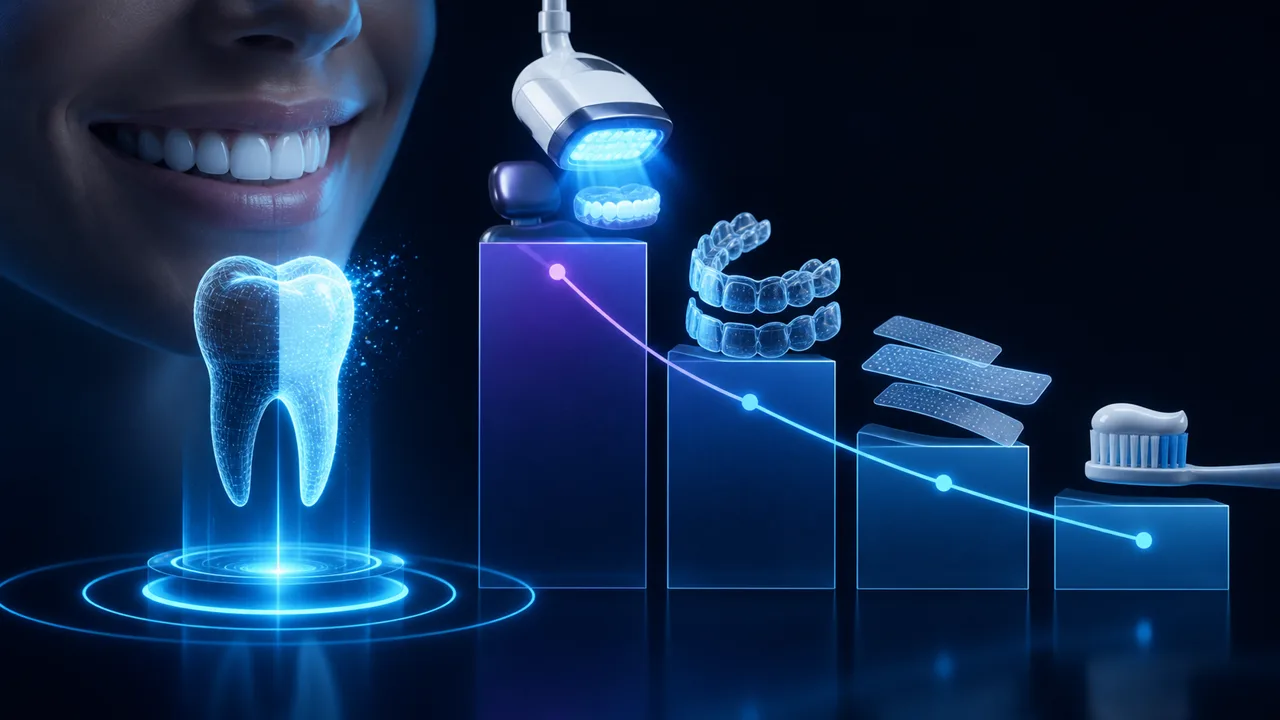
Almost everything sold as a whitening product falls into one of five buckets: in-office bleaching, dentist-supervised custom trays, over-the-counter peroxide strips, whitening toothpaste, and the newer peroxide-free optical correctors. They do not differ much on whether they work. They differ on how much change you get, how fast, and what it costs you in sensitivity.
In-office bleaching gives you the fastest visible shift and usually the strongest short-term effect, paired with the highest short-term sensitivity risk. Dentist-supervised custom trays get you close to that same final result with better sensitivity management, a better physical fit, and more schedule flexibility since you are not tied to a chair appointment. Over-the-counter peroxide strips are the best-supported home option for noticeable change over one to four weeks and have more randomized trial data behind them than any other home method.
Whitening toothpaste sits in a different category entirely. A systematic review found whitening dentifrices do produce a statistically significant color change compared to non-whitening pastes, but the researchers were explicit that the effect is limited and mostly addresses surface stain rather than the deeper bleaching that peroxide protocols deliver. Peroxide-free optical correctors, meaning violet-pigment serums and gels, are the newest entrants. A 2025 systematic review found they do cross the threshold of a perceptible color change, but land well below carbamide peroxide, with a mean color difference around 2.8 to 3.5 compared to up to 8.9 for peroxide. They left enamel hardness intact and caused sensitivity in under 3 percent of subjects.
Two patterns matter here. First, the ranking by raw effect size and the ranking by comfort run in opposite directions, which is exactly why a single 'best method' article cannot serve everyone. Second, the evidence base thins out fast toward the bottom of this list. The peroxide-free corrector review rested on one clinical trial plus five in vitro studies. That is a real finding, but it is a much thinner evidence class than the peroxide meta-analyses backing the top methods.
How to use this framework
Start by identifying your own stain profile, sensitivity level, timeline pressure, and whether you prefer a supervised or self-managed approach. Then flag any safety constraints. From there, a practical sequence emerges that tells you which method fits your situation, rather than which method has the best marketing budget. This is a method-selection framework, not a dosing chart and not a substitute for a treatment plan from your dentist. It exists to make that conversation sharper.
Two constraints should stop you before you pick anything. If you are pregnant or have an active, unresolved dental issue such as pain, untreated decay, or gum inflammation, the right next step is a clinical assessment, not a product choice. Whitening is commonly deferred during pregnancy and for children and adolescents unless a dentist says otherwise. Stabilize the mouth first.
When each method wins
Speed, comfort, and supervision pull against each other, so the right pick depends on which one you are optimizing for.
If speed is what matters most, in-office bleaching remains the fastest way to a visible shift, at the cost of a higher short-term sensitivity chance. If your tolerance for that is low, custom trays can be the smarter risk-adjusted choice even though they take longer to reach the same endpoint.
There is a lever here that most people never hear about: stronger gel is not the same as a better result. A meta-analysis of 25 randomized trials comparing low or medium concentration hydrogen peroxide against high concentration found no clinically meaningful difference in color change, while sensitivity risk was on average 33 percent lower in the low and medium concentration groups. The certainty of evidence on that sensitivity finding was rated moderate. Practically, that means it is entirely reasonable to ask your dentist to talk you out of the strongest gel on the shelf.
If sensitivity is what worries you most, a paced lower-intensity protocol usually beats an aggressive one-shot attempt, mainly because people finish it. The strips-versus-supervised-bleaching comparison illustrates this cleanly: the gentler route produced less sensitivity and a color difference the eye could not resolve anyway.
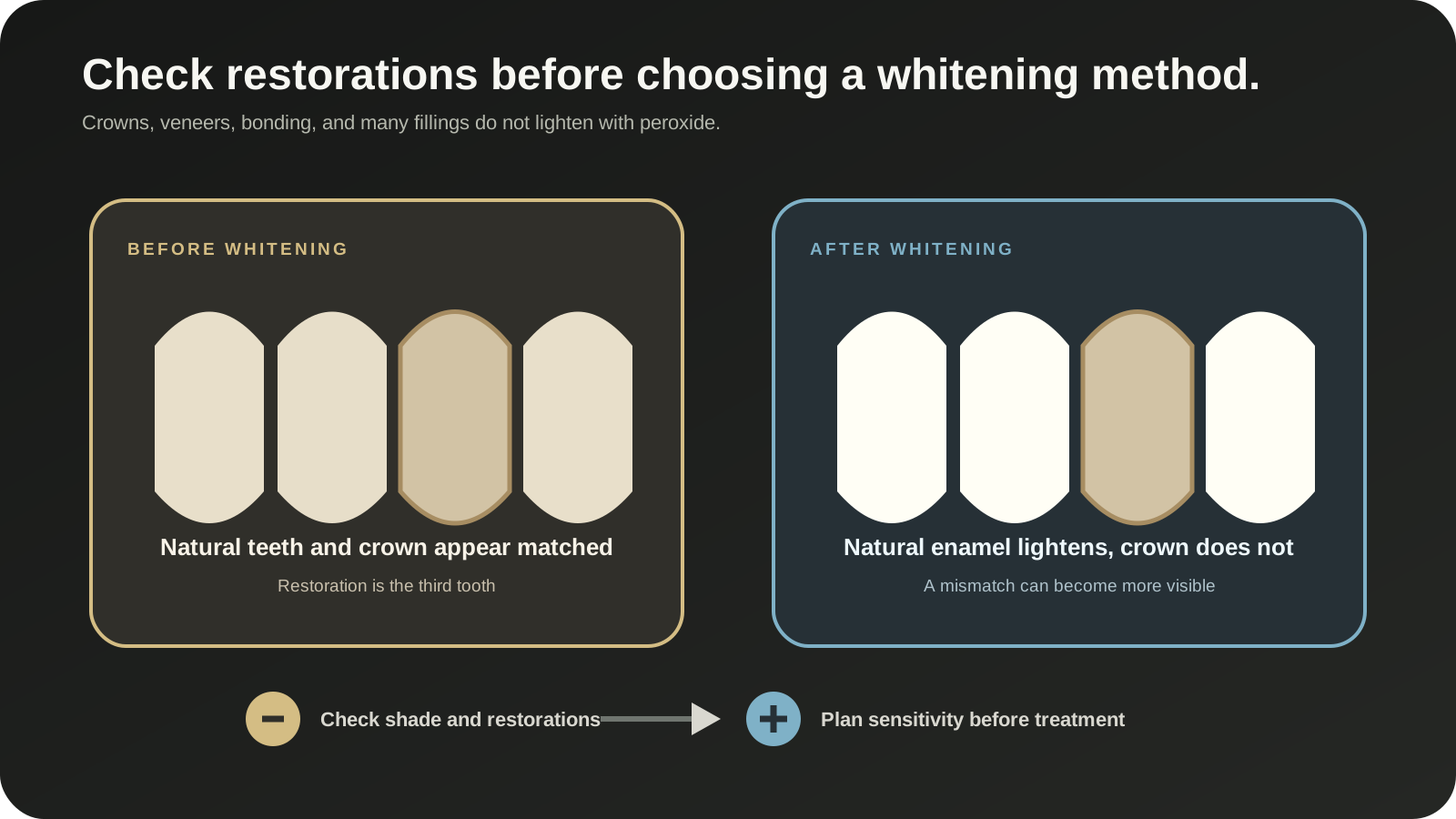
If you have crowns, veneers, or fillings, expectation management matters as much as method choice. Bleaching lightens natural enamel. It does not touch most restorations. That means your natural teeth can end up brighter while your crown or filling stays exactly the shade it started at, creating a visible mismatch that a whitening product cannot fix and only restorative dental work can correct.
Methods worth treating with real caution
Charcoal powders, abrasive scrub-and-polish routines, and acidic do-it-yourself recipes get marketed heavily as natural whitening. They are also the weakest-supported category in this entire space, and the evidence points toward harm rather than benefit.
A systematic review of in vitro studies concluded charcoal-based toothpastes whiten less than the alternatives and are less safe because of their high abrasive potential. A separate JADA literature review reached a compatible conclusion from the clinical side, finding insufficient clinical and laboratory data to substantiate the safety or efficacy claims made for charcoal dentifrices, and documenting unsubstantiated marketing claims, including antibacterial, antifungal, antiviral, and oral detoxification claims, across the products sampled. Both papers land on the same practical advice: be cautious here, not curious.
The abrasion mechanism is what makes this worse than simply useless. Enamel does not grow back. A method that scrubs away the stained surface layer is borrowing brightness against a finite account, and the dentin sitting underneath enamel is naturally more yellow than the enamel covering it. Repeated use risks avoidable enamel or soft-tissue damage for a result that plateaus quickly and then reverses.
Optical brighteners deserve a smaller but similar warning. A triple-blind randomized controlled trial of a blue-covarine silica toothpaste found no significant improvement in tooth whiteness after a single brushing on any color metric, and participants could not distinguish it from a pigment-free control. That does not make the category worthless, but the instant-whitening claim it is often sold on did not hold up under a controlled test.
Why checking your restorations should come before picking a method
Whitening only changes natural tooth structure. Crowns, veneers, bonding, and most fillings do not lighten with peroxide. If a visible restoration is already matched to your current tooth color, whitening around it can create a mismatch that then needs dental work to fix. That is why restoration status belongs near the top of your decision tree, not as an afterthought once you already have a brighter smile and a mismatched crown.
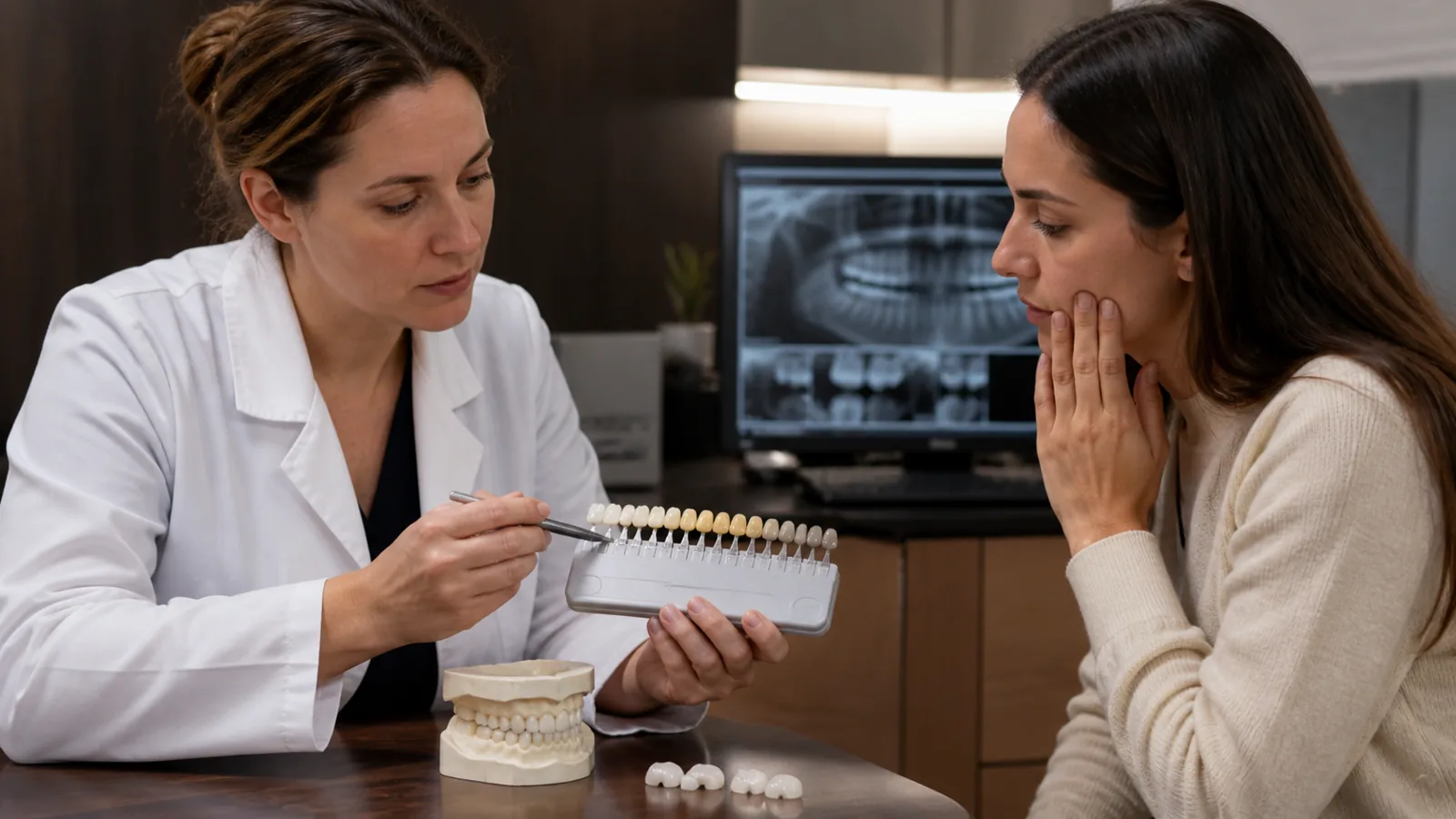
Baseline photos are a decent starting point, but a dentist shade tab under proper lighting beats bathroom mirror lighting every time. Compare your color before treatment, right after the active whitening phase, and again after the enamel rehydrates. Teeth often look temporarily brighter immediately post-bleaching because the enamel is dehydrated at that moment. The stable shade is what remains after that rebound settles, so judging your results on treatment day will overestimate them.
Preventing sensitivity beats trying to fix it after it starts
Sensitivity is far easier to head off than to chase down once it has already started. Shorter contact time, lower peroxide concentration, and spacing out sessions all make a slower protocol more likely to get finished, compared to an aggressive plan someone abandons halfway through. Gum irritation, sharp zingers, or lingering pain are signals to stop and reassess, not signals to push through for one more shade.
Desensitizing pastes are worth being precise about, since this is a category people tend to over-trust. A meta-analysis of 24 studies on topical potassium nitrate applied before bleaching found a statistically significant reduction: a 12 percent lower risk of sensitivity and a small drop in reported intensity, with no effect on the whitening result either way. The authors' own conclusion described that reduction as subtle and clinically questionable. So a desensitizing paste is a reasonable add-on, not a license to run a harsher bleaching protocol than you would otherwise choose. The bigger comfort lever remains concentration and contact time.
What whitening cannot fix, and when to see a dentist first
Whitening works on extrinsic stain and some age-related yellowing. It cannot correct cavities, calculus buildup, exposed root surfaces, gray discoloration from old trauma, or coloring that comes from old dental materials. If one tooth is noticeably darker than its neighbors, painful, or changing color quickly, that calls for a dental exam before any whitening plan, not after.
The planner logic works best once your mouth is already stable: cleanings are current, decay is treated, sensitivity is understood, and restoration expectations are set. At that point, method choice becomes a genuine tradeoff between speed, comfort, supervision, cost, and how much upkeep you are willing to do, rather than a gamble on a product that may not even match the problem you have.
Maintaining your result after the whitening cycle ends
Color relapse is normal after any whitening method, which is exactly why the maintenance plan matters as much as the whitening plan. Front-load stain control in the first 48 hours after a bleaching cycle, since that is when the enamel surface is most receptive to picking up new staining from coffee, tea, or wine.
Use maintenance toothpaste and periodic touch-ups instead of continuous bleaching. This is the job whitening dentifrices are genuinely suited for, given that their measured effect is real but modest. Track your results with monthly photos taken in consistent lighting rather than daily mirror checks, since day-to-day comparisons get swamped by lighting and hydration noise. If your progress plateaus early, revisit the underlying cause rather than reaching for a stronger product. An early plateau usually points to intrinsic stain depth or a restoration mismatch, not an insufficiently powerful gel.
The pattern across every section here is the same: the method that gets finished beats the method that scores highest in a lab trial. That is why sensitivity tolerance and personal preference deserve just as much weight in your decision as raw effectiveness numbers.
Sources
- Effectiveness of whitening strips use compared with supervised dental bleaching: a systematic review and meta-analysis
- Efficacy of dental bleaching with whitening dentifrices: a systematic review
- Hydrogen peroxide-free color correctors for tooth whitening in adolescents and young adults: a systematic review of in vitro and clinical evidence
- In-office bleaching with low/medium vs. high concentrate hydrogen peroxide: a systematic review and meta-analysis
- Effectiveness and abrasiveness of activated charcoal as a whitening agent: a systematic review of in vitro studies
- Charcoal and charcoal-based dentifrices: a literature review
- The whitening effect of single brushing with blue-covarine containing toothpaste: a randomized controlled trial
- Topical application of a desensitizing agent containing potassium nitrate before dental bleaching: a systematic review and meta-analysis
Educational content only. Not medical advice.