Wellness
Do Peptides Make You Taller? Height Methods Ranked by Evidence
A breakdown of "heightmaxxing" methods, from shoes and posture to GH secretagogues and limb lengthening surgery, organized around the one biological fact that governs all of them: whether your growth plates are still open. Includes evidence tiers, complication rates from published surgical series, and a decision framework for figuring out which category is worth your money.
Published by PeptideSchool Editorial Desk

The three categories of height enhancement
Online self-improvement communities call this "heightmaxxing," and the term covers a wide range of tactics that do not belong in the same conversation. Some change how tall you look. Some try to work through hormones. One cuts bone. Lumping them together and comparing them by inches gained is how people end up making bad decisions, because a reversible two-inch gain and a surgical two-inch gain are not remotely the same trade.
It helps to sort everything into three buckets first. Non-invasive methods, sometimes called "softmaxxing," include posture correction, elevator shoes, insoles, stretching, and spinal decompression. None of these change skeletal length. They change how tall you read to other people, and they are fully reversible.
Pharmaceutical methods include growth hormone secretagogues like MK-677, CJC-1295, and ipamorelin, along with recombinant HGH itself. All of them work through the GH/IGF-1 axis, and all of them share the same hard limitation: they can only influence linear bone growth while the growth plates are still open. If you are past that window and interested in body composition rather than height, that is a different conversation with its own evidence, and it is worth reading separately rather than assuming height compounds double as muscle compounds.
Surgical methods, sometimes called "hardmaxxing," mean limb lengthening surgery, technically distraction osteogenesis, done with intramedullary nails such as PRECICE or STRYDE to permanently add length to the femur or tibia. This is the only category on the list that adds real bone length after skeletal maturity, and it is also the only one that involves an operating room.
The comparison below rates each method on four separate questions: evidence, realistic change, risk, and cost burden. Keeping those columns apart is the point. A method can create a large change and still carry a terrible tradeoff. Another can be low risk and useful while adding no skeletal height at all.
Why growth plates are the whole story for pharmaceuticals
If you remember one fact from this entire topic, make it this one: growth plates decide whether any drug can work. The epiphyseal cartilage at the ends of your long bones is the only tissue in your body capable of lengthwise bone growth. Chondrocytes there proliferate during puberty and produce the growth spurt, and the same hormonal signals driving that spurt, estrogen acting on its receptors in particular, eventually close the plate and shut growth down for good. That closure typically happens in the late teens to early twenties, usually earlier in females than males, and a wrist or knee X-ray can tell you exactly where you stand.
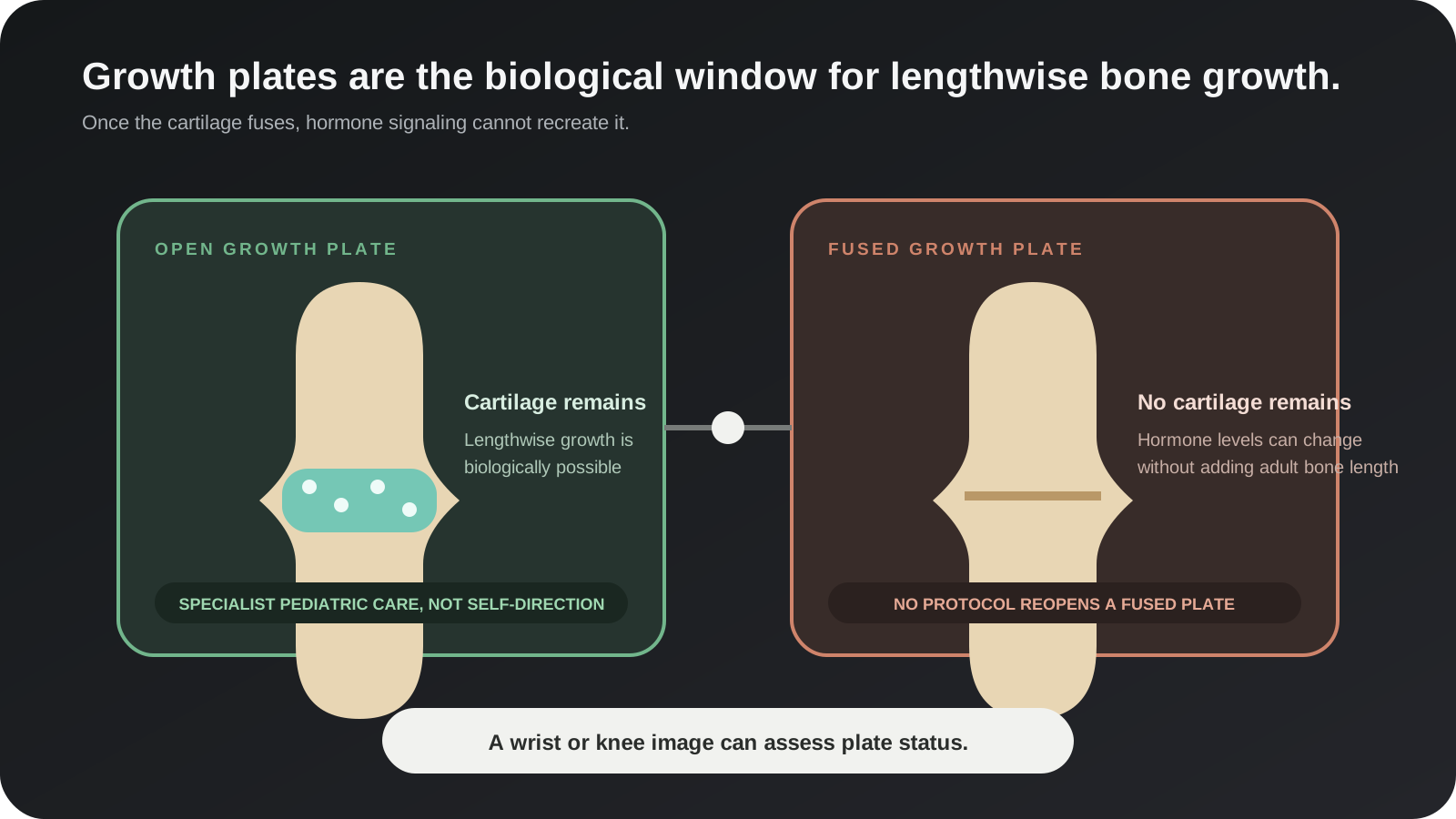
Once the plates fuse, there is no cartilage left to stimulate. It does not matter how much IGF-1 a compound raises. GH secretagogues, ghrelin mimetics, and recombinant HGH all run into the same closed door, and no protocol or dosing trick opens it. This is the detail that height-supplement marketing and grey-market GH peptide sellers routinely leave out, because it is inconvenient for the pitch.
The clearest proof of this did not even come from a height study. A two-year randomized, double-blind, placebo-controlled trial gave the oral ghrelin mimetic MK-677 to healthy adults aged 60 to 81. It successfully restored growth hormone and IGF-1 to young-adult levels and increased fat-free mass. Height did not move, because every participant's growth plates had fused decades earlier. The GH axis worked exactly as designed. The skeleton simply had nothing left to respond with.
Where growth hormone treatment genuinely does affect adult height, it is in children being treated for growth hormone deficiency, idiopathic short stature, or primary IGF-1 deficiency, under formal pediatric endocrine treatment guidelines and physician supervision. It is not something anyone runs on themselves. If you are under 25 and seriously considering pharmaceutical options, get a bone age X-ray of the wrist or a knee film first. That single test settles the question before any money changes hands.
How to read the evidence tiers
Every method in this space can be sorted into four evidence tiers, and reading the tier before the height-gain number is the cheapest protection you have.

Tier A means strong support: multiple randomized controlled trials, an approved medical indication, or a well-established surgical procedure backed by large published patient datasets. Tier B means moderate support: some real clinical or biomechanical evidence, or an established physiological principle without much randomized data behind it specifically. Tier C means limited support: small case series, off-label extrapolation from a related condition, or a mechanism that mostly comes from animal or lab work. Tier D means anecdotal: user reports, marketing copy, and studies with real methodological problems.
Height is an unusually easy thing to sell and an unusually hard thing to change, which is exactly why tiers matter more here than in most health topics. A product can be marketed as a height booster on the back of a mechanism that dead-ends at the growth plate, and the claim is never falsifiable to a customer who already finished growing. Check the tier first.
The Height Method Comparison
| Method | Evidence tier | Realistic change | Risk | Cost burden | What changes |
|---|---|---|---|---|---|
| Posture work or physical therapy | B | Recovers height lost to alignment; no new bone | Low | $ to $ | Standing posture |
| Insoles or elevator shoes | A for visible height | About 1 to 4 inches while worn | Low | $ to $ | Appearance only |
| Hanging or spinal decompression | B for a temporary effect | Usually well under 1 inch, then reverses | Low | Free to $ | Short-term disc unloading |
| Height supplements after growth plates close | D | No credible adult skeletal gain | Low to moderate | $ to $ | Marketing claim, not bone length |
| GH secretagogues or HGH after growth plates close | A for the growth-plate limit | No adult long-bone gain | High | $$ | Hormone levels, not adult height |
| Medically supervised GH while plates are open | A for approved pediatric indications | Varies by diagnosis, age, and remaining growth | Medical | $$ | Linear growth under specialist care |
| Limb lengthening surgery | A | Published series average about 3.5 to 6.7 cm | Very high | $$ | Permanent bone length |
Cost burden is relative because prices vary sharply by country, provider, insurance status, rehabilitation needs, and revision surgery. One dollar sign means inexpensive to test. Four means a major medical expense with substantial costs beyond the initial procedure.
Non-invasive methods: what works
The most effective non-invasive options are also the least glamorous. Elevator shoes and height-increasing insoles are the top of this list because they work instantly and carry zero health risk. Subtle insoles add roughly 1 to 2 inches and fit inside a normal shoe. Dedicated elevator shoes typically run 2 to 4 inches, and some specialty boots go higher, though taller lifts get more visible and start affecting your natural gait. The whole gain is reversible: take the shoes off, and you are back to your standing height.
Posture correction is different in kind. It is not adding height, it is recovering height you already lost to poor alignment. Anterior pelvic tilt, thoracic kyphosis, and forward head posture each cost real standing height, and a physical therapist can assess and correct those patterns. Because it is restoration rather than growth, it is one of the few non-invasive claims that survives scrutiny.
Spinal decompression, through hanging or inversion, is the claim most often oversold, and ironically it is also the one with the cleanest measurement behind it. Your stature genuinely changes over the course of a day as spinal discs load and unload with gravity. A precision measurement study found the daily swing averages about 19 millimeters, roughly 1.1 percent of standing height, with just over half of that daily loss happening in the first hour after getting out of bed and about 70 percent of it recovered during the first half of the night's sleep. So decompression can add well under an inch, and whatever it adds reverses within roughly an hour of normal upright activity. It is a real, measurable, and entirely temporary effect.
Supplements marketed as height boosters do not have credible evidence for increasing adult height. Most of them make their pitch through the same GH/IGF-1 axis language as the pharmaceuticals, which runs into the identical wall: a fused growth plate does not respond to anything. This is part of a broader pattern in wellness products where mechanism-sounding language substitutes for direct evidence, and it is worth learning to spot that pattern generally, not just here.
Surgical methods: limb lengthening
Limb lengthening surgery is the only method on this list that permanently adds real height after the growth plates have closed. The procedure is a surgical osteotomy, cutting the bone, followed by gradual distraction at roughly one millimeter per day while new bone forms in the widening gap through a process called distraction osteogenesis. Modern internal lengthening nails such as PRECICE are a substantial upgrade over older external fixator frames, since the entire lengthening mechanism sits inside the leg instead of protruding through the skin.
The engineering behind this is genuinely solid. A clinical evaluation of the PRECICE nail in 24 patients reported a mean total lengthening of 35 millimeters, with 96 percent accuracy and 86 percent precision against the prescribed distraction schedule, and minimal impact on bone alignment or on knee and ankle range of motion. Cosmetic lengthening itself is not new. A series of 54 patients treated with the Ilizarov method for constitutional short stature achieved a mean lengthening of 7 centimeters.
The complication numbers are where this needs a careful read, because they get quoted loosely elsewhere. A systematic review pooling 11 studies and 795 cosmetic lengthening patients found a mean end lengthening of 6.7 centimeters over an average follow-up of 4.9 years. It also found a mean of 0.78 problems, 0.94 obstacles, and 0.15 true major complications per patient. The most common problem and obstacle was ankle equinus deformity, and the most common true complications were deformation of the newly formed bone after treatment ended and stiffness in the subtalar joint. Read that carefully: major complications were relatively uncommon, but the average patient still hit roughly one problem and one obstacle somewhere along the way. An uneventful course is not the typical course.
Hardware failure is its own separate risk category. A single-institution review of 377 patients and 420 limbs lengthened with magnetic intramedullary nails found mechanical failure of the nail or its lengthening mechanism in 9.5 percent of nails, and 63 percent of those failures required an additional surgery to fix. Failures showed up across the lengthening, consolidation, and extraction phases, and removing the nail afterward can itself be technically difficult.
This is a major decision, not a cosmetic touch-up. Recovery runs months per bone, it needs a surgeon with specific limb lengthening experience, and the money involved is substantial. Anyone seriously weighing it should be reading the primary complication literature directly, not relying on forum summaries or marketing pages.
What limb lengthening costs
Reported prices for limb lengthening vary enormously by country, and any specific figures floating around online are market estimates, not published clinical data. Generally the procedure costs the most in the United States, sits in the middle in western Europe, and costs the least in destinations that specifically market to medical tourists.
Quoted prices usually cover the surgery itself, the hospital stay, and the internal nail device. They frequently leave out physical therapy, travel, extended accommodation abroad, follow-up visits, and any revision surgery, which the published literature shows is needed in a meaningful minority of cases. Budget for all of that separately, not just the headline number.
A decision framework before you spend money
Start by separating perceived height from skeletal height. Shoes, posture, clothing fit, and body composition all change how tall you read to other people without touching bone length at all. These options are reversible, low risk, and often enough to solve the underlying problem most people have, which is proportions and confidence, not a number on a chart. They also cost almost nothing to test. You can try elevator insoles for the price of a pair of insoles.
Medical interventions are a different category. If growth plates are closed, secretagogues and growth-hormone-adjacent peptides cannot create new long-bone length. If growth plates are open, growth concerns belong in pediatric or adolescent endocrine care under formal guidelines, not a self-directed experiment. A certificate of analysis cannot solve the absence of an appropriate indication, clinical oversight, or adult growth potential.
If surgery is genuinely on the table, the limiting factor is not just the price tag. Published series document months of rehabilitation and risks that include pain, nerve symptoms, joint stiffness, alignment problems, delayed healing, hardware failure, and revision surgery. Rates vary substantially by technique, center, amount lengthened, and how complications are counted, so one universal percentage would be misleading.
The simplest useful rule: rank your options by reversibility before you rank them by height gain. Reversible choices can be tested cheaply and dropped for free if they do not work out. Irreversible choices need a specialist consultation, a realistic recovery plan, and a clear written answer to what problem the extra height is supposed to solve. If that answer stays vague, stick with the reversible options.
Sources
- Pubertal growth and epiphyseal fusion
- Guidelines for growth hormone and IGF-I treatment in children and adolescents
- Effects of an oral ghrelin mimetic on body composition and clinical outcomes in healthy older adults
- Circadian variation in stature and the effects of spinal loading
- PRECICE intramedullary limb lengthening system
- Precision of the PRECICE internal bone lengthening nail
- Cosmetic bilateral leg lengthening: experience of 54 cases
- Cosmetic stature lengthening: systematic review of outcomes and complications
- Mechanical failures in magnetic intramedullary lengthening nails
Educational content only. Not medical advice.