Wellness
Sleepmaxxing: the evidence-based guide to optimizing every stage of sleep
The strongest sleep levers remain a consistent schedule, morning light, a dark and cool room, and enough time in bed. Supplements have smaller effects, wearable scores can become counterproductive, and experimental sleep peptides sit well below established behavioral measures.
Published by PeptideSchool Editorial Desk
What sleepmaxxing means
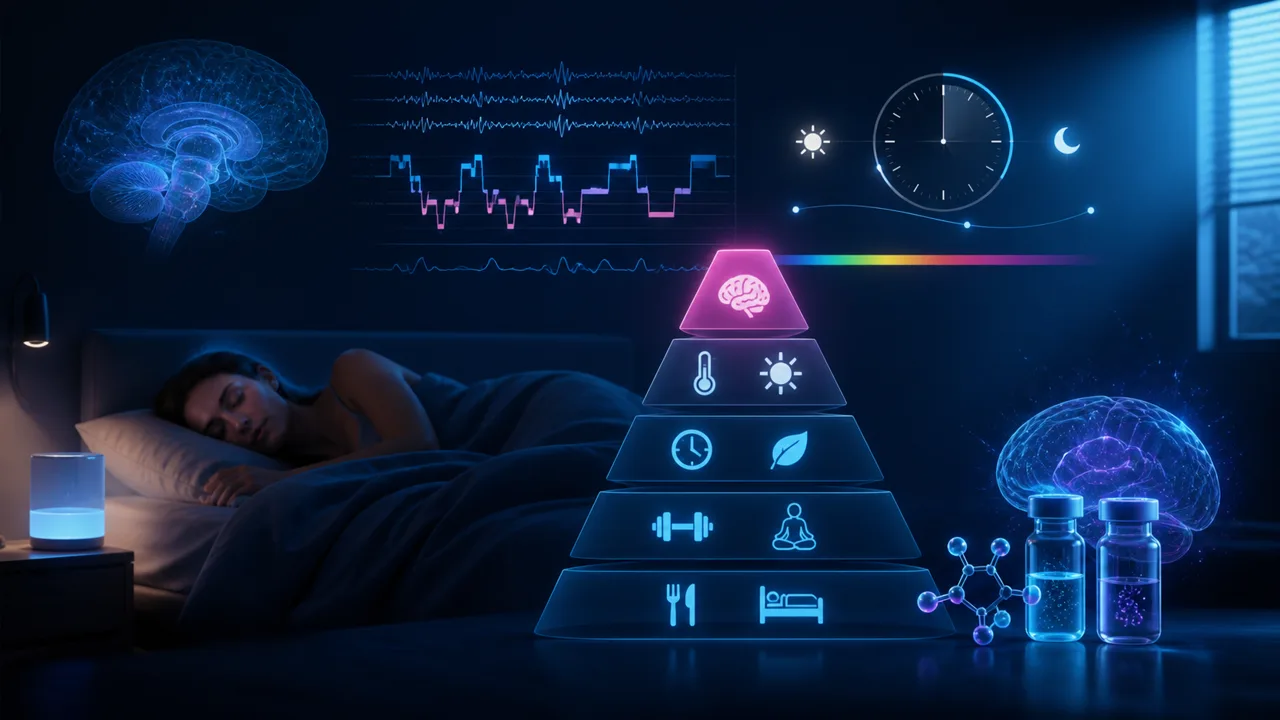
Sleepmaxxing is the systematic optimization of every controllable sleep variable, things like temperature, light, timing, supplements, and in some cases peptides, ranked by how strong the evidence is. It goes further than basic sleep hygiene because it targets specific sleep stages with interventions matched to those stages, instead of treating every tip you see online as equally useful.
The term started showing up on TikTok and Reddit around 2023, meaning something like doing everything possible to maximize sleep quality. It follows the same naming pattern as looksmaxxing and heightmaxxing, internet communities built around applying systematic optimization to a single biological goal. What separates sleepmaxxing from plain sleep hygiene is scope and precision. Sleep hygiene tells you to keep a steady bedtime. Sleepmaxxing asks which sleep stage you are trying to improve, then sorts interventions by whether a randomized controlled trial, a study where people are randomly placed into treatment or placebo groups and results are measured blind, backs them up, or whether they are just popular on video.
Most sleepmaxxing content fails because it treats every intervention as equal. A single post might list temperature control, magnesium, mouth taping, and DSIP together without mentioning that one has real systematic review support while another was recently described in a 2025 systematic review as having minimal evidence behind it. This guide separates those claims with a four-tier evidence ranking and a stage-by-stage breakdown of what helps and where.
Sleep architecture: the four stages you are optimizing
Every night your brain cycles through four stages of sleep, and each one does different work. N1 is the light doorway between waking and sleeping, lasting just a couple minutes, where the smallest noise can pull you back out. N2 takes up roughly half of your total sleep time and is where sleep spindles and K-complexes show up on a brain scan, bursts of electrical activity that help lock in motor learning and everyday memory. N3, often called deep or slow-wave sleep, is the stage where the real physical repair happens: growth hormone release peaks, tissues rebuild, and the glymphatic system flushes out metabolic waste from the brain. REM sleep is when dreaming occurs and emotional memories get sorted and stored. A full cycle through all four stages takes about 90 minutes, repeating several times a night.
What most sleepmaxxing advice skips over is that no single fix works on every stage. Cooling your bedroom mainly helps N3, since your core body temperature needs to drop about 1 degree Celsius to drop into and stay in deep sleep. Light exposure timing shifts your melatonin curve, which controls how easily you move into those deeper stages. Glycine works on that same temperature-drop mechanism, just from inside the body. DSIP appears, based on limited research, to shift delta-wave activity tied to N3. Selank, working as an anxiolytic, mostly shortens the time spent stuck in N1 before you drop deeper. Knowing which stage is giving you trouble is what decides which intervention is even worth trying, which is why the tool at the end of this guide starts by asking what your specific problem is.
Tier 1: the non-negotiables
Temperature, darkness, and a steady schedule carry more research weight than anything else in this guide. None of them cost a dime, none require a single supplement, and they need to be dialed in for several weeks before you even think about the tools in tiers 2 through 4. No peptide, powder, or gadget makes up for a bedroom that's too warm, too bright, or a bedtime that moves around constantly.
Temperature does more to shape your sleep than any other variable you can control. Obradovich and colleagues, writing in Science Advances in 2017, dug through 765,000 nights of self-reported sleep from about 47,000 people across the U.S. and found that warmer nighttime temperatures reliably predicted worse sleep, with older adults and lower-income households hit hardest. The reason is simple biology: your core temperature has to drop by roughly 1 degree Celsius for sleep to begin and for deep N3 sleep to hold. A room sitting at 18-20C (65-68F) lets that drop happen naturally; anything above 24C works against it.
Light comes second. Gooley and colleagues in 2011 tracked melatonin in 116 healthy adults, comparing ordinary room light (under 200 lux, dimmer than most office lighting) against dim light in the eight hours leading up to bed. Ordinary room light pushed back melatonin onset in 99% of subjects and cut its total duration by close to 90 minutes, and light exposure during normal sleep hours cut melatonin output by more than half in 85% of trials. Melatonin doesn't just make you drowsy, it tells your body how long the night is. Every bright minute before bed shortens that signal.
Consistency rounds out the trio. The suprachiasmatic nucleus, a cluster of hypothalamic neurons acting as your master clock, keeps sleep processes locked to a 24-hour cycle. Swing your bedtime or wake time by two hours or more across the week, sometimes called social jetlag, and the SCN can't hold steady timing for melatonin, cortisol, or temperature. Sleep architecture fragments even if total hours look fine. Holding your wake time inside a 30-minute window, weekends included, is the single highest-payoff circadian move you can make, and it's free.
Tier 2: supplements with real data
Magnesium, glycine, and l-theanine sit above the rest of the supplement field because they have trial data behind them, though "real data" doesn't mean dramatic results. The magnesium trials show small effect sizes, the glycine research comes almost entirely from a single research group, and l-theanine has the thinnest evidence of the three. Even so, all three clear the bar set by tier 4 by a wide margin.
Magnesium carries the broadest trial support here, and the specifics matter. A 2025 randomized, double-blind, placebo-controlled trial in 155 adults source 6 tested magnesium bisglycinate in people who simply reported poor sleep, not a clinically diagnosed insomnia group, and found a bigger drop in Insomnia Severity Index scores (a validated 0-28 questionnaire) than placebo after four weeks. That result reached significance at p = 0.049 with a Cohen's d of 0.2, which the researchers themselves call a modest effect. A separate trial by Abbasi and colleagues in 2012 source 5 looked at 46 elderly adults with primary insomnia and found improvements in ISI score, sleep efficiency, and sleep onset latency, plus higher serum melatonin and lower cortisol compared to placebo. That study used plain magnesium instead of bisglycinate, its finding on early-morning awakening was only borderline, and total sleep time was unchanged, so it backs magnesium as a category rather than any single salt form. Bisglycinate, sometimes labeled glycinate, remains the go-to recommendation anyway, since magnesium oxide is poorly absorbed and tends to cause more stomach upset.
Glycine works through a completely different route: body temperature. In a 2012 paper reviewing their own human trials, Bannai and Kawai source 7 found that glycine taken before bed improved subjective sleep quality in people prone to poor sleep, and companion rat studies showed that oral glycine drops core body temperature by widening blood vessels near the skin. Wider vessels let heat escape faster, core temperature falls, and the body gets the same internal cue a cold bedroom sends from outside. That means a cool room and glycine before bed stack rather than overlap, since they lower temperature through separate mechanisms. The catch is that most of this evidence traces back to one lab, so it hasn't been widely replicated elsewhere.
L-theanine boosts alpha-wave activity, the 8 to 12 Hz brainwave pattern tied to calm, relaxed wakefulness. Since alpha waves show up heavily as the brain drifts from alertness into drowsiness, encouraging them may ease the slide into light sleep stages without the sedation or dependency concerns tied to GABA-based sleep medications like benzodiazepines and Z-drugs. Its research base is the weakest of this group, built mostly on small studies with self-reported outcomes. It's safe and mechanistically reasonable, which makes it worth trying but not worth expecting much from.
Tier 3: peptides for sleep
DSIP, selank, and epithalon all have some clinical data suggesting sleep benefits, but none of them carry FDA approval for sleep or for any other use, and the human research behind them is small, decades old, and rarely repeated since. Because of that, the evidence here rates weak to moderate, which is exactly why these three sit behind environment fixes and supplements in the priority order.
DSIP (delta sleep-inducing peptide) is a nine-amino-acid neuropeptide first pulled from rabbit brain tissue back in the 1970s. The name promises more certainty than the science delivers, since it was named before anyone fully understood how it worked, and researchers still debate whether DSIP directly triggers delta wave sleep or works through some downstream neuromodulation pathway instead. That said, the clinical record isn't empty. Schneider-Helmert and Schoenenberger (1983) reported on five separate human studies using intravenous DSIP under double-blind conditions with polygraphic recordings, and found that repeated injections normalized disturbed sleep patterns in insomniac patients. Monti and colleagues (1987) ran a separate study looking at short-term DSIP use in chronic insomniacs. A 1984 review by Graf and Kastin pulled together the broader animal and human literature, noting a U-shaped dose-response curve along with effects on circadian rhythm and hormone levels, though a review summarizes existing work rather than proving efficacy on its own. These studies are small and from the 1980s, with no modern replication, but they were double-blind and placebo-controlled, which puts DSIP ahead of most other peptide sleep claims floating around today.
Selank is a synthetic version of tuftsin, an immune-related peptide fragment developed at Russia's Institute of Molecular Genetics. Its main effect is anxiety reduction rather than direct sleep promotion, working through GABA modulation and stabilizing enkephalin levels without the sedation or dependence risks tied to benzodiazepines. For sleep purposes, selank's use case is narrow: anxiety-driven trouble falling asleep. If a racing mind is what keeps you up, selank targets that root cause instead of forcing sedation. Most of the supporting research is Russian-language work that hasn't been repeated in Western trials, so the efficacy claims remain unconfirmed.
Epithalon (sometimes spelled epitalon) is a synthetic four-amino-acid peptide modeled after epithalamin, a pineal gland extract. The theory behind it is that it regulates the body's own melatonin output at the pineal gland rather than supplying melatonin directly, which is an interesting idea but still just a hypothesis, backed mainly by Russian research groups and animal studies with no independent modern human sleep trial to confirm it. None of these three peptides carry FDA approval for anything, so anyone weighing them should go in understanding the evidence sits at weak to moderate at best.
Tier 4: the trendy stuff
Mouth taping, weighted blankets, and sleep trackers show up everywhere in sleepmaxxing content online. The evidence behind them ranges from thin to mixed, one carries real physical risk for the wrong person, and one can make sleep worse through a documented pattern known as orthosomnia.
Mouth taping became a viral sleepmaxxing staple, but the science lags far behind the hype. A 2025 systematic review in PLOS ONE source 9 looked at mouth taping in people with mouth breathing, sleep-disordered breathing, or obstructive sleep apnea and found minimal supporting evidence, while also warning of a genuine asphyxiation risk in anyone with nasal obstruction. The idea behind it, that nasal breathing improves oxygenation and reduces snoring, holds up for people with clear nasal airways, but the practice turns dangerous fast for anyone with a deviated septum, chronic allergies, or undiagnosed apnea. If you cannot breathe easily through your nose while awake with your mouth closed, do not tape it shut at night.
Weighted blankets, usually in the 6 to 12 kg range, have a somewhat better track record. Small studies, mostly in people with anxiety disorders or ADHD, suggest that deep pressure stimulation, a sustained gentle pressure similar to being held, can lower autonomic arousal and reduce nighttime movement. The effect is modest and the trials are small, so results from anxious populations may not carry over to healthy sleepers. If your sleep is already solid, expect little benefit. If anxiety is keeping you up, the trade-off is reasonable since the downside is minimal.
Sleep trackers are the strangest entry here. These wrist-worn devices estimate sleep stages from movement and heart rate, and the data can help you notice inconsistent schedules or patterns of waking. But Baron and colleagues in 2017 source 8 coined the term orthosomnia to describe patients showing up for treatment of sleep problems they diagnosed themselves from tracker data. That finding deserves its own closer look.
The orthosomnia trap
Orthosomnia is what happens when chasing a perfect tracker score becomes the sleep problem itself. The term was coined in 2017 from clinical cases where people trusted their wearable's numbers over how they felt in the morning, and treated any gap between the two as something to fix.
Baron's 2017 paper describes patients showing up to sleep clinics worried about their tracker data rather than their actual daytime functioning. The pattern kept repeating: the device's estimate felt more trustworthy to the patient than validated tools like polysomnography or actigraphy, and a single low score turned into a perfectionist hunt for ideal sleep. The problem isn't that wearables are worthless, it's that people lean on them far harder than the technology can support. No published number exists for how common this is, so treat any percentage floating around online as unsourced.
The sleepmaxxing world has a specific vulnerability here, because it rewards optimization intensity. Posting your ring's deep sleep percentage or recovery score turns into a status marker, and falling short of the community benchmark becomes a source of stress that works against the goal. The practical rule is simple: pull one or two actionable patterns from your tracker, then stop checking it every morning. Weekly averages tell you more than nightly scores ever will, and no consumer device measures sleep stages with the precision of a clinical EEG study. Your tracker is guessing, not measuring, and it has no idea how rested you feel.
Building your protocol
Start with tier 1: temperature, darkness, and a steady schedule. Give it a couple of weeks before you add anything else. Most people who fix their sleep environment never need tier 2, let alone tier 3.
The tier system is a priority order, not decoration. Tier 1 interventions are free, carry the strongest evidence, and apply to the widest range of people. If your bedroom sits at 24C, your phone glows on the nightstand all night, and your bedtime shifts by two hours across the week, no supplement or peptide is going to save you from that. Fix the room first. The Obradovich temperature data alone, 765,000 nights showing that ambient heat predicts sleep loss, is reason enough to make temperature the first thing any sleepmaxxer tackles source 4. Meal timing matters too, and the eating before bed guide covers how much space to leave between dinner and lights out.
Once tier 1 has been genuinely locked in for at least two weeks, tier 2 is worth a look, with realistic expectations. The magnesium trials show real but modest gains on validated insomnia scales, not a transformation source 6 source 5. Glycine is worth trying if slow sleep onset or morning grogginess sticks around. Tier 3 peptides come only after tiers 1 and 2 are solid, and only with the understanding that the research behind them is older, smaller, and hasn't been replicated to modern standards. Tier 4 should never jump ahead of the rest. Cortisol disruption is a separate but overlapping problem, and the cortisol face guide explains how chronic stress hormones wreck sleep architecture along with skin and hair.
Sources
- Schneider-Helmert D, Schoenenberger GA. "Effects of DSIP in man. Multifunctional psychophysiological properties besides induction of natural sleep." Neuropsychobiology. 1983.
- Monti JM, Debellis J, Alterwain P, Pellejero T, Monti D. "Study of delta sleep-inducing peptide efficacy in improving sleep on short-term administration to chronic insomniacs." Int J Clin Pharmacol Res. 1987.
- Graf MV, Kastin AJ. "Delta-sleep-inducing peptide (DSIP): a review." Neurosci Biobehav Rev. 1984.
- Obradovich N, Migliorini R, Mednick SC, Fowler JH. "Nighttime temperature and human sleep loss in a changing climate." Sci Adv. 2017.
- Abbasi B, Kimiagar M, Sadeghniiat K, Shirazi MM, Hedayati M, Rashidkhani B. "The effect of magnesium supplementation on primary insomnia in elderly: a double-blind placebo-controlled clinical trial." J Res Med Sci. 2012.
- Schuster J, Cycelskij I, Lopresti A, Hahn A. "Magnesium bisglycinate supplementation in healthy adults reporting poor sleep: a randomized, placebo-controlled trial." Nat Sci Sleep. 2025.
- Bannai M, Kawai N. "New therapeutic strategy for amino acid medicine: glycine improves the quality of sleep." J Pharmacol Sci. 2012.
- Baron KG, Abbott S, Jao N, Manalo N, Mullen R. "Orthosomnia: are some patients taking the quantified self too far?." J Clin Sleep Med. 2017.
- Mouth Taping: A Systematic Review of the Literature and Its Safety Implications
- Gooley JJ, Chamberlain K, Smith KA, Khalsa SB, Rajaratnam SM, Van Reen E, Zeitzer JM, Czeisler CA. "Exposure to room light before bedtime suppresses melatonin onset and shortens melatonin duration in humans." J Clin Endocrinol Metab. 2011. PMID 21193540
Educational content only. Not medical advice.