Peptide Guides
GHK-Cu Skincare Routine: Three Layering Questions That Matter
A practical guide to building a GHK-Cu copper peptide routine without sabotaging it. Covers why copper and vitamin C fight each other chemically, how to layer copper peptides with retinoids safely, a gradual introduction schedule, a full interaction matrix for common actives, and a realistic framework for judging whether the routine is working.
Published by PeptideSchool Editorial Desk
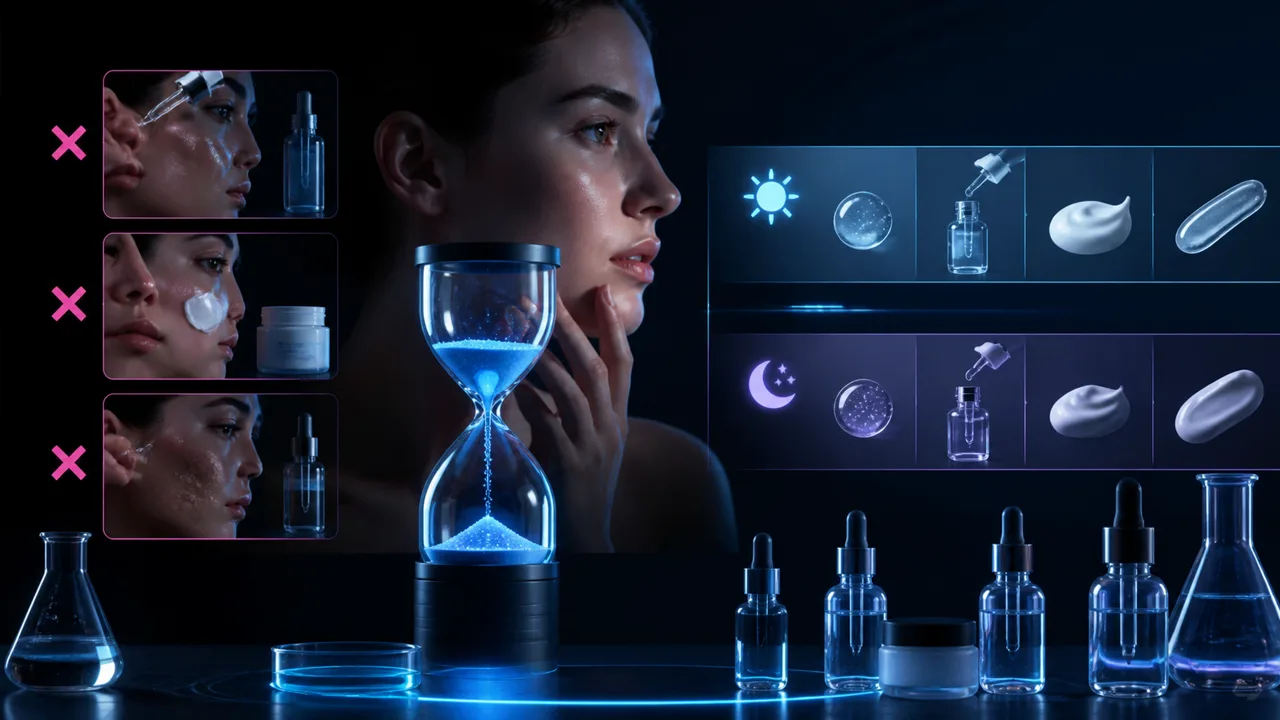
What GHK-Cu does for skin
GHK-Cu, short for glycyl-L-histidyl-L-lysine copper complex, is a naturally occurring tripeptide that researcher Loren Pickart identified in human blood plasma back in 1973. It has since turned into one of the most talked-about ingredients in dermatology circles, and for good reason on paper. Gene-array work published by Pickart's own lab describes GHK-Cu as touching the activity of thousands of genes tied to tissue remodeling, collagen production, and inflammation control.
Here is the part worth flagging before you get too excited: Pickart discovered the peptide and later built a skincare company, R&D Skin Biology, around it. That does not make his research wrong, but it does mean his papers are a better place to understand the proposed mechanism than to judge how well any of it holds up in real people using real products.
In cell and tissue studies, GHK-Cu has been shown to bump up production of collagen types I and III, elastin, and glycosaminoglycans, the structural proteins responsible for skin firmness and bounce. It has also been linked to angiogenesis, meaning new blood vessel formation that can improve nutrient delivery to skin cells. In a cultured skin-equivalent model, copper-GHK increased proliferation and turnover markers in keratinocytes, the cells that make up your outer skin layer. That is genuinely one of the more concrete data points behind the wound-healing narrative.
But a tissue model in a lab is not a clinical trial in people with sun damage, scarring, or visible aging. That distinction gets blurred in skincare marketing. GHK-Cu's removal from the FDA's Category 2 list in April 2026 did not approve it, authorize a treatment claim, or establish that a compounded product is available. It only changed how the agency categorized the nominated bulk substance. The topical cosmetic market is a separate lane.
Question 1: Do vitamin C and copper peptides need separation?
Copper can accelerate ascorbic acid oxidation in chemical models. That gives the vitamin C and GHK-Cu pairing a plausible compatibility concern, especially when raw ingredients are mixed together.
What has not been shown is that every finished vitamin C product becomes ineffective or harmful when layered with every finished GHK-Cu product on human skin. Formulation, pH, chelation, packaging, and timing all matter. A chemistry paper is not a head-to-head skincare routine trial.
If you want the simplest conservative routine, put vitamin C and GHK-Cu in separate application windows, such as morning and evening, or use them on different days. That is a practical way to reduce uncertainty, not proof that a 30-minute gap is a clinically validated rule.
Question 2: Where do retinoids fit?
Good news here: GHK-Cu and retinoids, whether that is retinol, tretinoin, or adapalene, have no direct chemical conflict. They are commonly layered in the same PM routine without issue. The two ingredients are thought to support collagen synthesis through separate pathways. Retinoids activate retinoic acid receptors, while GHK-Cu is proposed to work through gene expression modulation.
That said, the two are not on equal evidentiary footing, and it is worth being honest about that. Retinoids, tretinoin especially, are among the most clinically studied anti-aging actives that exist. Even so, a 2006 review of retinoid evidence still called for more rigorous studies on gentler options like retinol. GHK-Cu has nothing close to that trial record behind it.
The practical issue is tolerance, not a proven chemical conflict. Keep the clinically established retinoid as the anchor if it already works for you, and introduce only one new product at a time. That makes irritation easier to trace without pretending GHK-Cu and retinoids have been tested as a combined anti-aging program.
Question 3: How should a new product be introduced?
Treat GHK-Cu like any new active product: change one variable at a time, patch test according to the product directions, and begin at a frequency your skin tolerates. There is no clinical trial establishing one universal week-by-week schedule for every concentration and formula.
If redness, stinging, or irritation appears, simplify the routine and check the product instructions. The reaction may come from the formula, another active, or the total load on the skin barrier. It cannot automatically be blamed on one ingredient collision.
A practical compatibility map
A useful routine map separates established evidence from conservative formulation choices. Strong acids create a lower-pH environment, oxidizing formulas can affect stability, and retinoids can add irritation. None of that supports a universal list of ingredients that must never touch GHK-Cu.
With AHA or BHA exfoliants, alternating application windows is a simple way to lower irritation and compatibility uncertainty. The source set does not contain a clinical trial comparing simultaneous use, a 20-minute wait, and alternate nights, so no exact buffer can be called proven.
The cleanest summary is this: separation from acidic or strongly oxidizing products is conservative; retinoids have the stronger anti-aging evidence; and any multi-active routine should be built slowly enough that you can identify what your skin tolerates.
How to judge whether your routine is working
Judge tolerance before you judge results. Early stinging, tightness, or flushing almost always means your total active load is too high, not that something is working harder than expected. When that happens, reduce frequency, pull acids out of that same window, and keep your moisturizer step boring and unremarkable until your skin barrier settles back down.
It is worth being honest about what the standard 8 to 12 week timeline is resting on. An independent review of topical peptides for aging skin, not funded or written by anyone selling GHK-Cu, found that evidence in this category leans heavily on ex vivo and small in vivo efficacy studies rather than large controlled human trials. That does not mean GHK-Cu does nothing. It means the confident before-and-after language common in skincare marketing is running ahead of what has been proven in people. Treat a GHK-Cu routine as a reasonable bet, not a guaranteed result.
Because collagen-related change is slow, take baseline photos, keep your lighting consistent, and give any routine at least 8 to 12 weeks before deciding whether it is helping texture or firmness. If you change retinoid strength, add a new exfoliant, or switch moisturizers during that window, you lose the ability to credit or blame the copper peptide specifically for whatever happens.
Product form matters too. A watery serum usually sits earlier in a routine, while a richer cream tends to belong after lighter humectants. The goal is not to pile on the most products possible, it is to keep GHK-Cu in its stable pH window while protecting the same skin barrier that collagen-supporting routines depend on in the first place.
If a retinoid already works for you, keep it as the routine's anchor. GHK-Cu can be tested in a separate application window or on alternate nights, with the product label and skin tolerance guiding frequency. That setup is easier to evaluate than changing several actives at once.
Sources
- Tripeptide in human serum which prolongs survival of normal liver cells and stimulates growth in neoplastic liver
- Regenerative and Protective Actions of the GHK-Cu Peptide in the Light of the New Gene Data
- Copper-GHK increases integrin expression and p63 positivity by keratinocytes
- Ascorbate oxidation by iron, copper and reactive oxygen species: review, model development, and derivation of key rate constants
- Topical vitamin C: a useful agent for treating photoaging and other dermatologic conditions
- Retinoids in the treatment of skin aging: an overview of clinical efficacy and safety
- Physicochemical characterization of native glycyl-l-histidyl-l-lysine tripeptide for wound healing and anti-aging
- Role of topical peptides in preventing or treating aged skin
Educational content only. Not medical advice.