Peptide Guides
Tirzepatide Beyond the Dosing Chart: Muscle, Plateau, and the Off-Ramp
Most tirzepatide content stops at the titration chart and the headline weight loss number. This guide covers the three questions that decide whether results hold up over time: what happens to lean mass, why the scale stalls around week 24 to 36, and what the withdrawal trials found in the year after people stopped. Each section is tied to a named trial with a citation, and the framing throughout is that pharmacology decisions belong to the prescriber while protein and resistance training are the two levers a patient controls.
Published by PeptideSchool Editorial Desk

Why most tirzepatide guides stop short
Type tirzepatide into a search bar and you get the same article ten times over: a titration chart, the headline weight loss number from SURMOUNT-1, and a line about nausea being the main side effect. SURMOUNT-1 randomized 2,539 adults to once-weekly tirzepatide at 5 mg, 10 mg or 15 mg, or to placebo, over 72 weeks. Mean weight change came in at -15.0%, -19.5% and -20.9% across the three dose arms versus -3.1% on placebo. That is real and worth knowing, but it is also information any prescriber already has memorized.

The questions that determine whether tirzepatide works for someone over the long haul sit past that chart. How much of the weight lost is muscle, and what changes that number? What is happening when the scale quits moving somewhere around week 24, which the trial data say happens to almost everyone eventually? And what did the trials find in the year after people came off the drug?
Those three gaps are what this guide covers. Every claim below traces back to a named clinical trial, cited at the point it is used. None of it recommends a dose or a way to change one. Dose decisions belong to the person prescribing the drug, full stop.
Gap one: does tirzepatide eat into muscle mass
The published research on tirzepatide and lean mass genuinely disagrees with itself, and it is worth knowing both sides rather than the one that shows up in the first search result.
A 2025 systematic review of randomized trials that used validated imaging to measure skeletal muscle and lean mass concluded that tirzepatide reduces fat mass while relatively preserving lean mass, with markers of muscle composition staying stable or improving. The authors called for more research into what that means functionally over longer stretches of time.
A separate 2025 review in Obesity Reviews, looking at the incretin-mimetic drug class more broadly, reported the opposite framing: participants lost 10% or more of their muscle mass over the 68 to 72 week trial periods, which the authors describe as roughly equivalent to 20 years of ordinary age-related muscle decline compressed into about a year and a half. They argue this can degrade functional and metabolic health, contribute to weight cycling, and hurt quality of life, and that clinical guidelines have not caught up with how quickly these drugs got adopted.
Both papers are current and both are real. The honest read is that absolute lean mass does fall on tirzepatide, and the disagreement is over whether that proportion is normal for the amount of total weight lost and whether it carries functional consequences. That unresolved argument does not change what both papers recommend as mitigation: adequate high-quality protein, attention to micronutrients, and resistance training alongside general activity.
This matters beyond the scale. Lean mass is a big part of what keeps resting energy expenditure from dropping further than weight loss alone would explain, and it strongly influences whether any regained weight comes back as fat or as muscle. If you are older, already carrying less muscle than average, or planning to eventually stop the drug, this is the variable worth protecting now. Obesity medicine commonly aims well above the general adult reference intake of 0.8 g/kg of protein, spread across meals, because appetite suppression naturally cuts total food intake. The right number for any individual depends on body size, kidney function, and what someone can realistically eat, which is a conversation for a clinician or registered dietitian rather than a blanket rule.
Gap two: the week-24 to week-36 plateau
Weight loss on tirzepatide slows and eventually flattens because of biology, not because the drug stopped working. Treating a plateau as a failure is the single most common misread in generic coverage of this drug.
A 2025 post hoc analysis published in Clinical Obesity pooled adherent participants from SURMOUNT-1 and SURMOUNT-4 who had already lost at least 5% of body weight, and defined a plateau as under 5% additional weight change across a 12-week window and every window after it. Median time to plateau came out to 24.3 weeks for participants with overweight, 26.0 weeks for class I obesity, and 36.1 weeks for classes II and III. By week 72, between 87.6% and 90.2% of participants across all BMI categories had plateaued. Higher doses, younger age, and being female were all associated with reaching the plateau later.
Most articles treat a stall as one problem with one fix. It is closer to a fork with several branches. Sometimes someone simply has not reached a real plateau yet and is misreading ordinary week-to-week noise as a stall. Sometimes lean mass changes hold the number on the scale flat even while body composition keeps shifting underneath it. Metabolic adaptation, the drop in energy expenditure that follows any large weight loss, eventually shows up for nearly everyone. And food intake tends to creep back up as the body partially adjusts to appetite suppression. Which mechanism is driving a specific plateau changes what is worth looking at.
None of that is a cue to change the prescription on your own. It is a cue to look honestly at protein intake, training consistency, sleep, and whether intake has quietly drifted upward. Anything involving the medication itself stays a conversation with the prescriber.
Gap three: what happens after you stop
SURMOUNT-4 is the trial most generic guides skip entirely, and it is the one that answers the question everyone eventually asks: what happens when you stop.
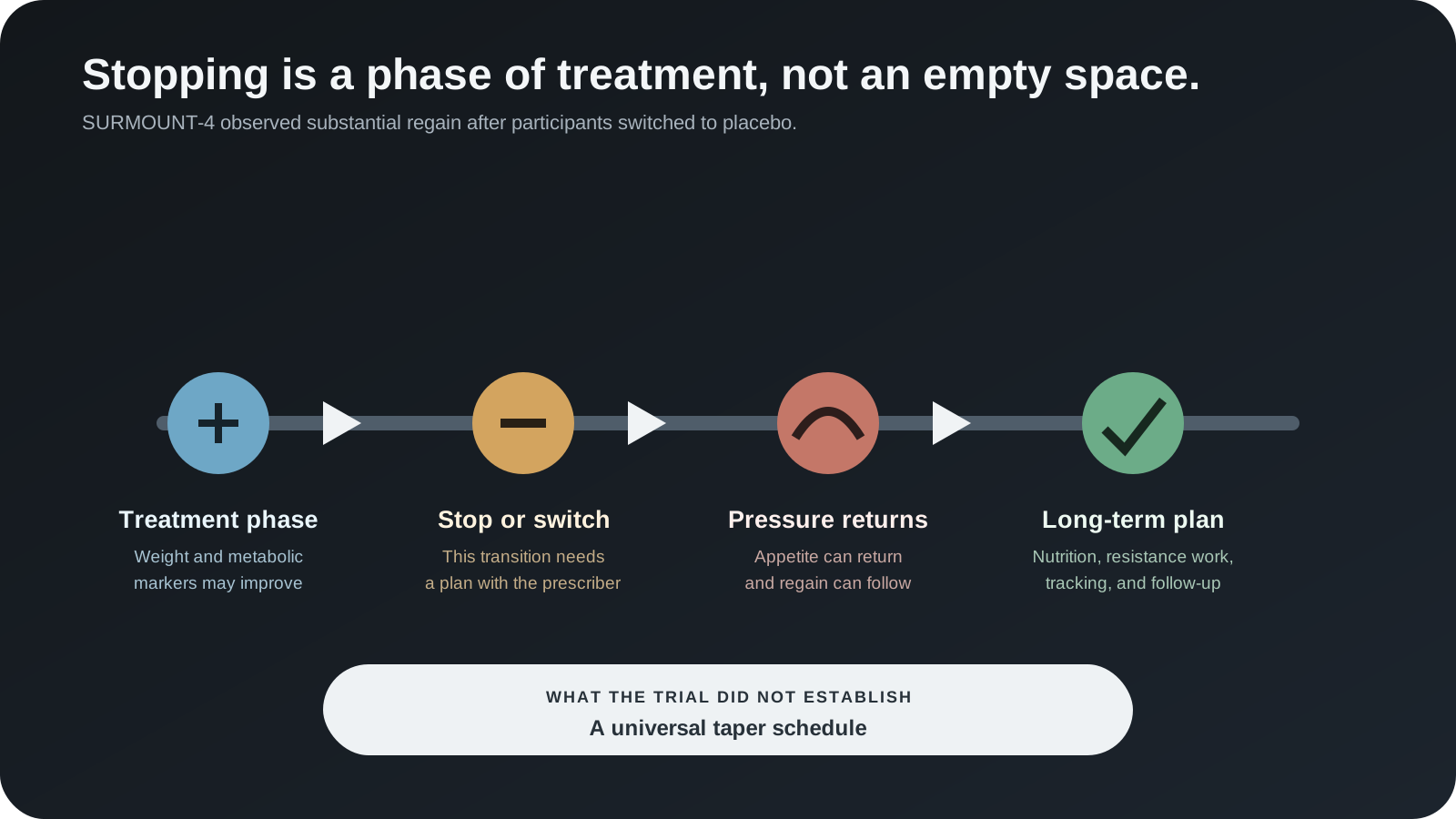
The trial ran a 36-week open-label lead-in phase where 783 adults took once-weekly tirzepatide at the maximum tolerated dose used in that protocol, reaching an average weight reduction of 20.9%. At week 36, 670 of those participants were randomized to either keep taking tirzepatide or switch to placebo for another 52 weeks. From week 36 to week 88, the group that continued the drug lost another 5.5% on average, while the group switched to placebo regained 14.0%. By week 88, 89.5% of those who stayed on tirzepatide had held onto at least 80% of the weight they lost during the lead-in, compared with only 16.6% of those who stopped.
A later post hoc analysis, published in JAMA Internal Medicine, dug into the 308 placebo-arm participants who had lost at least 10% of body weight by week 36 and sorted them by how much they regained after stopping. Only 54 of 308, about 17.5%, managed to keep regain under a quarter of what they had originally lost. That is the flip side of the more commonly quoted 82.5% regain figure. The rest split into 77 people who regained 25% to under 50%, 103 who regained 50% to under 75%, and 74 who regained 75% or more.
The secondary finding matters just as much as the headline number. Waist circumference, systolic blood pressure, non-HDL cholesterol, hemoglobin A1c, and fasting insulin all worsened in direct proportion to how much weight came back. Waist circumference rose 0.8 cm in the group that kept regain under 25%, versus 14.7 cm in the group that regained 75% or more. Systolic blood pressure rose 6.8 mm Hg versus 10.4 mm Hg across those same extremes. In the group that kept regain lowest, waist circumference, non-HDL cholesterol, and fasting insulin at week 88 were not significantly different from where they stood at week 36. The metabolic benefit tracks the weight that stays off, not the weight that was once lost.
The practical implication is that stopping tirzepatide is a phase of treatment, not the end of one. No clinical trial has established a taper protocol for this drug. SURMOUNT-4 studied an abrupt switch to placebo rather than a gradual step-down, so there is no trial-backed schedule to hand anyone, and none should be invented here. What the data do support is that appetite tends to return before resting energy expenditure recovers from the suppression caused by the weight loss itself. Having a protein target, a resistance training routine, and some form of intake tracking already in place before stopping, rather than scrambling to build them afterward, is squarely supported by what the withdrawal data show. Whether and how to taper off the drug is a decision to plan out with the prescribing clinician, not something to improvise.
What the trials measured besides the scale
A stalled scale reads as failure mostly because weight is the only number most people are watching. The trial programs measured considerably more than that.
SURMOUNT-OSA randomized adults with moderate to severe obstructive sleep apnea and obesity to tirzepatide or placebo, using the apnea-hypopnea index, breathing events per hour of sleep, as its primary endpoint rather than body weight at all. SURMOUNT-1 reported improvements across its full set of prespecified cardiometabolic measures alongside the weight results, and the SURMOUNT-4 post hoc analysis showed those same markers, waist circumference, blood pressure, cholesterol, A1c and fasting insulin, moving in step with regain.
Practically, that means a flat scale is worth checking against whatever else is being tracked: waist measurement, blood pressure, lab work, sleep quality, and training progress. Those numbers often keep improving through a period when the scale itself has stalled.
Putting the three phases together
Strip away the volume of tirzepatide content online and the full picture is fairly simple. Two variables run through all three phases of treatment, and they are the two things a patient controls: protein intake and resistance training. During the loss phase, they are what the muscle-preservation literature agrees on regardless of which side of the lean-mass debate you find more convincing. When the scale stalls, they are part of what is worth examining alongside sleep and intake drift. And after stopping, they matter more, not less, because the drug is no longer doing any of the compensating.
Expect the plateau. The trial data put it somewhere in the 24 to 36 week range for most people, and its arrival is information, not a verdict on whether the drug is working. When it happens, look first at body composition, intake, sleep, and training consistency before assuming anything about the prescription needs to change. And if treatment does end, plan for it the same way you would plan the start, because the withdrawal data are unambiguous that regain is the default outcome without structure in place, and that the metabolic gains follow the weight rather than existing independently of it.
When to call your clinician instead of researching further
Every question about dose, every question about stopping or switching treatment, and every new or worsening symptom belongs with the prescribing clinician, not with another article. Persistent vomiting, severe abdominal pain, anything suggesting pancreatitis or gallbladder problems, and unexplained fatigue are clinical events that need same-day attention, not troubleshooting from a guide like this one. Tirzepatide carries labeled warnings that only a prescriber can weigh against an individual's full history, which is exactly why this content exists to make those conversations sharper rather than to replace them.
Sources
- Tirzepatide Once Weekly for the Treatment of Obesity
- Effects of Tirzepatide on Skeletal Muscle Mass in Adults: A Systematic Review
- Strategies for minimizing muscle loss during use of incretin-mimetic drugs for treatment of obesity
- Time to weight plateau with tirzepatide treatment in the SURMOUNT-1 and SURMOUNT-4 clinical trials
- Continued Treatment With Tirzepatide for Maintenance of Weight Reduction in Adults With Obesity: The SURMOUNT-4 Randomized Clinical Trial
- Cardiometabolic Parameter Change by Weight Regain on Tirzepatide Withdrawal in Adults With Obesity: A Post Hoc Analysis of the SURMOUNT-4 Trial
- Tirzepatide for the Treatment of Obstructive Sleep Apnea and Obesity
Educational content only. Not medical advice.