Research Updates
Tirzepatide Mixed With B12: What Lab Testing Found
A drug-safety journal analysis found that compounded tirzepatide products containing vitamin B12 all showed a new molecule formed by the two ingredients bonding together, at levels up to 10 percent of total peptide content. Eli Lilly says it reproduced the finding and has called for a recall of these products. No patient harm has been tied to the adduct, but researchers say its effects on receptor binding, absorption, and immune response are unstudied. The issue applies only to compounded products with B12 added, not to approved tirzepatide pens.
Published by PeptideSchool Editorial Desk

What the lab tests found
A study published in a drug-safety journal looked at compounded tirzepatide, meaning medicine mixed by a pharmacy rather than manufactured as an approved finished product, that also contained vitamin B12. The samples came from sources on the US market. What the researchers found was not some stray contaminant that snuck in from dirty equipment. It was a brand new substance created when the two ingredients reacted with each other inside the vial.
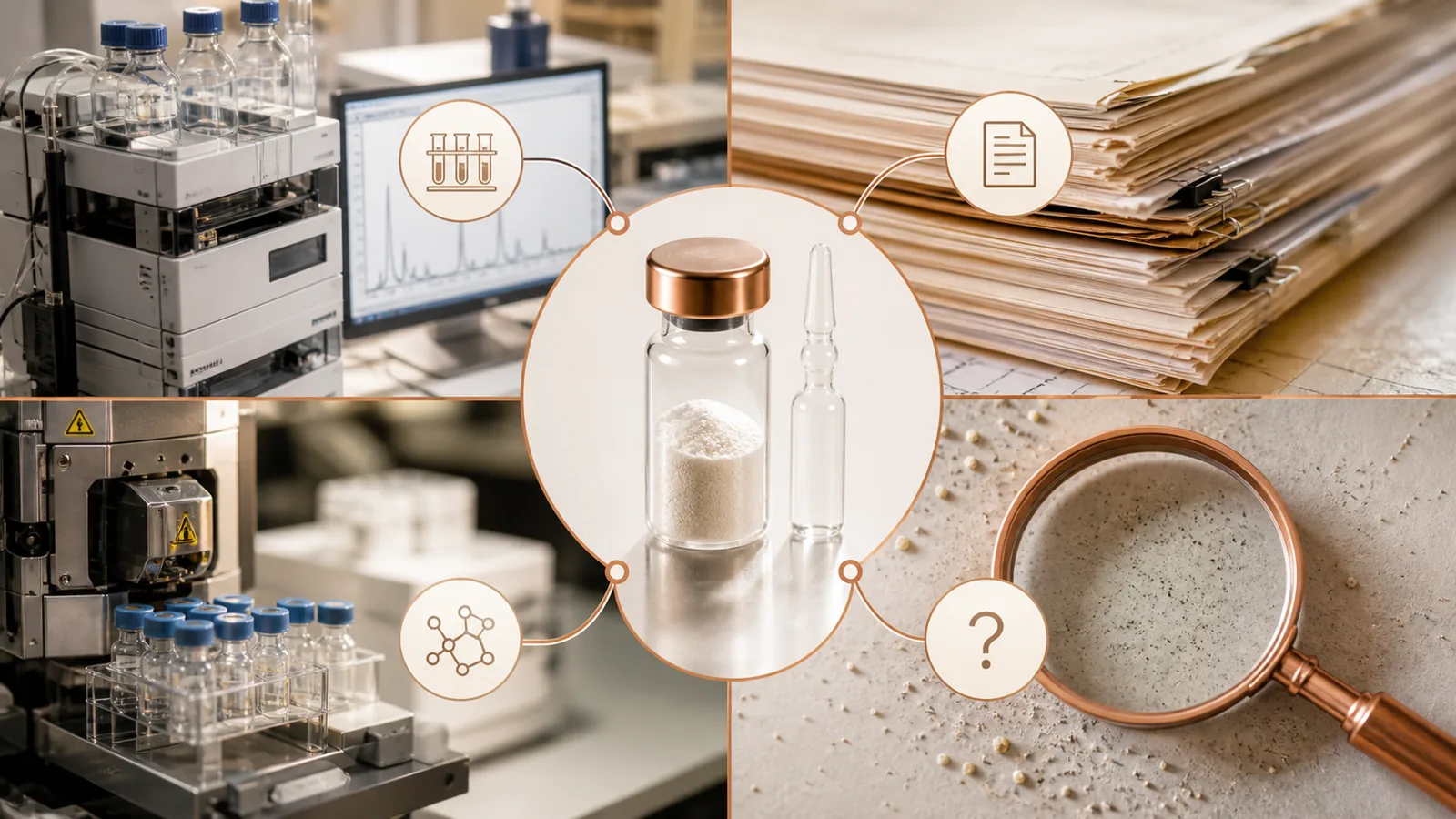
Chemists have a word for this kind of thing: an adduct, which just means two molecules have fused into one. The paper reported this tirzepatide/B12 adduct in every single B12-containing sample it tested, reaching as high as 10 percent of the total peptide content in the vial. Using a technique called peptide mapping, which breaks a peptide into known fragments to figure out where something has attached, the researchers narrowed the binding site down to a specific spot on the tirzepatide chain, the sixteenth amino acid, a lysine.
Here is the detail that separates a real finding from a fluke. The material was put through denaturing conditions, a lab process that unfolds proteins and knocks loose anything that is just weakly clinging on. The adduct did not budge. It also held together through a mass spectrometry step, a method that measures molecular weight by turning molecules into charged particles, that would normally shake apart a loose association. That is the evidence pointing to a genuine chemical bond rather than two ingredients simply floating near each other in solution.
Eli Lilly, the maker of the approved tirzepatide products, says it reproduced this finding independently in its own labs. The company then published an open letter to prescribers and pharmacists calling for a recall of tirzepatide products that contain untested additives. When the originator company confirms an outside lab's result on its own, it takes away the easiest way to wave the finding off as a one-off.
Why is vitamin B12 in there at all?
This is the question most coverage skips right past, and it matters a lot, because the adduct only exists because B12 was added to the vial in the first place. Approved tirzepatide pens contain tirzepatide plus standard inactive ingredients. They do not contain B12. Whoever compounds the product is the one making the choice to add it, and it typically gets marketed to patients as a bonus, something for extra energy or to help with the nausea that often comes with this class of drug.
Go looking for the trial that backs any of that up and you will come up empty. Tirzepatide's efficacy and safety were established through large randomized trials of the drug by itself, the SURPASS program in type 2 diabetes and the SURMOUNT program in obesity. None of those trials included B12. So there is no evidence the combination works better, gets tolerated better, or even behaves the same way once it is in the body. A pharmacy review of compounded incretin products as a category makes the same point: these mixtures are sold to patients as comparable to approved medicines while never going through any evaluation of potency or impurity profile.
There is a plainer, more commercial reason worth naming too. Adding an extra ingredient makes a product look different from the branded pen, which supports marketing it as its own thing rather than a copy. Whatever the real motivation is, the pharmacological result is the same either way. A beginner comparing a compounded tirzepatide/B12 vial against an approved pen is not looking at the same medicine in different packaging. It is a different formulation, and now, demonstrably, a different mixture of molecules entirely.
What "up to 10 percent" means in a vial
The paper reported the adduct at up to 10 percent of total detected polypeptide material in the most affected samples. That is a large analytical signal, but it should not be translated casually into an exact count of one in every ten molecules or an exact loss of active dose without the full quantitative method and biological testing.
Approved medicines operate under impurity identification and qualification thresholds that depend on factors such as daily dose and the type of impurity. A signal near 10 percent would demand investigation well before release under a validated manufacturing program. The important contrast is not that approved manufacturing can never fail. It is that validated methods, specifications, deviation controls, and recalls exist to detect and respond when it does.
The adduct also complicates how the labeled amount should be interpreted because the mixture is no longer chemically identical to tirzepatide alone. Separate reports have found contamination and potency problems in some unapproved or compounded GLP-1 products. Those findings should not be assigned to every pharmacy or every vial, but they show why product-specific quality controls matter.
What is still genuinely unknown
This is the part where honest reporting matters most, because the finding is easy to push too far in either direction. The study authors say plainly that whether the adduct changes how tirzepatide binds its receptors, how it gets absorbed or cleared from the body, or whether it triggers an immune response, remains unknown. To be just as clear on the other side, no patient harm has been attributed to this adduct. Nobody has documented an injury caused by it.
Both of those statements are true at the same time, and holding them together is really the whole point. The concern here is not that harm has been proven. The concern is that a molecule nobody has studied is being injected at scale into people who believe they are taking a well understood medicine. Tirzepatide works by activating two gut hormone receptors, GLP-1 and GIP, and B12 is attached at a specific point on that peptide chain. Whether that attachment interferes with how the molecule fits into those receptors is exactly the kind of question that should get answered before a product reaches patients, not after.
Repeated exposure to a modified peptide raises a plausible immunogenicity question, but whether this adduct changes immune response is unstudied. FDA adverse-event reports involving compounded semaglutide and tirzepatide add context, while the agency also notes that reporting requirements differ from those for manufacturers. That makes passive reports incomplete without proving the size or direction of any undercount.
How to tell if this applies to you
The practical question here is narrow and it has a clear answer. This finding is about compounded tirzepatide that contains vitamin B12. It has nothing to do with the approved branded pens, which do not contain B12 and are made under manufacturing controls specifically designed to test for this class of problem.
Check the carton and ingredient list rather than relying on container shape alone. Approved Zepbound and Mounjaro products identify the manufacturer and do not list cyanocobalamin or methylcobalamin. A pharmacy-dispensed compounded product should identify the compounding pharmacy and its ingredients. Powder sold for the buyer to mix is a different, unapproved research-market category and should not be treated as ordinary pharmacy compounding.
If that is your situation, the right move is a conversation with your prescriber, not a decision made off an article. Do not stop an injectable medicine on your own based on something you read online, including this piece. Lilly's own recommendation to people using these products is to contact their physician and discuss alternatives, and that is genuinely the sensible path, since the person who prescribed it can weigh your reasons for being on it against a legitimate quality concern in a way a general article never can.
The shortage-era enforcement window for copies of tirzepatide ended in 2025, but that did not make every form of patient-specific compounding categorically unlawful. Federal law still permits limited compounding when its conditions are met, including circumstances in which a prescriber documents a clinically significant difference for an identified patient. The practical point is narrower: legal status and quality depend on the product, pharmacy, prescription, and formulation, not on the word compounded alone.
Sources
- A novel, widespread impurity in mass-compounded tirzepatide/B12 products: potential patient safety implications
- An open letter warning of potential patient safety risks associated with tirzepatide compounded with vitamin B12
- FDA's concerns with unapproved GLP-1 drugs used for weight loss
- Compounded incretins in clinical practice: an opinion of the endocrine and metabolism practice and research network of the American College of Clinical Pharmacy
- FDA clarifies policies for compounders as national GLP-1 supply begins to stabilize
- Tirzepatide versus semaglutide once weekly in patients with type 2 diabetes
- Tirzepatide once weekly for the treatment of obesity
Educational content only. Not medical advice.