Research Updates
TFEB and Aging Kidneys: A Cell-Cleanup Pathway Under Stress
Experiments in mice and kidney cells link impaired autophagy with vulnerability to septic injury. The peptide and small-molecule experiments answer different questions.
Published by PeptideSchool Editorial Desk
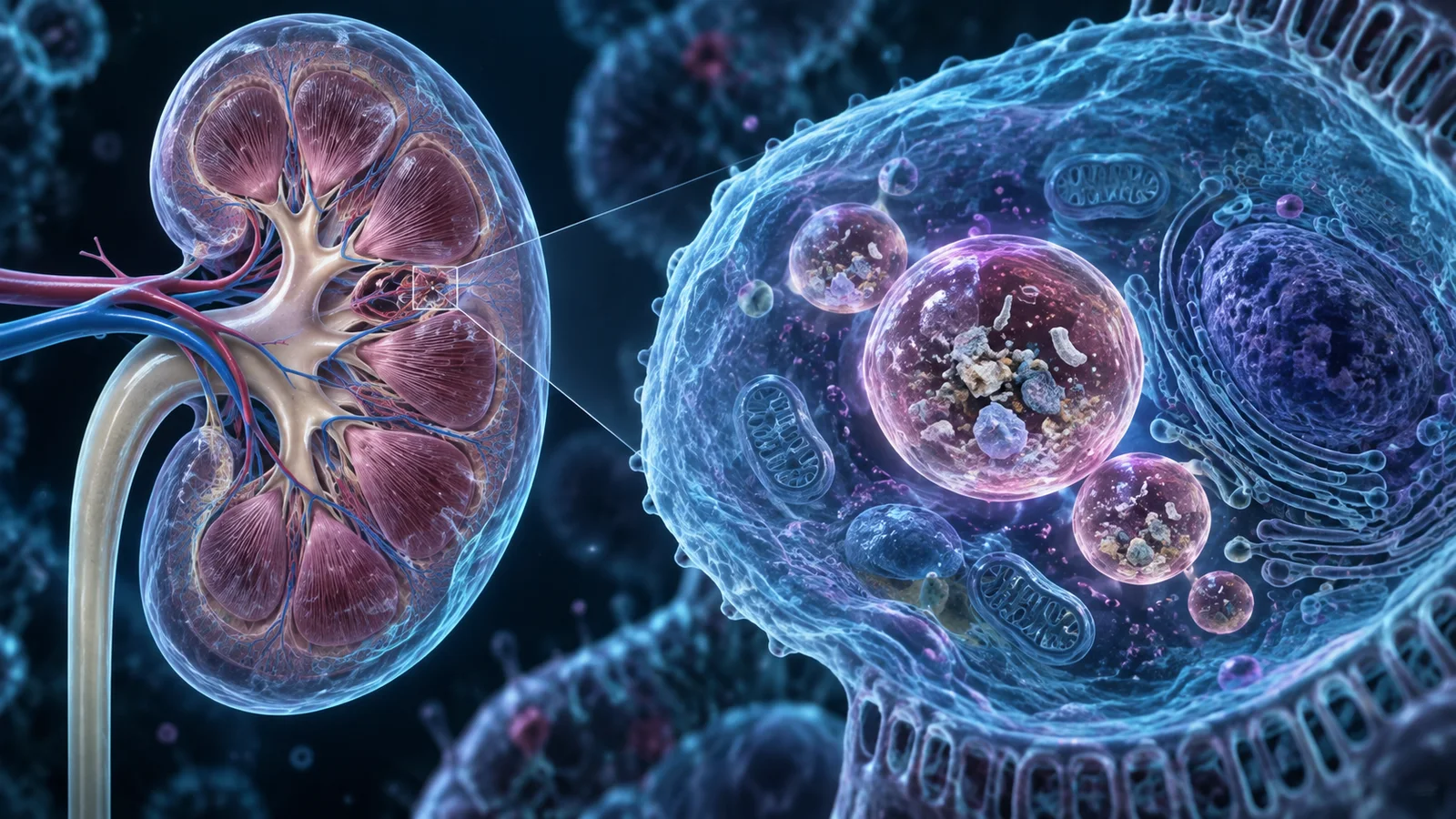
A kidney cell's ability to clear damaged material may help determine how it responds to severe inflammatory stress. A 2026 study examined that idea in aging mice and senescent kidney cells, focusing on autophagy and the regulator TFEB.
The researchers found that aging kidneys mounted a weaker autophagy response in their septic-injury experiments. TFEB, a protein that helps regulate this cellular recycling system, became a candidate explanation for the difference. Read the primary study.
Separate the experiments
The study used several approaches. In cultured senescent renal tubular cells, TAT-Beclin-1 peptide was used to activate autophagy during exposure to lipopolysaccharide, a bacterial component used to create inflammatory stress. The investigators reported less cell death and inflammation.
Increasing TFEB expression partly restored autophagic activity in those cells. In aging mice, a curcumin analog called C1 increased autophagic function and reduced injury in the lipopolysaccharide model.
These findings belong together as a mechanistic argument, but the interventions should not be blended into one result. The peptide experiment was in cells. C1 was the intervention in the described mouse experiment.
Why the model is informative
Looking at older cells under a defined challenge lets researchers ask whether impaired maintenance contributes to vulnerability rather than merely appearing alongside it. Testing more than one way to influence the pathway helps develop that causal hypothesis within the experimental system.
The remaining question is how far that explanation travels. A controlled inflammatory challenge does not reproduce every feature of human sepsis, and protection of a cell culture does not establish a clinical intervention for an older person.
What to follow next
The useful next evidence would clarify which parts of the response can be reproduced in other models, whether the effect lasts, and whether the same pathway can be influenced safely in people. Kidney function and patient outcomes would need direct evaluation rather than inference from cellular markers.
For peptide research, this paper's value is specificity. It links a named peptide tool to a defined cell experiment and places that result within a broader TFEB investigation. It does not show that a generic “autophagy peptide” rejuvenates kidneys or that C1 is equivalent to ordinary curcumin.
Sources
Educational content only. Not medical advice.