Research Updates
A Recovery Stack Needs Evidence on the Combination
Human studies of individual peptides can answer narrow questions. They do not validate a multi-peptide recovery stack, even when some components have plausible mechanisms.
Published by PeptideSchool Editorial Desk
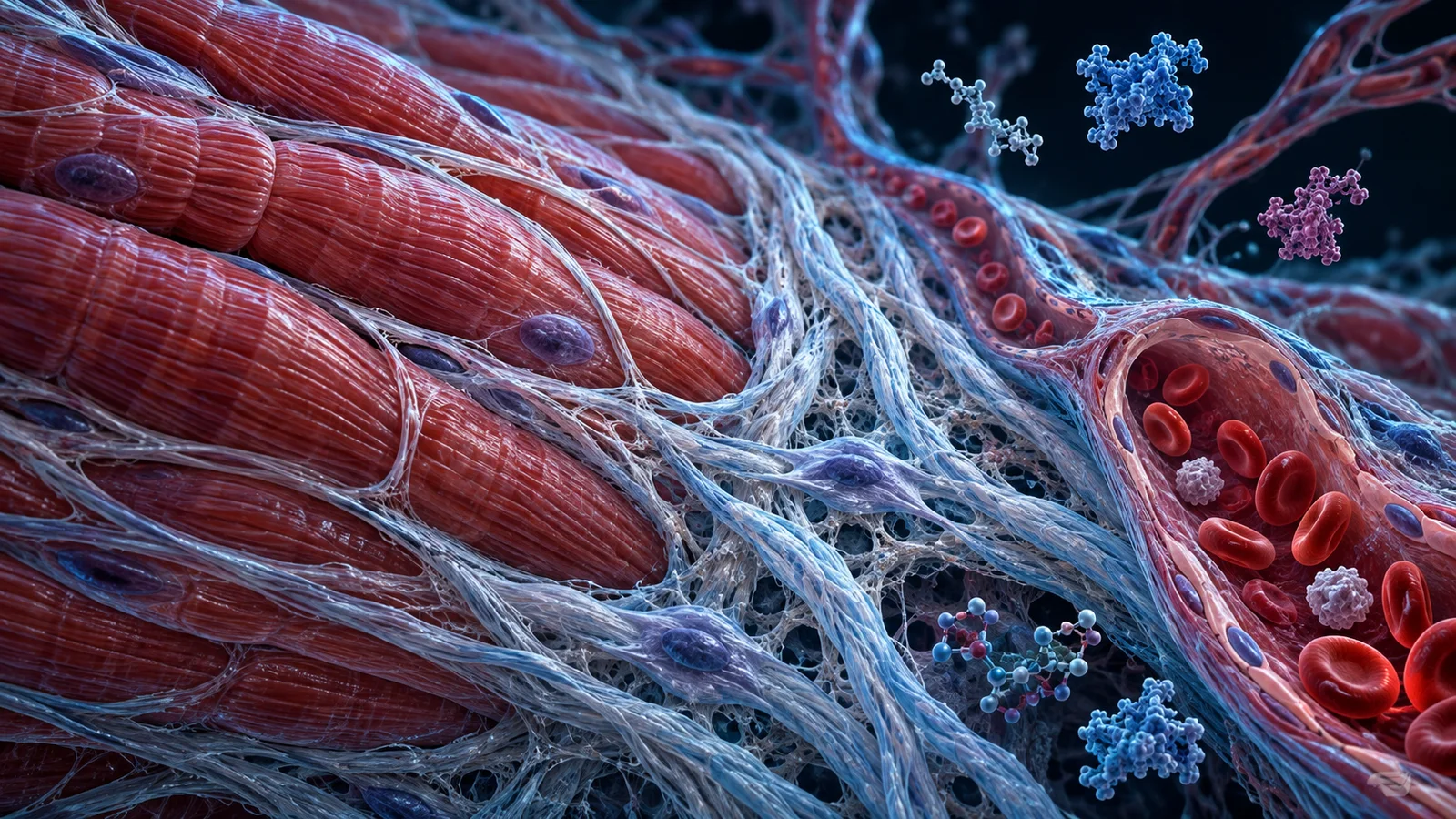
A recovery stack can sound well supported when each ingredient is paired with a separate paper. The missing step is showing that the combination produces a useful outcome without introducing new problems.
The proposed mix discussed here includes BPC-157, TB-500, GHK-Cu, KPV, CJC-1295, ipamorelin, and Semax. Calling the CJC-1295/ipamorelin pair one component does not make it one molecule. That naming detail already makes comparisons with the literature harder.
Human evidence still has a defined job
CJC-1295 was tested in two small randomized, placebo-controlled dose-escalation studies in healthy adults. The studies examined exposure, growth hormone, and IGF-I over 28 and 49 days. They reported sustained changes in hormone concentrations. They did not test postoperative recovery or the proposed multi-peptide combination. Read the CJC-1295 study.
A hormone measurement can show that a compound is biologically active. It is not equivalent to demonstrating stronger tissue, better mobility, improved sleep, or a faster return to normal activity.
Ipamorelin offers a useful clinical reality check
A randomized phase 2 trial studied ipamorelin after bowel-resection surgery, with postoperative bowel function as its focus. Of 117 enrolled patients, 114 were included in the safety and modified intention-to-treat populations. The trial found no significant difference between ipamorelin and placebo in its key and secondary efficacy analyses. Read the postoperative trial.
This is directly relevant to how recovery claims should be read. Even a mechanistically plausible intervention tested in actual surgical patients can fail to establish its intended clinical benefit.
What a combination study would need
The preparation and every component would need to be specified. The comparison would need to answer whether the combination adds something useful beyond its components or standard care. Outcomes would need to match the claim, and adverse events would need systematic collection.
Separate papers cannot fill in those missing observations by addition. A cell-culture result for one compound and a hormone result for another are not a trial of their interaction.
A well-organized evidence map keeps each source attached to its own question. For this stack, the available examples support investigating individual mechanisms and clearly defined clinical hypotheses. They do not establish the safety or effectiveness of administering the full combination after surgery.
Sources
Educational content only. Not medical advice.