Regulatory
FDA Advisers Back Six of Seven Peptides, Overruling the Agency's Own Reviewers
On July 23 and 24, 2026, the FDA's Pharmacy Compounding Advisory Committee recommended six of seven peptides, including BPC-157, KPV, TB-500 and MOTS-c, for the 503A compounding list, rejecting only emideltide. The panel voted against the recommendations of FDA staff reviewers, who had recommended against all seven for lack of human evidence. The vote is advisory only and changes nothing legally yet.
Published by PeptideSchool Editorial Desk

What the panel decided
Over two days at the FDA's White Oak campus, the Pharmacy Compounding Advisory Committee reviewed seven peptides and voted to recommend six of them for the 503A bulk drug substances list. On Thursday, July 23, members backed BPC-157, KPV, TB-500 and MOTS-c. On Friday, July 24, they added epitalon and semax, and voted down emideltide, a sleep-related peptide also known as DSIP, by a 6 to 7 margin.
The committee is a standing panel of outside advisers. It reviews evidence and votes, but it does not write regulations, and its recommendation does not change any law by itself. The FDA is free to accept, modify, or reject what the panel advised.
Most of the vote counts were never made public. TIME reported the one detailed tally that exists: BPC-157 passed 8 yes, 6 no, with one abstention. The Associated Press described an 8 to 6 split with one abstention as a general pattern across several Thursday votes, without tying it to a specific substance. No numbers were ever released for KPV, TB-500, MOTS-c, epitalon or semax individually. What is confirmed is the outcome, not the exact count, for five of the six approvals.
The bigger story isn't any single tally. It's that the FDA's own scientific reviewers had recommended against all seven peptides in writing before the meeting even started, and the panel voted the other way on six. Coverage of the vote noted that support came largely from members the FDA had newly added to the roster, many with industry ties, while the more academic members tended to vote no.
What the vote is about
The question in front of the committee was narrow: should each peptide be added to the Section 503A bulk drug substances list? That list determines which raw ingredients a licensed compounding pharmacy can legally use to prepare a custom medicine for a specific patient with a prescription. It is not drug approval and it is not a safety endorsement.
A few terms matter here. Compounding means a pharmacy custom-makes a medicine for one patient rather than dispensing a mass-produced product. Section 503A is the part of federal law governing those pharmacies. A bulk drug substance is the raw active ingredient itself, before it becomes a finished preparation. If an ingredient has no approved-drug status and no official quality standard, a pharmacy can only use it if the FDA has cleared it for this list.
So the real question is whether a compounding pharmacy can legally make these peptides on a prescription for a named patient. That's much narrower than asking whether peptides in general are legal or whether they work, and it is not the same thing as FDA approval, which requires large trials proving safety and effectiveness for a specific use. Nothing here has cleared that bar.
It also helps to understand the direction of risk. All seven peptides had already been removed from the FDA's Category 2 list, the agency's older 'significant safety concern' bucket, back in April 2026. That removal is what made this whole review possible in the first place. A yes vote can open a new legal channel. A no vote does not close one that already exists.
Why the FDA's own scientists said no to all seven
Before the meeting, FDA reviewers published briefing documents recommending against adding any of the seven peptides. Every one of the seven got the same verdict from career staff: don't add it. That's an unusual starting point for a meeting that ended with six favorable recommendations.

The reviewers' concerns fell into three buckets. First, missing human evidence. There were no human clinical studies at all supporting the proposed uses of KPV, TB-500 or MOTS-c, and only small or poorly controlled studies existed for BPC-157, emideltide and semax. Most of the available research across all seven compounds is animal work, which suggests something is worth studying further, not that it works in people.
That gap shows up in the published literature too. A 2025 systematic review of BPC-157 in orthopedic sports medicine found 36 total studies, and 35 of them were preclinical. Only one was a clinical study. This is a peptide with a large public following and almost nothing behind it in terms of human trials.
Second, product quality. Reviewers flagged inadequate characterization of these substances, inconsistent naming across suppliers, and missing quality data. Third, safety, including unassessed immunogenicity risk, reported adverse events tied to BPC-157, and the fact that TB-500 and MOTS-c are both on the World Anti-Doping Agency's prohibited list, which matters a great deal to any athlete subject to drug testing. A briefing document is a recommendation, not a final word, and the committee was free to disagree with it, which is exactly what happened.
Who sat on the panel and why it matters
A committee willing to vote against FDA staff recommendations only carries weight if its independence is clear, which is why the roster drew almost as much scrutiny as the science.
The FDA overhauled the committee's membership in June 2026. Reporting found at least seven members with financial ties to the peptide industry, including people who own wellness clinics that sell peptides, run pharmacies that produce them, or operate online consulting businesses. The FDA's own published roster supports that picture: of eleven standing voting members, nine list a clinic, pharmacy, or health-business role as their primary affiliation.
There's a wrinkle the headline numbers miss. Alongside the standing members sat eight temporary voting members, drawn mostly from universities, the Veterans Health Administration, and patient advocacy groups. Several were seated for a single peptide only, such as a USC liver specialist brought in just for the BPC-157 vote, a Georgetown dermatologic surgeon for KPV and TB-500, and a Weill Cornell neurologist alongside a VA pain director for semax. In other words, the panel that voted on BPC-157 wasn't the same group that voted on semax.
None of this proves bias on its own. People who work with these compounds often understand them well. But when a panel is asked whether to expand a market, and part of that panel operates in that market, the resulting recommendation carries a reasonable asterisk that a purely academic panel wouldn't.
How this review got started
This meeting didn't come out of nowhere. Health and Human Services Secretary Robert F. Kennedy Jr. has publicly supported expanding peptide access and has called himself a big fan of the category. On February 27, 2026, he announced that roughly fourteen of the nineteen peptides previously moved to the restrictive Category 2 list would be moved back, arguing the original reclassification had been improper.
The FDA's action removing twelve peptides from Category 2 followed in April 2026, and the Federal Register notice scheduling this committee meeting and opening its public docket was published on April 16, 2026. That sequence is what put these seven peptides in front of an advisory panel this July.
This isn't the usual pattern of an agency responding to fresh clinical trial data. It's a policy push meeting a scientific record that hasn't grown much, which explains why the FDA's own reviewers and the department's leadership ended up on opposite sides of the same meeting. Someone can support wider peptide access and still notice that the underlying evidence hasn't caught up.
What changes right now
Nothing changed the day of the vote, and that's more important than any headline calling it a win for peptides. The committee only recommends. The FDA reviews those recommendations and decides independently, and it can accept, modify, or reject any of them.
Even if the FDA agrees, adding a substance to the 503A list requires formal rulemaking, a public notice-and-comment process that typically takes many months. No pharmacy's legal standing shifted the moment the panel voted, and none of these six peptides became legal to compound or approved as drugs that day.
In practical terms, a vial sold online today labeled for research use only is untouched by any of this. That market operates entirely outside the compounding system, and it's where most of the real day-to-day risk sits, since the FDA's quality concerns were largely about what's in the raw substance rather than whether the compound works. Those concerns hit unregulated suppliers far harder than a licensed compounding pharmacy. Learning to evaluate a supplier and read a certificate of analysis is a genuinely useful skill no matter how this regulatory process ends.
What happens next
With the votes recorded, three things follow. First, the FDA has to decide. Its own reviewers said no to all seven in writing, so the agency now has to publicly resolve the split its committee just created. That decision, not the advisory vote, is what would change any peptide's legal status.
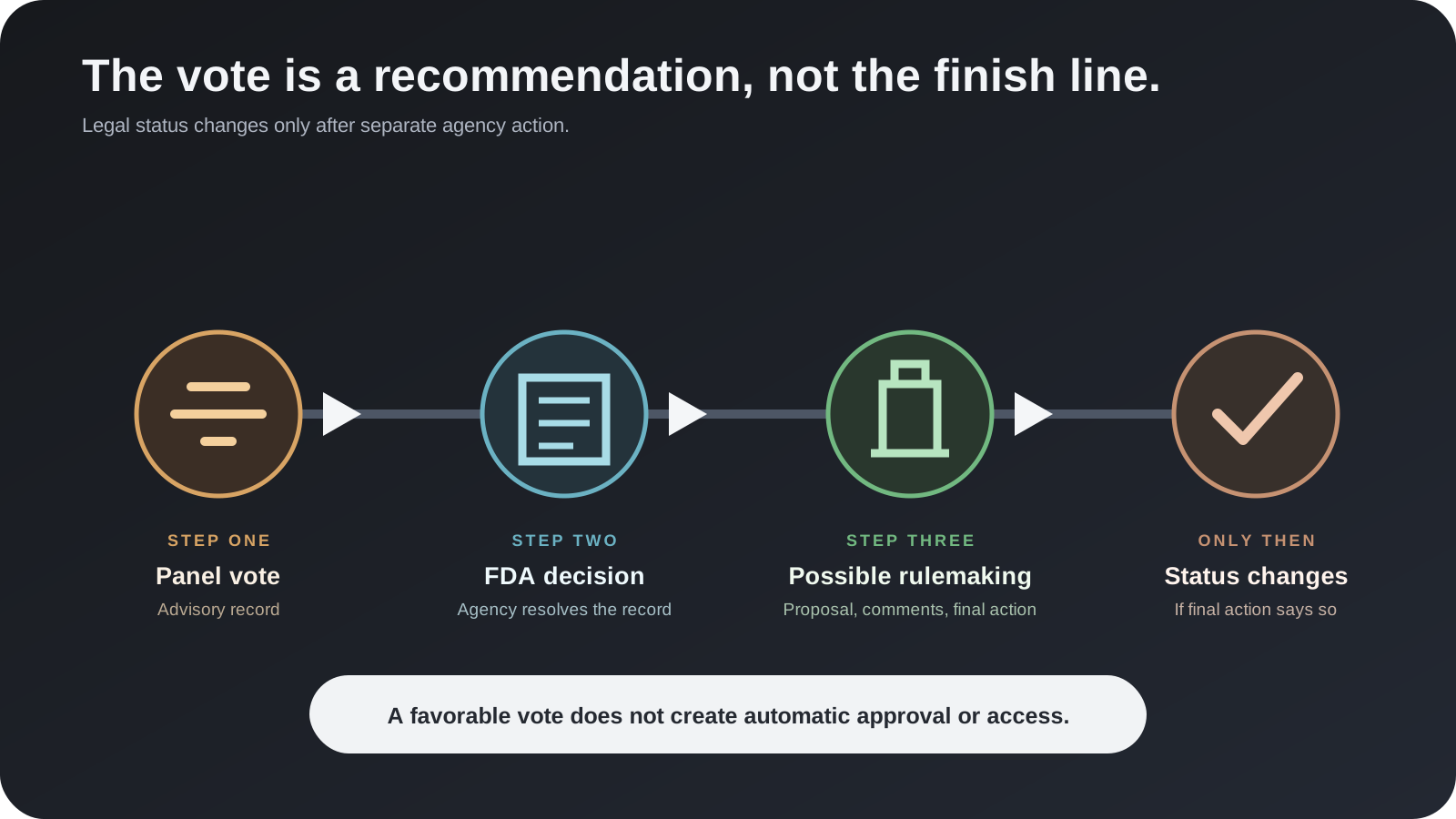
Second, rulemaking. Even for the six peptides the panel backed, adding a substance to the 503A list runs through a formal process that commonly takes several months to well over a year. A yes vote from the committee and the ability to legally get one of these from a compounding pharmacy are separated by a real regulatory gap.
Third, a second committee meeting is scheduled before the end of February 2027 to review five more peptides: cathelicidin, also known as LL-37, GHK-Cu, dihexa acetate, melanotan II, and pegylated mechano growth factor. Several of those compounds have a longer published research history than the seven decided this week, so that evidence discussion may look different.
The underlying tension isn't going away. Demand for these peptides is high and the human evidence remains thin, and no committee vote changes either fact. The case for expanding legal compounding is that restriction just pushes people toward an unregulated overseas market. The case against is that a pharmacy channel implies a level of validation these compounds haven't earned. Both arguments hold up at once, which is why this fight isn't over.
Sources
- July 23-24, 2026: Meeting of the Pharmacy Compounding Advisory Committee
- FDA Briefing Document, July 23-24, 2026 PCAC Meeting
- Final Meeting Roster
- FDA advisers vote to ease peptide restrictions, despite agency concerns
- FDA panel narrowly backs unapproved peptide drugs favored by RFK Jr. and wellness influencers
- An FDA Committee Just Voted in Favor of Peptides, Despite the Agency's Opposition
- In win for RFK Jr., FDA advisory panel narrowly votes to allow compounding of unapproved peptides
- Emerging Use of BPC-157 in Orthopaedic Sports Medicine: A Systematic Review
Educational content only. Not medical advice.