Regulatory
FDA's 2026 Category 2 peptide update: what changed
FDA moved 12 withdrawn peptide nominations out of the active Category 2 table in April 2026. That administrative change did not approve a drug or place a substance on the final 503A Bulks List. PCAC reviewed seven substances in July, but its recommendations remain advisory while FDA considers rulemaking.
Published by PeptideSchool Editorial Desk

What changed in April 2026
On April 22, 2026, FDA updated its public compounding records after nominators withdrew 12 peptide-related bulk-substance nominations. The agency's safety-risk page now places those substances in a separate table for withdrawn nominations rather than the active Category 2 table.
The 12 were BPC-157, TB-500, injectable GHK-Cu, epitalon, MOTS-c, emideltide, Melanotan II, KPV, LL-37, Semax, Dihexa, and PEG-MGF. FDA uses the name emideltide for the substance often discussed as DSIP. The route qualifier matters for GHK-Cu because the withdrawal record concerned injectable use, not every topical copper-peptide product.
This was an administrative change tied to withdrawal of the nominations. It was not a new-drug approval, a finding of effectiveness, or a final decision that earlier safety questions had been resolved. It also did not place the substances on the final 503A Bulks List.
What Category 1, 2, and 3 mean
FDA's Category 1, 2, and 3 documents are part of an interim enforcement policy for older 503A nominations. They are not three levels of drug approval. Category 1 contains sufficiently supported nominations that have not been placed on another list, and FDA describes conditions under which it generally does not intend to take action while evaluation continues.
Category 2 contains sufficiently supported nominations for which FDA identified significant safety risks in compounding. Those substances do not receive the Category 1 enforcement approach. Category 3 contains nominations that did not include enough information for FDA to evaluate, and those substances also fall outside the Category 1 policy.
A withdrawn nomination no longer sits in the evaluation queue in the same way. Removing its active Category 2 row therefore tells you what happened to the nomination, not what FDA concluded about a finished drug product. The distinction is easy to miss because the word “removed” sounds like a safety clearance when it is really a change in nomination status.
Withdrawal did not automatically move the 12 substances into Category 1. Category 1 is tied to an active, sufficiently supported nomination and the conditions in FDA's interim policy. The accurate description is that the withdrawn entries left the active Category 2 table and appear in FDA's withdrawn-nomination record.
The final 503A Bulks List is different
Section 503A generally covers patient-specific compounding by eligible state-licensed pharmacists, pharmacies, and physicians. FDA says a bulk drug substance used under this pathway must meet one of three conditions: comply with an applicable USP or NF monograph, be a component of an FDA-approved drug when no such monograph exists, or appear on the final 503A Bulks List.

The bulk substance must also come with a valid certificate of analysis and be manufactured by an FDA-registered establishment. Those requirements show why a favorable discussion about one ingredient does not automatically authorize every seller, formulation, route, or finished vial.
FDA develops the 503A Bulks List through evaluation, consultation with the Pharmacy Compounding Advisory Committee, and notice-and-comment rulemaking. Category documents and committee recommendations can inform that process, but the final regulation is the legal list. A reader checking current status should look at the final list and the latest FDA action rather than relying on a screenshot of an interim table.
What PCAC reviewed in July
PCAC met on July 23 and 24, 2026 to discuss seven bulk substances nominated for the 503A list. Day one covered BPC-157, KPV, TB-500, and MOTS-c. Day two covered emideltide, Semax, and epitalon. FDA's meeting page contains the agenda, briefing packages, voting questions, presentations, and webcast record.
The committee recommended BPC-157, KPV, TB-500, MOTS-c, Semax, and epitalon for possible inclusion. It did not recommend emideltide. Injectable GHK-Cu, Melanotan II, LL-37, Dihexa, and PEG-MGF were not decided at that meeting.
An advisory committee provides expert advice to FDA. FDA is not legally bound to follow its recommendation. The July votes did not themselves add six substances to the final list, approve any finished drug, or establish a broad indication such as recovery, longevity, sleep, or cognitive enhancement.
The meeting materials also separated chemical forms. Voting questions addressed a free base and an acetate form where applicable, and FDA's scientific reviews examined identity, peptide-related impurities, immunogenicity, route, human evidence, and whether the nominated use created a clinical need for compounding. A favorable vote on a nominated bulk substance should not be stretched into support for every salt, formulation, or use sold under the same short name.
FDA staff and the outside advisory committee can reach different judgments because they have different roles in the process. The committee's vote is part of the public record FDA considers. The agency still weighs the full administrative record and must use the rulemaking process before changing the final 503A Bulks List.
Why 503A and 503B should not be blended together
Section 503B governs registered outsourcing facilities and uses a separate bulk-substance framework. Under 503B, a bulk substance generally must appear on the 503B Bulks List or be used to compound a drug that appears on FDA's drug-shortage list, subject to the statute and current enforcement policy.
That is different from a 503A pharmacy preparing a patient-specific prescription. A substance discussed for the 503A list does not automatically gain the same status under 503B, and a shortage rule for an approved drug does not turn an investigational peptide into an approved or freely compoundable product.
The distinction matters whenever a headline says “FDA allowed compounding.” The useful follow-up questions are: under which section, for which bulk substance, for which dosage form or route, under what prescription or shortage condition, and based on which final rule? Without those details, the claim is too broad to guide a real decision.
What changes for pharmacies, prescribers, and consumers
For pharmacies, the April withdrawal and July recommendation are pieces of a regulatory process, not a substitute for checking the statute, final lists, current guidance, state law, and the exact facts of a preparation. A committee vote may affect planning, but it does not erase the need for a lawful bulk source, a certificate of analysis, registered manufacturing, and every other applicable condition.
For prescribers, a bulk-list discussion is not a new indication or proof that a compounded version is safe and effective. FDA approval evaluates a specific finished product, its manufacturing controls, labeling, dose, route, and clinical data. Bulk-list evaluation answers a different and narrower compounding question.
For consumers, the change does not validate an online product labeled “research use only.” It also does not guarantee that a compounded preparation matches the identity, purity, potency, sterility, or clinical evidence of an FDA-approved medicine. Product status and bulk-substance status need to be checked separately.
How to verify the current status
Start with FDA's 503A bulk-substances page. Check the final 503A Bulks List first, then the interim categories and the withdrawn-nomination table. If the substance was discussed by PCAC, open the meeting record and distinguish the committee's recommendation from later FDA action.
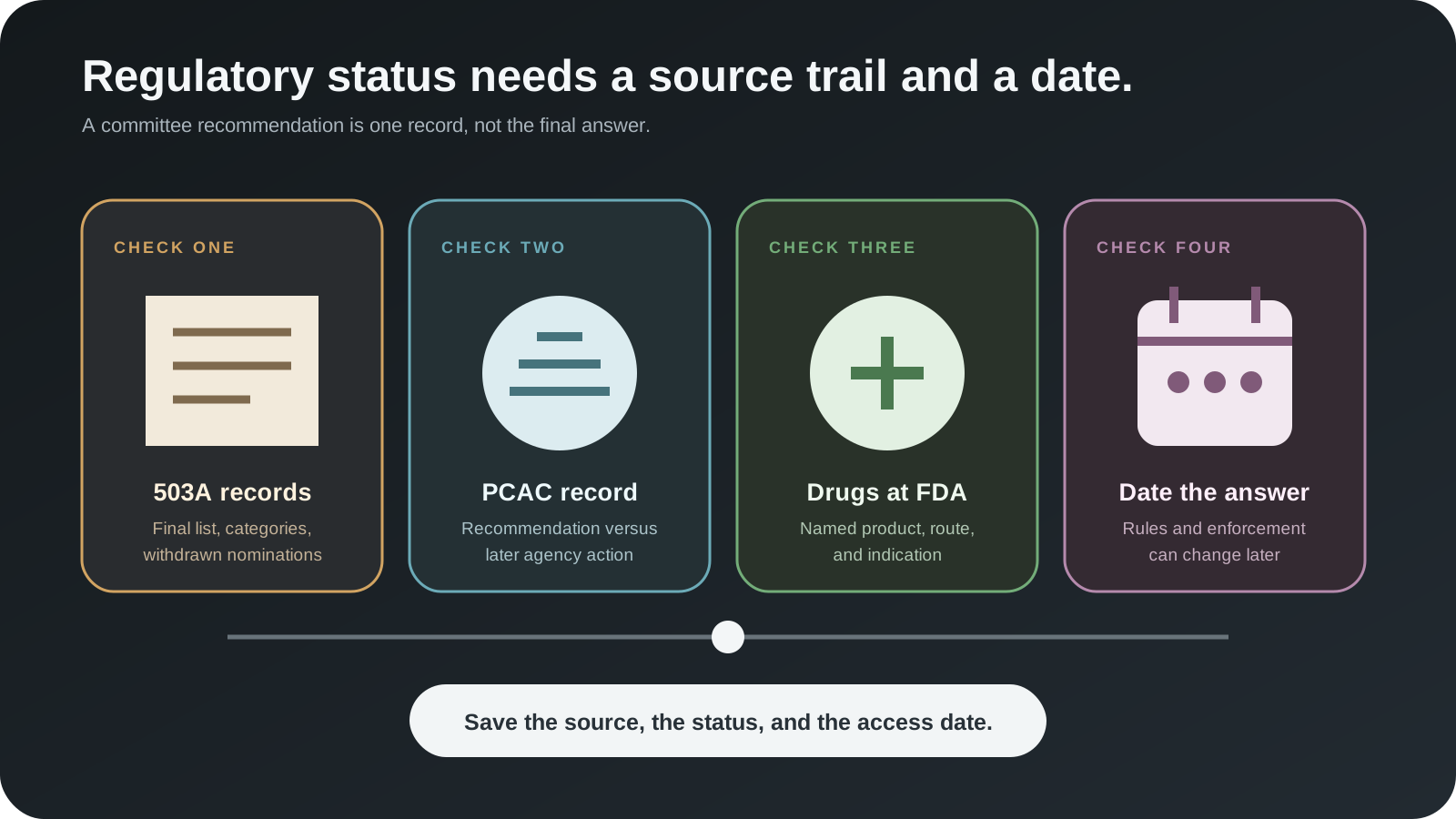
Next, search Drugs@FDA or the current prescribing information for a finished approved product. Approval belongs to that named product and indication. A similar sequence, a different salt, another route, or a compounded preparation does not inherit the approval automatically.
Finally, date the answer. Regulatory status can change after an advisory meeting through a proposed rule, public comments, a final rule, guidance, or enforcement update. For the seven substances reviewed in July 2026, the accurate August 2026 description is: six favorable PCAC recommendations, one unfavorable recommendation, and no automatic approval or final-list addition created by the vote itself.
Sources
- Bulk Drug Substances Used in Compounding Under Section 503A of the FD&C Act
- Certain Bulk Drug Substances for Use in Compounding that May Present Significant Safety Risks
- Pharmacy Compounding Advisory Committee meeting notice
- July 23 and 24, 2026 Pharmacy Compounding Advisory Committee meeting
- Interim Policy on Compounding Using Bulk Drug Substances Under Section 503B
Educational content only. Not medical advice.