Research Updates
Intranasal Peptides: Delivery to the Brain Is Only the First Test
Intranasal insulin trials show why reaching the brain and improving cognition are separate questions. The findings cannot be transferred to every peptide.
Published by PeptideSchool Editorial Desk
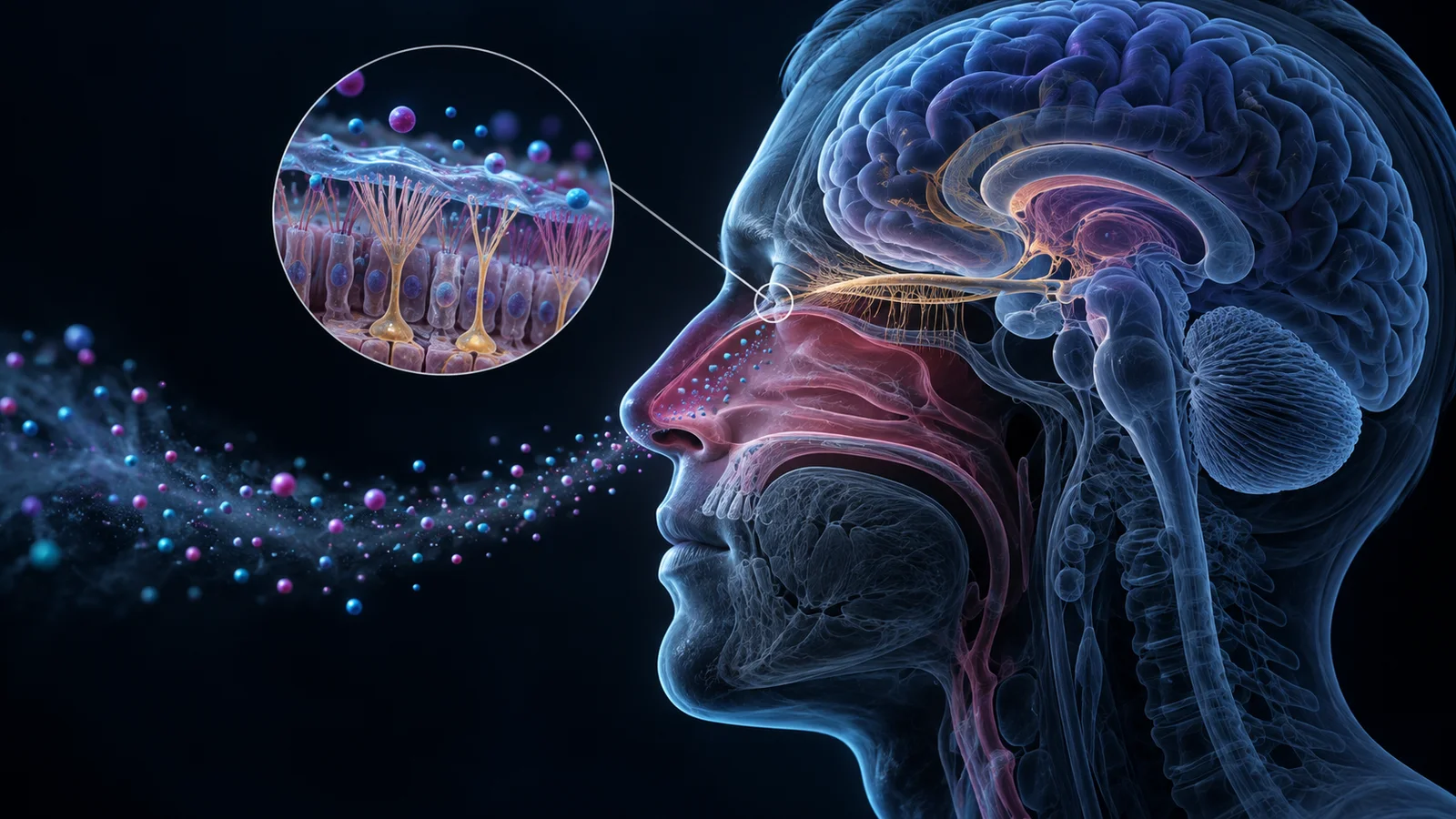
A nasal route can be scientifically interesting without establishing that a particular peptide reaches its intended brain target or changes an outcome people care about. The strongest way to assess a nose-to-brain claim is to separate delivery, biological activity, and clinical benefit.
The delivery question comes first
A 2025 review of intranasal peptide research describes work on delivery pathways and specialized carriers, including nanoparticles. Its subject is a research field, not a validation of every molecule sold as a nasal preparation. A formulation that protects one peptide or changes where it travels cannot be assumed to do the same for another. Read the delivery review.
A useful paper should identify the actual molecule and formulation, the model studied, and what was measured. Finding a marker associated with a preparation is a different result from measuring intact peptide in a relevant tissue. Measuring a tissue concentration is different again from demonstrating a functional benefit.
Insulin shows why the clinical test matters
A randomized trial published in 2020 enrolled 289 adults with mild cognitive impairment or Alzheimer disease dementia. Investigators studied intranasal insulin over 12 months. Device problems led to a change in the delivery system, and the primary analysis in the second-device cohort did not show a cognitive or functional advantage over placebo. Read the randomized trial.
That result is informative precisely because it tests more than the appeal of the delivery route. It also illustrates how a device can become part of the intervention rather than a neutral container.
Applying that distinction to BPC-157, TB-500, GHK-Cu, and KPV
Neither of these sources establishes clinical benefit from intranasal BPC-157, TB-500, GHK-Cu, or KPV. They also do not provide interchangeable formulation instructions for those compounds. A claim about one of them needs its own evidence chain.
When comparing a nasal-delivery claim with a paper, keep three questions together: Was this exact preparation tested? Was the intended exposure demonstrated? Was a meaningful outcome measured? A positive answer to the first two would still leave the third open.
The useful lesson from this research is to judge the entire delivery system. The word “intranasal” describes a route, not the quality of the evidence behind it.
Sources
Educational content only. Not medical advice.