Research Updates
BPC-157 Tendon Research: Cell Movement Is a Clue, Not a Clinical Result
Rat tendon experiments found changes in cell movement and survival. Understanding those endpoints helps separate the research from claims about BPC-157 and TB-500 combinations.
Published by PeptideSchool Editorial Desk
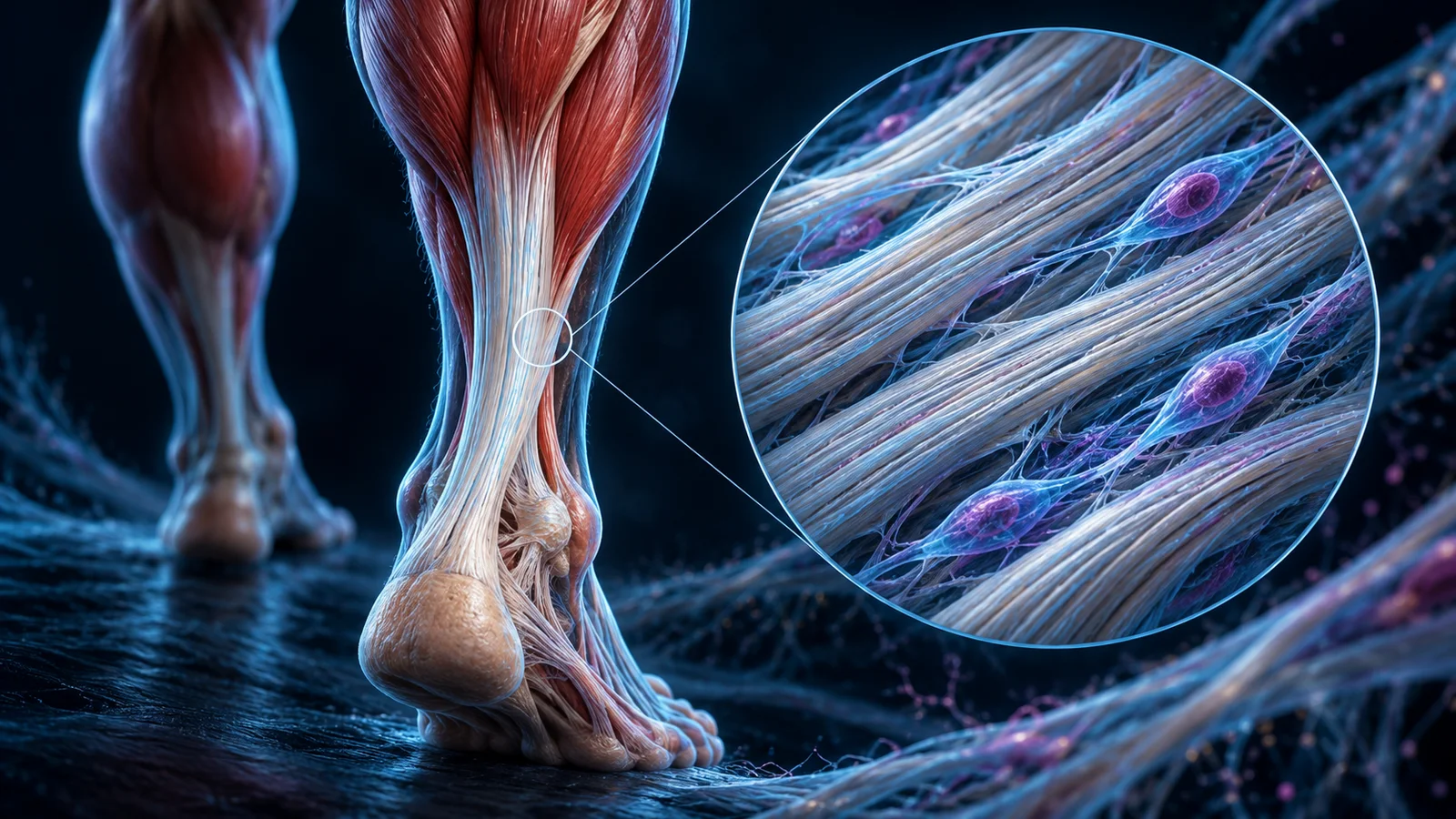
The most useful BPC-157 tendon paper asks a smaller question than whether an injection repairs a sports injury: how do tendon cells behave when exposed to the compound in a laboratory model?
In a 2011 study, researchers used rat Achilles tendon tissue and tendon fibroblasts, the cells that help maintain connective tissue. BPC-157 increased outgrowth from tendon explants, cell migration, and survival during an oxidative-stress challenge. It did not directly increase fibroblast proliferation in the assay used. Read the original study.
Movement is different from multiplication
A larger area covered by cells can arise because cells move, spread, survive, or multiply. Those are different processes. Distinguishing them helps explain why the paper measured several endpoints rather than calling every visible change “healing.”
The investigators also reported increased phosphorylation of FAK and paxillin, proteins involved in cell adhesion and movement. The total amount of those proteins did not change in the same way. That detail points toward altered signaling activity rather than simply more protein being present.
What the model leaves unanswered
Cultured cells and isolated tissue do not reproduce the full setting of a human tendon problem. A clinical claim would need to address symptoms, function, adverse events, and follow-up in the population concerned. A shoulder complaint and a surgically created injury model are not interchangeable research questions.
The experiment also did not test a BPC-157 plus TB-500 combination. Adding a second name to the protocol does not add its evidence to the first compound's result.
Be precise about TB-500
The FDA safety page identifies TB-500 as the thymosin beta-4 fragment LKKTETQ. Full-length thymosin beta-4 and that fragment should not be treated as interchangeable when matching a paper to a claim. Check the molecular identity in the FDA source.
This study is worth keeping because it offers a specific mechanistic lead. Its strongest finding concerns cell behavior under defined experimental conditions. The next useful evidence would connect that mechanism to reproducible outcomes in an appropriate clinical study, rather than extending it into an untested combination claim.
Sources
Educational content only. Not medical advice.