Research Updates
GHK-Cu, Collagen, and Loose Skin: What Was Actually Measured
A study of GHK-Cu with hyaluronic acid measured collagen signals in cells and skin samples. That endpoint is different from loose skin after weight loss.
Published by PeptideSchool Editorial Desk
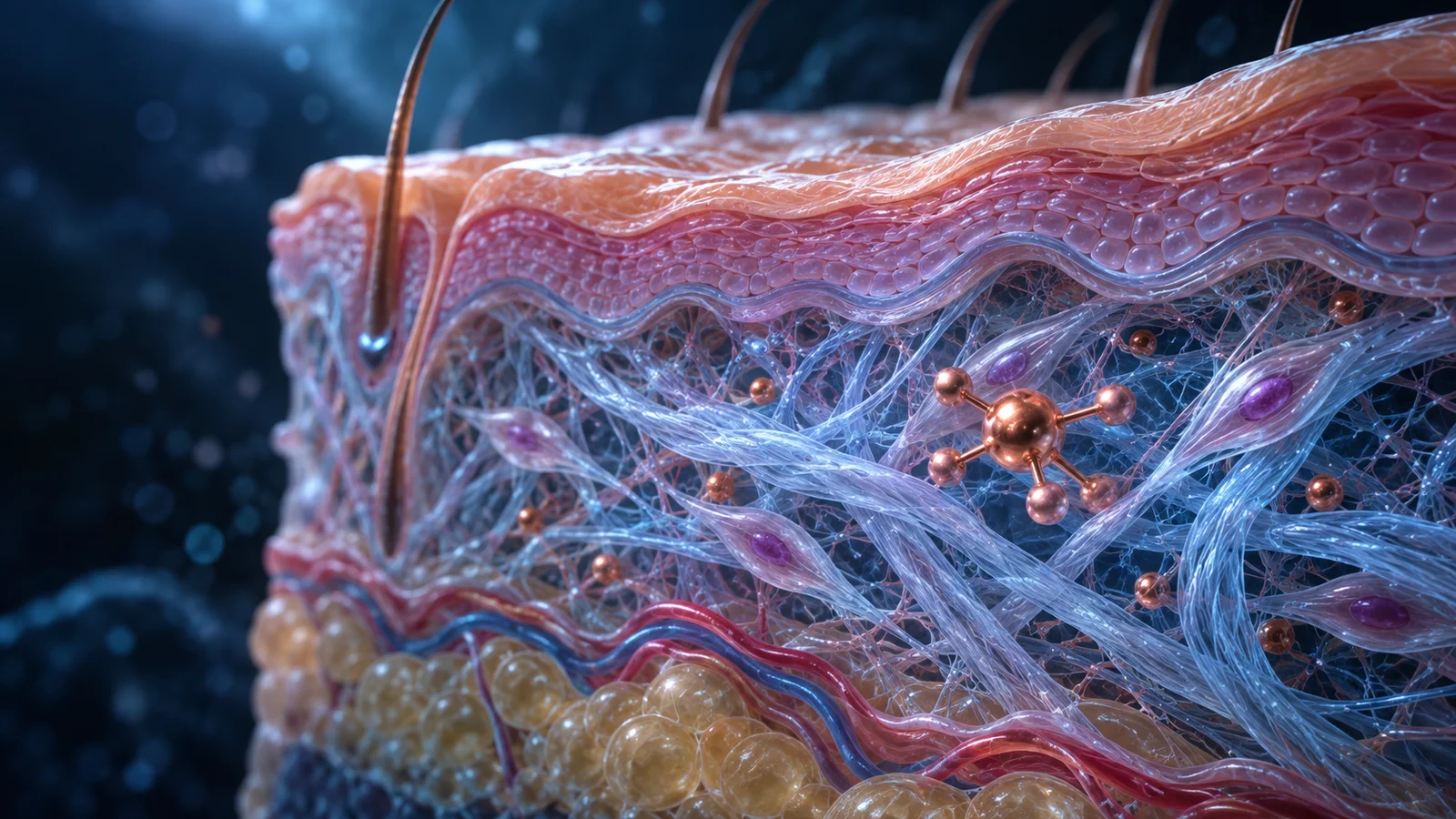
Collagen production and visible skin tightening are different outcomes. A GHK-Cu study can support interest in skin biology without demonstrating that the peptide changes loose skin after substantial weight loss.
A combination tested in the laboratory
In a 2023 study, investigators tested GHK-Cu with different forms and proportions of hyaluronic acid. They measured collagen-related expression in human dermal fibroblasts, then examined a selected formulation in skin tissue outside the body.
The combination produced a particularly strong response for collagen IV. The leading formula increased the cell-test measure more than the skin-tissue measure, underscoring how results can change between experimental systems. This was research on GHK-Cu plus hyaluronic acid, not a trial of GHK-Cu alone after weight loss. Primary study.
Three questions that the word “collagen” can hide
First, which collagen was measured? A study focused on collagen IV has a more specific target than an advertisement saying it “boosts collagen.”
Second, where was the measurement made? Gene expression in cultured cells, protein detected in a skin sample, and a visible change in a participant are separate endpoints.
Third, what formulation produced the result? A combination with a selected hyaluronic-acid size and ratio does not establish that any product containing one ingredient will reproduce the effect.
Reading a post-weight-loss claim
An article supporting that claim would need to identify people with skin laxity after weight loss, specify the intervention and comparator, and measure the relevant change over time. None of those elements is supplied by the cited cell and ex-vivo experiment.
The useful conclusion is narrower and more interesting than a blanket endorsement or dismissal: GHK-Cu formulation research is examining how ingredients affect a defined part of skin structure. That creates a research question about translation to people. It does not answer the post-weight-loss question by itself.
When saving the paper, preserve “GHK-Cu plus hyaluronic acid” and “cells and ex-vivo skin” in the note title. Those words protect the finding from losing its context.
References
Sources
Educational content only. Not medical advice.